Heorhii Narbut: The Artist Who Designed Ukraine's First Banknotes
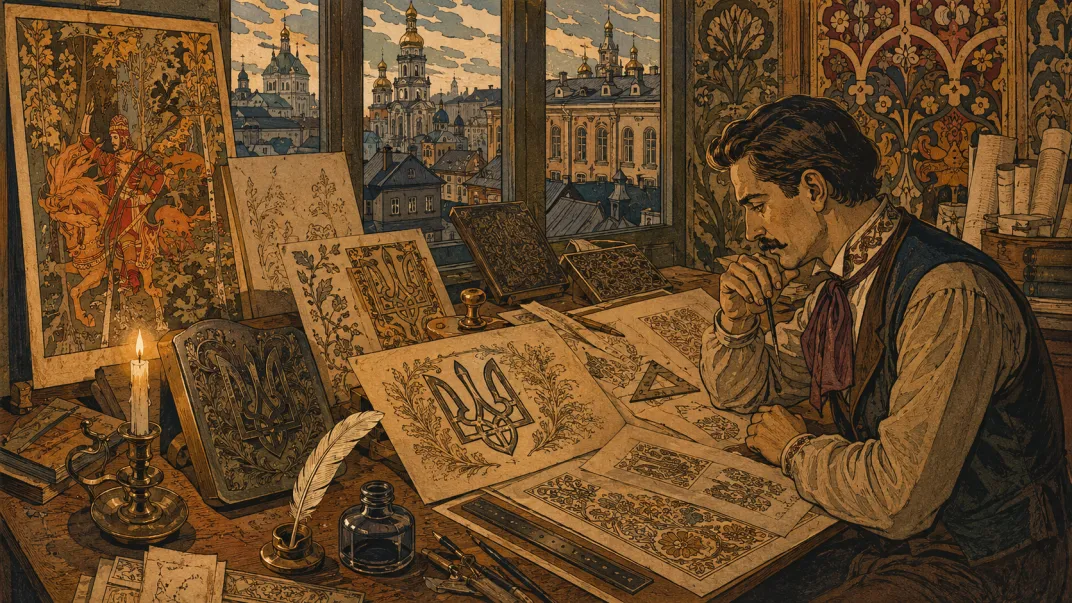
An Artist at the Crossroads of Revolution
In the turbulent years between 1917 and 1920, when Ukraine was attempting to establish itself as an independent state for the first time in the modern era, the task of creating a visual language for the new nation fell in large part to one man: Heorhii Narbut. Born in 1886 and dead by 1920, Narbut lived only thirty-four years, but in that brief span he transformed Ukrainian graphic design, book illustration, and heraldic art — and left his mark on the most widely circulated objects of the revolutionary period: the banknotes that every Ukrainian handled daily.
To understand what Narbut brought to Ukrainian currency design, it is necessary to understand what Ukrainian graphic culture looked like before him. The visual identity of the region had been dominated for centuries by Russian imperial aesthetics, which absorbed or suppressed distinctly Ukrainian stylistic traditions. Narbut's achievement was to excavate those traditions — from medieval manuscripts, from Baroque church art, from folk embroidery and woodcut prints — and to rework them into a coherent modern style that was recognizably Ukrainian without being merely antiquarian.
When Mykhailo Hrushevsky announced a design competition for Ukrainian paper money in the summer of 1917, Narbut was the natural choice to lead the effort. His training in St. Petersburg under Ivan Bilibin, the master of Russian decorative illustration, had given him command of the European Art Nouveau tradition, but his interests had always pulled toward Ukrainian and Old Slavonic sources. The competition brought together other significant artists as well — Anton Sereda, H. Zolotov, O. Krasovsky, M. Romanovsky — but it was Narbut's choices that defined the iconographic program of the first Ukrainian money.
The Trident: Choosing a Symbol for a Nation
The selection of the trident as the central symbol of Ukrainian statehood was not predetermined. Among the symbols proposed during the 1917 competition were a trident with a cross, a Cossack with a musket, and a swastika — the latter a traditional folk decorative motif whose dark associations lay far in the future. Narbut, conducting careful research into ancient coins and medieval heraldic imagery, settled on the trident with a cross. This was the symbol that appeared on the reverse of early coins of Volodymyr the Great, the Kyivan Rus prince who adopted Christianity in 988, and it connected the new republic to the deep roots of Ukrainian statehood.
The choice was both historically grounded and artistically appropriate. The trident's clean geometric lines made it well-suited to the demands of banknote design: it was reproducible, distinctive, and resistant to forgery through simplicity. It also projected a particular vision of Ukrainian identity: rooted in the Kyivan Rus heritage, distinct from Russian imperial symbolism, and connected to a Christian tradition that carried its own legitimacy.
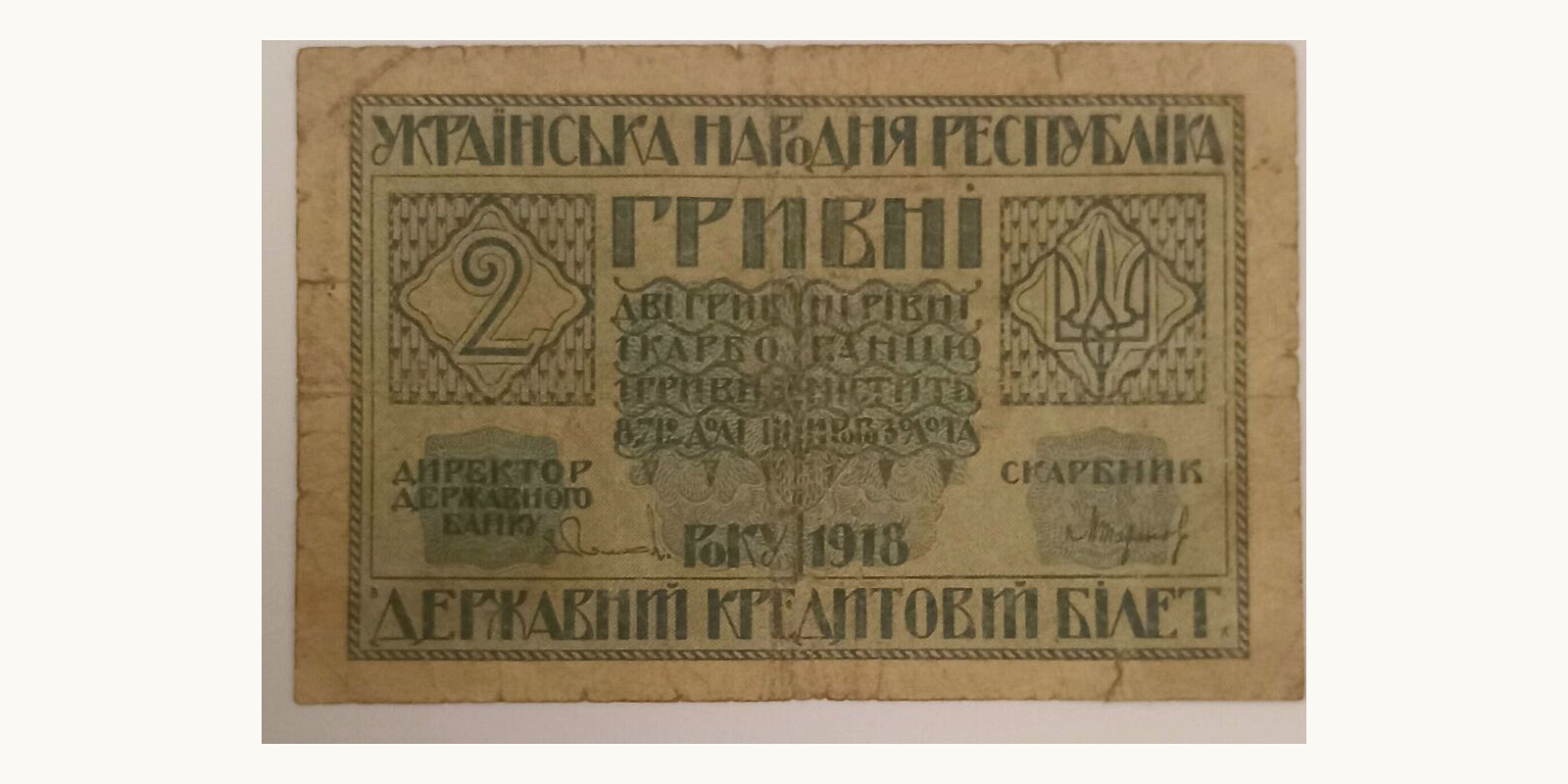
Narbut's version of the trident was rendered with characteristic refinement. Unlike the heavy heraldic forms used in some other contexts, his trident was elegant and balanced, fitting naturally into the intricate ornamental frameworks that surrounded it on the banknote designs. The symbol appeared prominently on the first 100 karbovanets note and continued to be central to subsequent designs throughout the period.
The Banknote Designs: A Program of National Art
The range of denominations that Narbut designed between 1917 and 1919 constitutes one of the most coherent bodies of applied national art produced during the revolutionary era in any of the successor states to the Russian Empire. Each design was carefully calibrated to the denomination it served and to the symbolic message it was intended to convey.
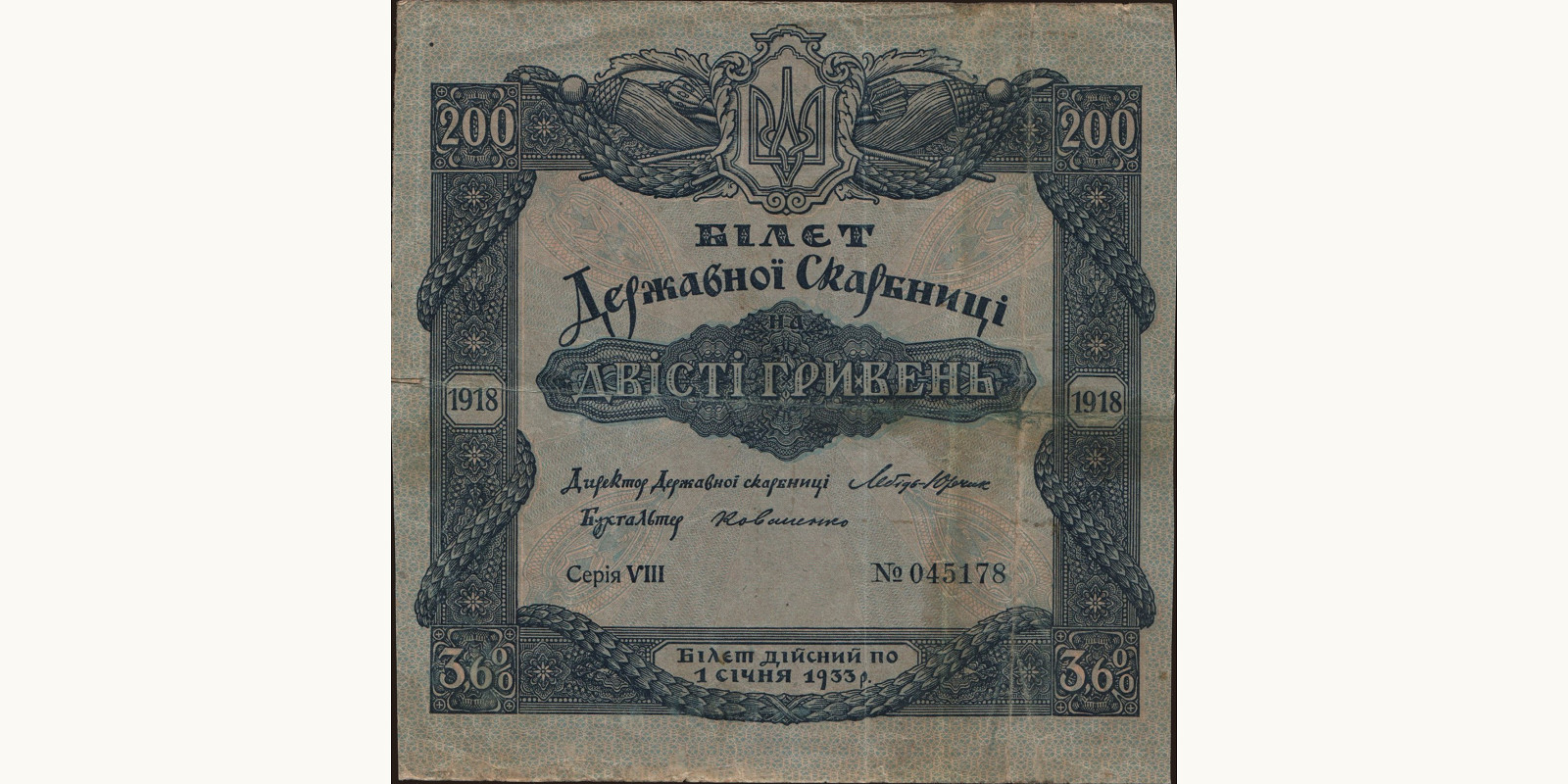
For the 10 hryvnia note, Narbut drew on Ukrainian decorative traditions, incorporating floral and vegetal motifs drawn from the embroidery patterns and decorative arts of rural Ukraine. For the 100 hryvnia note — one of the most elaborate designs of the series — he created a composition of remarkable density and balance. The central trident was surrounded by an oval wreath of Ukrainian vegetables, fruits, and flowers. Flanking the central field were two allegorical figures: on the left, a peasant woman in national dress holding a sickle and a sheaf of grain; on the right, a worker in an apron holding a hammer wreathed in laurel. The reverse displayed two columns above which flowers arched, with a laurel wreath enclosing a trident at center. This composition drew simultaneously on classical European emblematic traditions and on Ukrainian folk symbolism, achieving a synthesis that felt neither borrowed nor artificial.
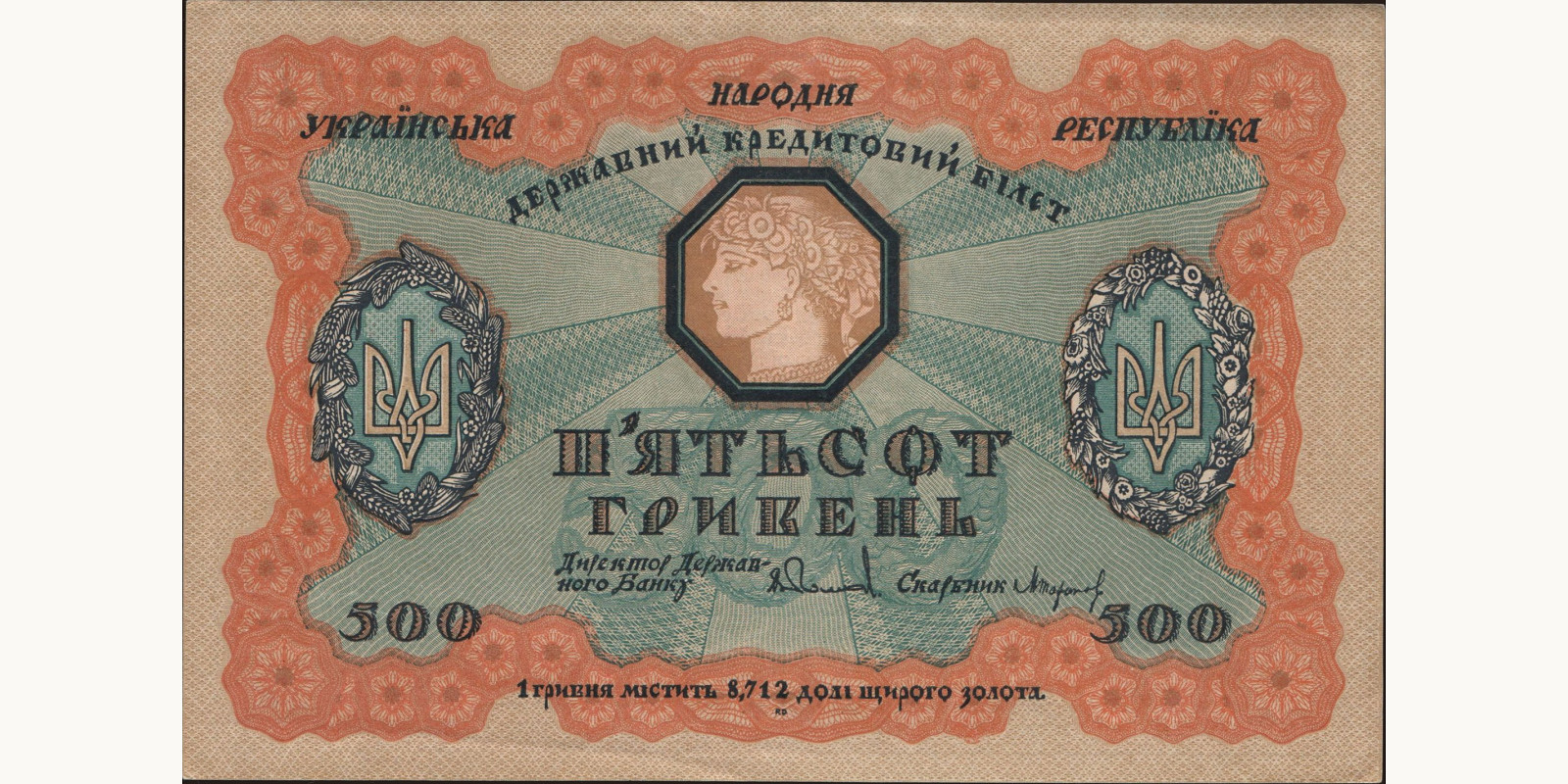
The 500 hryvnia note carried perhaps the most evocative single image of the series: a woman's head representing "Young Ukraine." This allegorical figure had already appeared in Narbut's design for a 30-shahi postage stamp, establishing a visual continuity across different state-issued objects. The "Young Ukraine" image drew on the tradition of national allegory common in European nationalist iconography — the figure of a young woman representing a nation's aspirations and vitality — but Narbut adapted the type to specifically Ukrainian features and dress, grounding the universal allegory in local specificity.
For the higher denominations, including the 1000 and 2000 hryvnia notes, Narbut's colleague Ivan Mozalevsky continued in the same vein, incorporating ancient Kyivan heraldic imagery. The 1000 hryvnia note featured a design element taken from a 1622 panegyric text — a laurel wreath form that connected the new state's currency to the literary and religious culture of early modern Ukraine.
Folk Art, Baroque, and the Grammar of Ukrainian Visual Identity
What made Narbut's banknote designs genuinely innovative was not merely their incorporation of Ukrainian motifs but the sophistication with which those motifs were organized and presented. Narbut understood that a banknote was a different kind of object from a book illustration or a poster. It had to function at very small scale, under difficult lighting conditions, in the hands of people who might be illiterate. Its symbols had to communicate clearly and quickly, while also achieving the ornamental complexity that traditionally signals value and authority.
The folk art tradition that Narbut drew on — particularly the decorative embroidery of Ukrainian peasant dress, the painted woodenware of various regions, and the textile patterns of central and eastern Ukraine — provided him with a vocabulary of forms that were simultaneously decorative and culturally legible. Flowers, sheaves of grain, the agricultural tools of the rural economy: these appeared throughout the banknote series as visual anchors connecting the currency to the land and people it represented.
At the same time, Narbut incorporated elements from the Ukrainian Baroque tradition, particularly from the decorative arts of the seventeenth and eighteenth centuries — the era of Cossack statehood and the Hetmanate under Bohdan Khmelnytsky and his successors. This was a deliberate historical claim: by invoking the Baroque period, the currency designs were asserting a continuity between the Ukrainian state of 1917–1920 and the autonomous Ukrainian political entities of the seventeenth century.
The ornamental frameworks — the borders, cartouches, and decorative surrounds — that Narbut developed for the banknote series were original compositions that nonetheless felt deeply familiar to Ukrainian eyes, because they were built from forms that had been present in Ukrainian decorative culture for centuries. This quality of simultaneously inventive and traditional design was the signature achievement of Narbut's graphic art.
Narbut's Legacy in Ukrainian Numismatic and Graphic History
Narbut died in 1920, at the age of thirty-four, during a typhus epidemic. He did not live to see the final collapse of the Ukrainian People's Republic or the suppression of the currency he had done so much to shape. In the decades that followed, his work was largely suppressed under Soviet cultural policy, which had little interest in celebrating the graphic artists of the Ukrainian national movement.
His rehabilitation came gradually. By the late twentieth century, as Ukraine moved toward independence, Narbut's work was recognized as foundational to the visual identity of the Ukrainian state. The trident he had chosen as the national symbol in 1917 was readopted as the official state emblem of independent Ukraine in 1991. His banknote designs were rediscovered by collectors and art historians, and the original notes he designed are now among the most sought-after items in Ukrainian numismatic collections.
For collectors of Ukrainian paper money, the hryvnia and karbovanets notes bearing Narbut's designs — particularly the 100 hryvnia, 500 hryvnia, and the various karbovanets denominations of the Central Rada period — represent the intersection of monetary history and fine art. They are objects that were made to be spent and discarded, but which have survived as irreplaceable evidence of a remarkable creative achievement under the most difficult possible circumstances.
| Artist | Heorhii Narbut (1886–1920) |
|---|---|
| Training | Ivan Bilibin's studio, St. Petersburg |
| National symbol chosen | Trident with cross (from Volodymyr the Great's coins) |
| Main denominations designed | 10, 100, 500 hryvnia; 100 karbovanets |
| Allegorical figure on 500 hryvnia | Young Ukraine (woman's head) |
| Sources of visual vocabulary | Ukrainian folk embroidery, Baroque church art, medieval manuscripts |
| Key composition element | Oval wreath of vegetables, fruits, and flowers (100 hryvnia) |
| Figures on 100 hryvnia | Peasant woman with sickle (left), worker with hammer (right) |
| Death | 1920, typhus epidemic |
| Legacy | Trident readopted as state emblem of independent Ukraine, 1991 |
Who was Heorhii Narbut?
Narbut (1886–1920) was the principal designer of Ukraine's first banknotes, a graphic artist and illustrator who combined training in European Art Nouveau with deep knowledge of Ukrainian folk art and Baroque traditions.
What symbol did Narbut choose for Ukrainian banknotes?
He chose the trident with a cross, a symbol derived from the medieval coins of Kyivan Rus prince Volodymyr the Great. It appeared on the first 100 karbovanets note and remained central to subsequent designs.
What was the allegorical meaning of the figures on the 100 hryvnia note?
The peasant woman with a sickle and sheaf represented agricultural Ukraine, while the worker with a hammer represented industry. Together they expressed a vision of national unity between rural and urban labor.
What folk art traditions influenced Narbut's banknote designs?
He drew on Ukrainian embroidery patterns, painted woodenware decoration, textile motifs from central and eastern Ukraine, and the decorative arts of the seventeenth-century Cossack Baroque period.
Are banknotes designed by Narbut valuable today?
Yes. Notes bearing Narbut's designs — especially the Central Rada-period karbovanets and the German-printed hryvnia series — are highly valued by collectors of Ukrainian and Eastern European paper money.
Related Articles