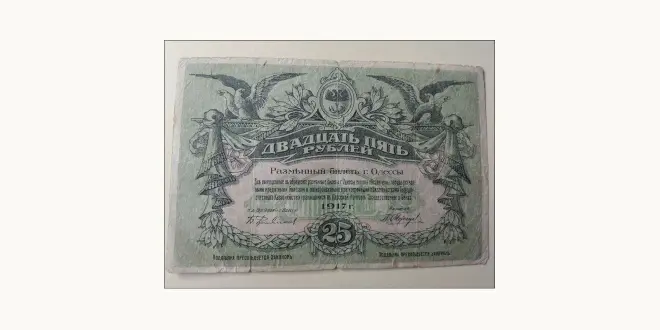
Eastern Ornament in Soviet Banknotes: Turkestan Issues, Islamic Design, Symbolism, Cultural Identity and Collector Value
Introduction to Eastern Ornament in Soviet Banknotes
Eastern ornament in Soviet banknotes represents one of the most unique and intellectually rich intersections between monetary history, visual culture, and regional identity. Unlike the majority of Soviet currency—designed under strict ideological and centralized artistic frameworks—certain regional issues emerged during moments of systemic collapse and therefore retained strong local artistic characteristics.
Among these, the Turkestan banknotes of 1918 occupy a special place. These notes were not created as part of a unified Soviet monetary program. Instead, they emerged as a direct response to economic breakdown during the Russian Civil War. However, what makes them truly exceptional is not only their historical context, but their visual language.
Rather than adopting purely functional or propagandistic design elements, these banknotes incorporated deeply rooted Eastern ornamental traditions. This reflects not only necessity, but also identity—an attempt to preserve cultural continuity in the midst of political chaos.
As a result, Turkestan banknotes represent more than emergency currency. They are hybrid artifacts—simultaneously economic tools, cultural expressions, and works of applied design.
Historical Context: Revolution, Collapse of Empire and Regional Artistic Autonomy
The collapse of the Russian Empire in 1917 created a fragmented geopolitical landscape. Regions that had once been integrated into a centralized administrative and financial system suddenly found themselves isolated.
Turkestan, located in Central Asia, was one of the most culturally distinct territories within the former empire. Its identity had been shaped over centuries by Islamic civilization, Persian artistic traditions, Silk Road trade, and nomadic influences.
When the Bolsheviks came to power, they inherited not a unified country, but a network of disconnected regions. Turkestan’s geographical remoteness and infrastructural limitations meant that communication with central Russia became extremely difficult during the Civil War.
This isolation had two key consequences:
Economic systems collapsed due to lack of monetary supply
Cultural autonomy increased due to reduced central control
When the region began issuing its own banknotes, local designers did not follow strict Soviet visual standards. Instead, they naturally relied on artistic traditions familiar to them.
Thus, Eastern ornament entered Soviet monetary design not through ideology, but through necessity and cultural continuity.
What is Eastern Ornament: Core Principles and Aesthetic Logic
Eastern ornament is not merely decoration—it is a structured visual language with deep philosophical and mathematical foundations. Rooted primarily in Islamic art, it developed under specific cultural and religious conditions that shaped its unique characteristics.
Key principles include:
• Geometric repetition — patterns based on precise mathematical systems
• Symmetry — balance across axes, creating visual harmony
• Arabesque structures — flowing, interlaced lines suggesting infinity
• Floral motifs — stylized representations of nature
• Non-figurative design — avoidance of human and animal imagery
Unlike Western artistic traditions, which often prioritize realism, perspective, and narrative, Eastern ornament focuses on abstraction and symbolic representation.
This abstraction makes it particularly suitable for banknote design. Currency must be both visually distinctive and difficult to counterfeit. Complex ornamental patterns fulfill both requirements.
In Turkestan banknotes, these principles are clearly visible. The designs are not random decorations—they are structured systems that reflect centuries of artistic development.
Turkestan Banknotes of 1918: The First Soviet-Era Expression of Eastern Design
The Turkestan issues of 1918 represent one of the earliest integrations of Eastern ornament into Soviet-era monetary systems.
These banknotes differ fundamentally from later Soviet issues. While Soviet currency typically emphasized political imagery—workers, factories, state emblems—Turkestan notes focused on decorative structure.
Key characteristics include:
• Highly detailed ornamental borders
• Symmetrical composition
• Centralized design fields
• Integration of text within decorative frames
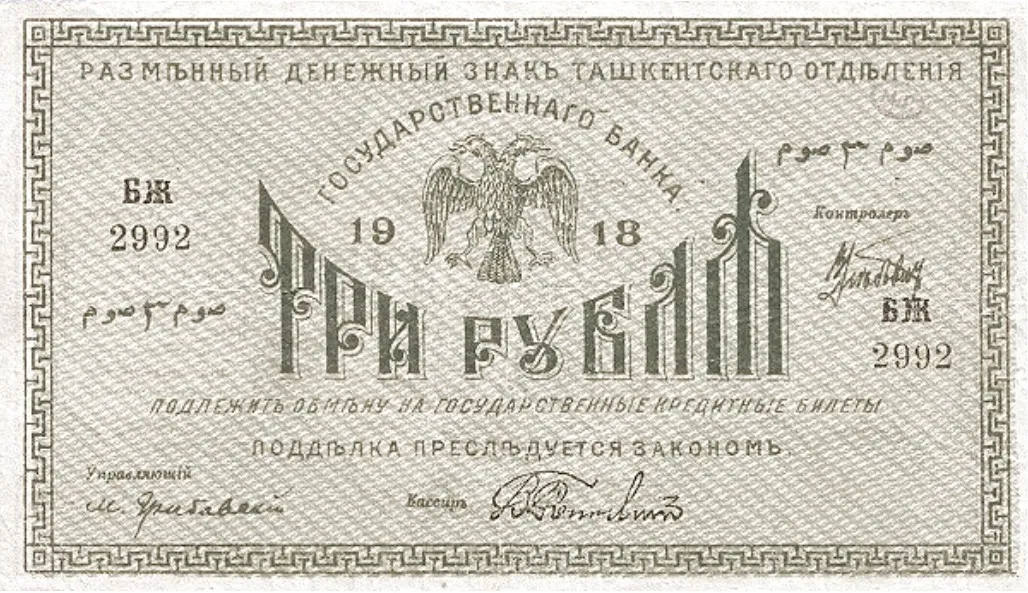
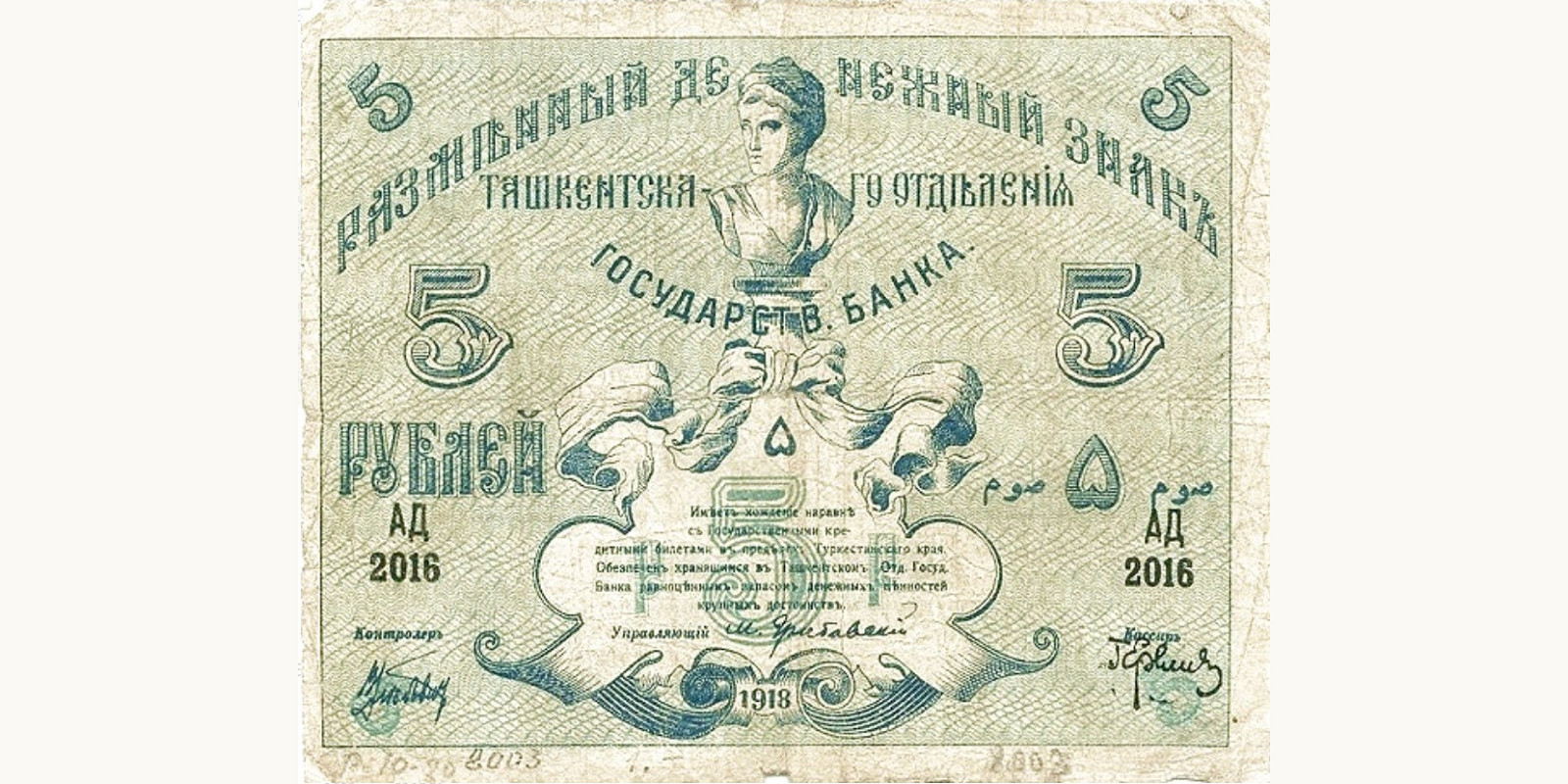
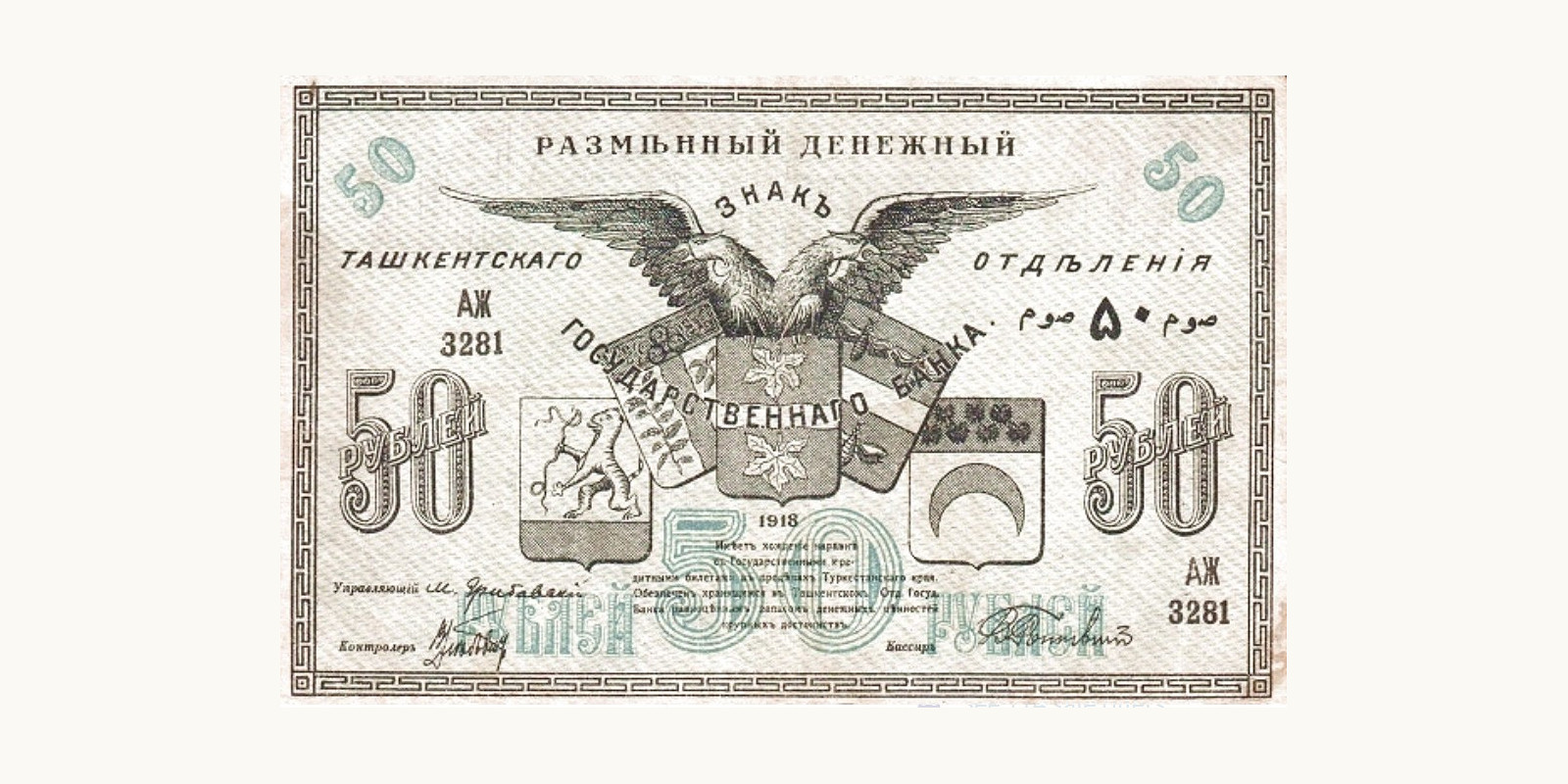
Lower denominations such as 1, 3, and 5 rubles feature simpler layouts but still retain ornamental logic. Higher denominations, particularly 50 and 100 rubles, display significantly more complex designs, often incorporating architectural references and layered compositions.
This hierarchy reflects both economic function and artistic intention.
Geometry as Structure: Mathematical Foundations of Design
One of the defining features of Eastern ornament is its reliance on geometry as a structural foundation. In Turkestan banknotes, this principle is clearly evident.
Patterns are constructed using repeating units based on mathematical grids. These grids ensure that the design remains balanced, regardless of scale or complexity.
The use of geometry serves multiple purposes:
• It creates visual harmony
• It reinforces symbolic meaning (order, stability, infinity)
• It increases resistance to counterfeiting
In Islamic art, geometry is often seen as a reflection of universal order. By incorporating these patterns into currency, designers unintentionally created banknotes that conveyed stability—even in unstable times.
Symbolism Embedded in Ornament
Eastern ornament is deeply symbolic. Each element can carry multiple layers of meaning.
Geometric repetition suggests infinity and continuity—important concepts in both Islamic philosophy and economic systems.
Floral motifs represent life, renewal, and growth. During periods of crisis, such imagery may have provided psychological reassurance.
The absence of portraits is also significant. Unlike European banknotes, which often feature rulers or political figures, Turkestan notes rely entirely on abstract and symbolic elements. This makes them more universal and less tied to specific political regimes.
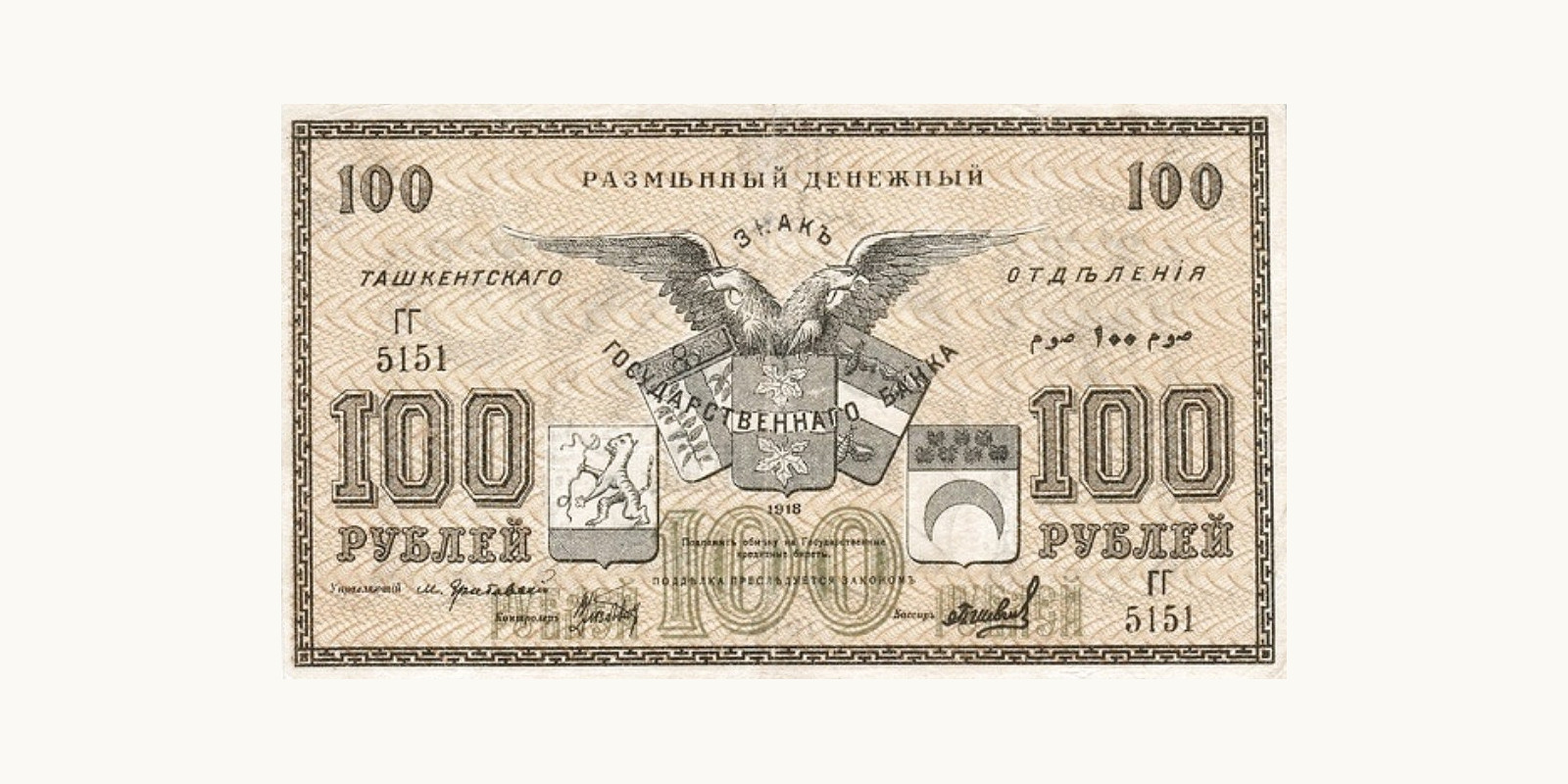
Visual Contrast with Standard Soviet Banknotes
The contrast between Turkestan banknotes and standard Soviet currency is striking.
Soviet banknotes were designed to communicate ideology. They featured:
• workers and peasants
• industrial scenes
• state symbols
• propaganda narratives
Turkestan banknotes, in contrast, communicate structure, pattern, and cultural identity.
This difference reflects a broader tension between centralization and regional diversity in early Soviet history.
Eastern Ornament as a Marker of Cultural Identity
The use of Eastern ornament in Turkestan banknotes is not merely aesthetic—it is a statement of identity.
Even under Soviet control, the region retained its cultural heritage. The banknotes reflect this continuity.
They serve as visual evidence that cultural identity can persist even in periods of political transformation.
Rarity of Eastern Ornament Banknotes
Banknotes featuring Eastern ornament are relatively rare within the broader context of Soviet currency.
Turkestan issues are particularly scarce due to:
• limited print runs
• harsh circulation conditions
• natural loss over time
Well-preserved examples are especially difficult to find.
Collector Demand and Market Dynamics
Demand for Eastern ornament banknotes is driven by multiple factors:
• visual uniqueness
• historical context
• cultural significance
• rarity
This creates a stable and growing collector base.
Why Design Matters in Banknote Collecting
In modern numismatics, design has become a key value driver.
Collectors are increasingly interested in:
• artistic complexity
• cultural symbolism
• uniqueness
Turkestan banknotes meet all these criteria.
Building a Collection Focused on Ornament
A design-based collection can include:
• Turkestan banknotes
• Middle Eastern currency
• North African issues
• decorative Asian notes
This creates a visually cohesive and intellectually rich collection.
Investment Perspective: Long-Term Growth Potential
Eastern ornament banknotes have strong investment potential.
Their value is supported by:
• limited supply
• growing demand
• unique design
Over time, these factors are likely to drive price increases.
Connection to Turkestan (Internal SEO Logic)
Turkestan banknotes form the foundation of Eastern ornament in Soviet currency.
Understanding them is essential for exploring this broader theme.
Technical Features of Turkestan Banknotes: Paper, Printing and Security
Although Turkestan banknotes are often discussed primarily in terms of their visual design, their technical characteristics are equally important for understanding their historical and collector value. These notes were produced under extremely difficult conditions, which directly influenced both their quality and their uniqueness.
The paper used for Turkbon issues varies significantly. In some cases, it appears thin and fragile, while in others it shows a denser structure. This variation reflects supply limitations and the lack of standardized production processes.
Printing techniques were relatively simple compared to later Soviet issues. However, this simplicity does not reduce their complexity. On the contrary, the combination of basic printing methods with intricate ornamental designs creates a striking contrast.
Security features were minimal. Unlike later banknotes, Turkestan issues relied more on visual complexity than on technological protection. The dense ornamental patterns themselves acted as a form of anti-counterfeiting measure.
Today, these technical imperfections are not seen as flaws but as defining characteristics that increase collector interest.
Differences Between Denominations: Design Evolution
One of the most interesting aspects of Turkestan banknotes is how their design evolves across different denominations. This evolution reflects both practical needs and artistic choices.
Lower denominations such as 1, 3, and 5 rubles were designed for everyday use. As a result, they tend to feature simpler compositions, fewer decorative elements, and more straightforward layouts.
In contrast, higher denominations such as 50 and 100 rubles demonstrate a clear increase in complexity. These notes often include more elaborate ornamental borders, layered compositions, and additional symbolic elements.
This difference is not accidental. Higher denominations required stronger visual identity and greater protection against forgery, which was achieved through more intricate design.
For collectors, this creates an additional dimension of interest. A complete set is not only economically structured but also visually progressive.
Printing Variations and Collectible Differences
Due to the нестабильные условия производства, Turkestan banknotes exist in multiple variations. These differences can be subtle, but they are highly important for collectors.
Variations may include:
• differences in ink tone
• slight shifts in alignment
• changes in paper texture
• variations in print sharpness
Some of these differences occurred unintentionally, while others may have resulted from changes in materials or printing conditions.
For experienced collectors, identifying such variations becomes a key part of the collecting process. It transforms collecting from simple acquisition into detailed research.
Circulation Reality: How These Banknotes Were Used
Understanding how Turkestan banknotes circulated provides deeper insight into their historical significance. These notes were not collector items—they were tools of survival.
They were used in markets, shops, and everyday transactions. Their physical condition often deteriorated quickly due to heavy use and poor paper quality.
This explains why high-grade specimens are extremely rare today. Most surviving banknotes show signs of wear, folds, stains, or damage.
From a collector’s perspective, this makes well-preserved notes significantly more valuable.
Economic Role: Stabilization vs. Devaluation
Turkestan banknotes played a dual role in the economy. On one hand, they stabilized trade by providing a medium of exchange. On the other hand, they contributed to inflation due to uncontrolled issuance.
This contradiction is typical for emergency currencies. While they solve short-term problems, they often create long-term challenges.
In Turkestan, the primary goal was survival, not economic perfection. Therefore, even imperfect money was better than no money at all.
Comparison with Islamic Art Beyond Currency
The ornamentation found on Turkestan banknotes can be directly compared with traditional Islamic art in architecture, textiles, and manuscripts.
Similar patterns appear in:
• mosque decorations
• ceramic tiles
• carpets and fabrics
• manuscript illumination
This connection reinforces the idea that these banknotes are part of a broader artistic tradition.
Global Context: Ornament in World Banknotes
Eastern ornament is not unique to Turkestan, but its application in Soviet-era currency is rare.
Other regions, including the Middle East and North Africa, have used similar decorative systems in their banknotes. However, Turkestan stands out because of the historical context in which these designs were used.
This makes them particularly interesting for comparative studies in global numismatics.
Why These Banknotes Attract Non-Numismatists
Turkestan banknotes are not only attractive to traditional collectors. Their artistic value draws interest from designers, historians, and art collectors.
The combination of geometry, symmetry, and cultural symbolism makes them visually compelling even outside a monetary context.
Long-Term Collecting Strategy
For those interested in building a serious collection, Turkestan banknotes offer multiple entry points.
Beginners can start with lower denominations, while advanced collectors can focus on rare varieties or high-grade specimens.
Over time, such a collection can evolve into a specialized portfolio with both historical and financial value.
Future of Eastern Ornament in Collecting
The importance of design in collecting is increasing. As more collectors move beyond traditional themes, visually unique banknotes gain prominence.
Eastern ornament is particularly well-positioned in this trend due to its complexity and cultural depth.
| Theme | Eastern Ornament |
|---|---|
| Region | Turkestan |
| Year | 1918 |
| Style | Islamic / Central Asian |
| Key Feature | Geometric Symmetry |
| Collector Demand | High |
Related Articles