Romania 2000 Lei Solar Eclipse Banknote: History, Design, Value and Collecting Guide
Introduction to the Romanian 2000 Lei Solar Eclipse Banknote
The Romania 2000 lei banknote issued in 1999 is one of the most iconic and unusual modern banknotes ever created. Dedicated to the total solar eclipse of August 11, 1999, this note stands at the intersection of science, history, and numismatics. It is not just a piece of currency, but a commemorative artifact that reflects a rare astronomical event observed across Europe.
What makes this banknote particularly important is that it was the first polymer commemorative banknote issued in Europe. At a time when most countries still relied on traditional paper money, Romania took a bold technological step forward by introducing polymer material.
Collectors, investors, and astronomy enthusiasts alike consider this banknote a must-have. Its combination of scientific symbolism, innovative material, and limited historical context makes it one of the most searched modern banknotes in the world.
The 1999 Total Solar Eclipse: A Historic European Event
On August 11, 1999, one of the most significant solar eclipses of the 20th century occurred. The path of totality stretched across Europe and Asia, passing through countries such as France, Germany, Austria, Hungary, Romania, Turkey, Iran, Pakistan, and India.
Romania became one of the prime locations for observing the eclipse due to its favorable weather conditions and geographical positioning. Cities like Râmnicu Vâlcea gained international attention as ideal observation points.
This event attracted scientists, tourists, and media from around the world. It was not only a scientific milestone but also a cultural phenomenon. The Romanian government recognized the importance of this moment and decided to commemorate it in a unique way — through a banknote.
Why Romania Issued a Commemorative Banknote
The National Bank of Romania saw an opportunity to combine science, national pride, and innovation into a single collectible object. Instead of issuing a coin or a medal, they chose a banknote — a decision that ensured wide circulation and visibility.
By placing the solar eclipse on currency, Romania effectively turned everyday money into an educational and historical tool. Millions of people handled this note, unknowingly interacting with a representation of a major astronomical event.
The decision to use polymer material further emphasized Romania’s forward-thinking approach. It positioned the country as a pioneer in modern currency design within Europe.
Detailed Design Analysis of the 2000 Lei Banknote
The design of the Romanian 2000 lei banknote is both artistic and scientific. It visually communicates the phenomenon of a solar eclipse while integrating national identity.
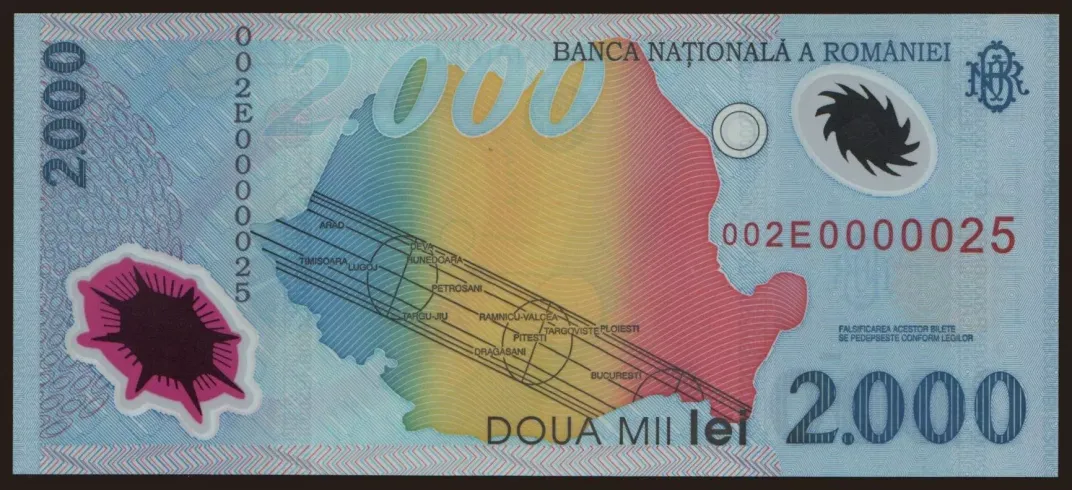
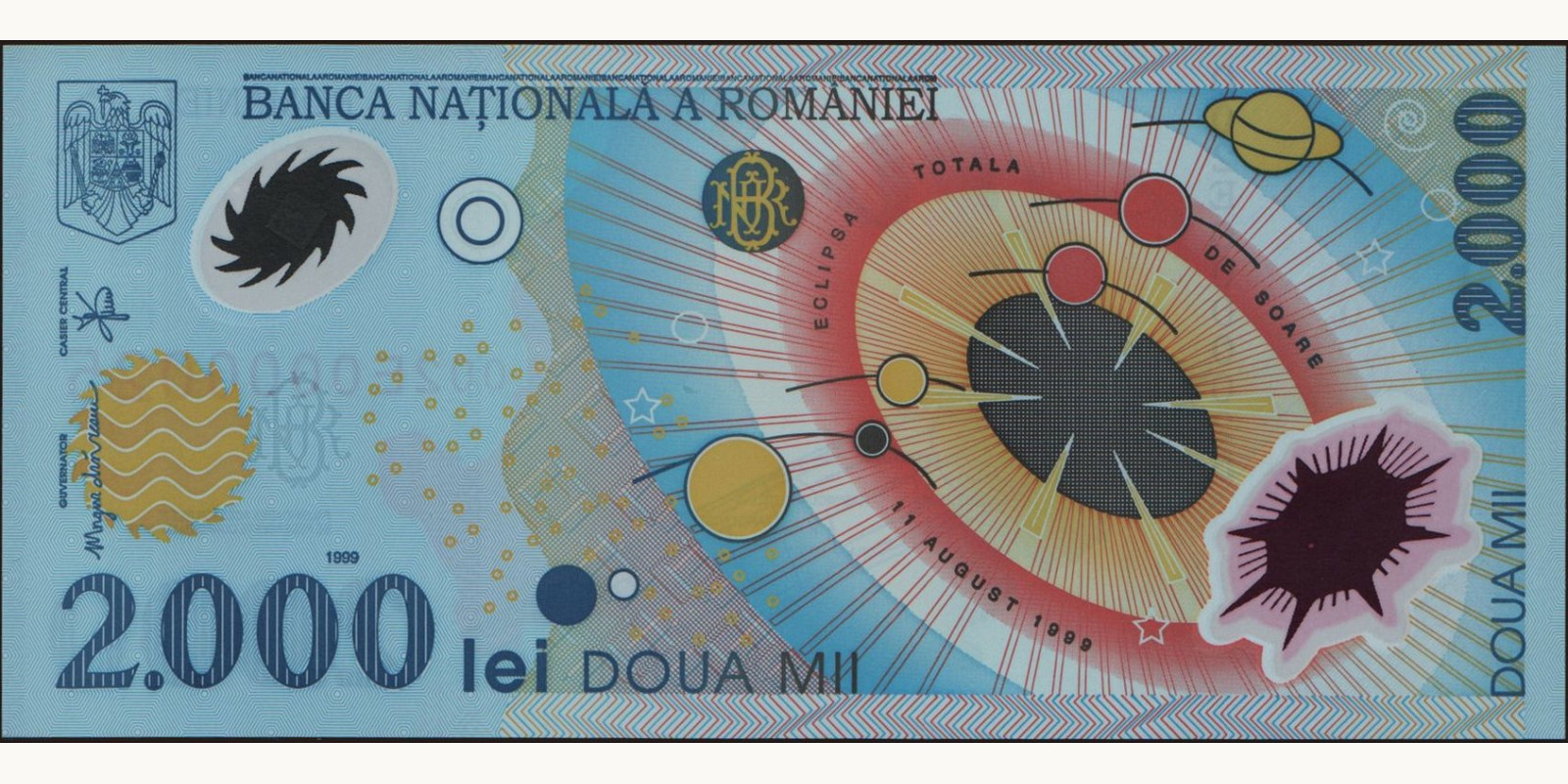
On the obverse side, the banknote features a detailed image of the solar eclipse, with the Moon covering the Sun. Around it, subtle gradients represent the transition from daylight to darkness.
A map of Romania is included, showing the path of totality across the country. This element is particularly important as it connects the global astronomical event directly to Romanian geography.
The reverse side continues the theme with additional scientific illustrations. The trajectory of the eclipse is shown in a clear and educational manner. The design balances aesthetics and information, making it appealing to both collectors and educators.
Polymer Innovation: A Technological Breakthrough
One of the defining features of the 2000 lei banknote is its polymer composition. Unlike traditional cotton-based paper, polymer banknotes are made from plastic substrates, offering several advantages.
They are significantly more durable, resistant to water, dirt, and physical damage. This extends their lifespan compared to paper notes.
Polymer also allows for advanced security features such as transparent windows, holographic elements, and complex microprinting. These features make counterfeiting extremely difficult.
Romania’s decision to adopt polymer early placed it among a select group of countries experimenting with future currency technologies.
Security Features of the Banknote
The Romanian 2000 lei banknote includes a range of advanced security features. These were cutting-edge at the time of issuance and remain impressive even today.
The transparent window is one of the most recognizable elements. It is seamlessly integrated into the design and cannot be replicated using traditional printing methods.
Microtext and fine line printing add another layer of protection. These details are difficult to reproduce without specialized equipment.
Under ultraviolet light, additional hidden features become visible, further confirming authenticity.
Together, these elements make the banknote both secure and visually distinctive.
Rarity and Availability in Today’s Market
Although millions of these banknotes were originally issued, their availability has decreased over time. Following Romania’s currency redenomination in 2005, many older notes were withdrawn from circulation.
As a result, surviving examples — especially those in uncirculated condition — have become increasingly valuable.
Collectors actively seek notes with crisp edges, no folds, and original brightness. Serial numbers also play a role in value, with unique or low-numbered notes commanding higher prices.
Today, the banknote is considered a modern collectible with steady demand.
Market Value and Price Trends
The value of the Romanian 2000 lei solar eclipse banknote depends on its condition. Circulated examples are relatively affordable, making them accessible to beginner collectors.
However, uncirculated notes can reach significantly higher prices, especially when graded by professional services.
Over the years, the price trend has shown gradual growth. This is driven by increasing collector interest and decreasing supply.
As more collectors enter the market, the long-term outlook for this banknote remains positive.
Why Collectors Love This Banknote
There are several reasons why collectors are drawn to the Romanian 2000 lei note.
First, it represents a real historical event with global significance.
Second, it is one of the earliest polymer banknotes in Europe.
Third, its design is both educational and visually appealing.
Finally, it is relatively affordable compared to other rare banknotes, making it an excellent entry point for new collectors.
Investment Potential and Future Outlook
From an investment perspective, the banknote offers strong potential. Its unique combination of rarity, innovation, and historical relevance makes it attractive for long-term holding.
As supply continues to decrease, prices are expected to rise gradually. Collectors who acquire high-quality examples today may benefit from future appreciation.
It is particularly recommended to focus on uncirculated notes or those with special serial numbers.
| Country | Romania |
|---|---|
| Year | 1999 |
| Denomination | 2000 lei |
| Material | Polymer |
| Event | Solar Eclipse |
| Redenomination | 2005 |
| Type | Commemorative Banknote |
What is special about the Romanian 2000 lei banknote
It commemorates the 1999 solar eclipse and is made of polymer.
Is it rare today
It is becoming increasingly rare, especially in perfect condition.
Is it a good investment
Yes, due to its historical significance and collector demand.
Why is polymer important
It increases durability and security compared to paper money.
Related Articles