Germany 1923 Hyperinflation: Full Collapse of the Weimar Currency and the Rise of Trillion Banknotes
Introduction: The Most Famous Hyperinflation in History
The hyperinflation crisis in Germany in 1923 is one of the most dramatic and well-documented economic collapses in modern history. It transformed a developed European economy into a chaotic system where money lost its value almost completely.
This period is often used as a textbook example of hyperinflation, illustrating how quickly a stable currency can collapse under pressure. The German experience provides valuable insights into the causes, mechanics, and consequences of extreme inflation.
Beyond economics, the crisis reshaped society, destroyed savings, and contributed to political instability that would influence future historical events.
Background: Germany After World War I
After World War I, Germany faced enormous economic challenges.
The Treaty of Versailles imposed heavy reparations, placing a massive financial burden on the country. At the same time, Germany had accumulated significant war debt.
Industrial production was disrupted, and political instability weakened the government's ability to respond effectively.
To meet its financial obligations, the government increasingly relied on printing money, which set the foundation for hyperinflation.

Early Inflation and Warning Signs
Inflation in Germany did not begin suddenly in 1923. It started gradually in the early 1920s.
Prices began to rise as the government expanded the money supply. Initially, this seemed manageable, but underlying structural problems remained unresolved.
As confidence in the currency declined, inflation accelerated. Businesses and consumers began to expect rising prices, reinforcing the cycle.
This process follows the same pattern explained in What is Hyperinflation.
The Ruhr Occupation and Economic Breakdown
A key turning point occurred in 1923 when French and Belgian troops occupied the Ruhr region, Germany’s industrial heartland.
In response, the German government encouraged passive resistance, including strikes. Workers were paid despite not producing goods, which increased government spending.
To finance this policy, even more money was printed, dramatically accelerating inflation.
Production fell while money supply increased, creating the perfect conditions for hyperinflation.

Explosion of Hyperinflation
By mid-1923, inflation spiraled out of control.
Prices began to double every few days. By late 1923, they were doubling every few hours.
The cost of everyday items became absurd. A loaf of bread that cost a few marks before the war reached billions and eventually trillions of marks.
Money lost its value so quickly that people rushed to spend it immediately.
Trillion Mark Banknotes
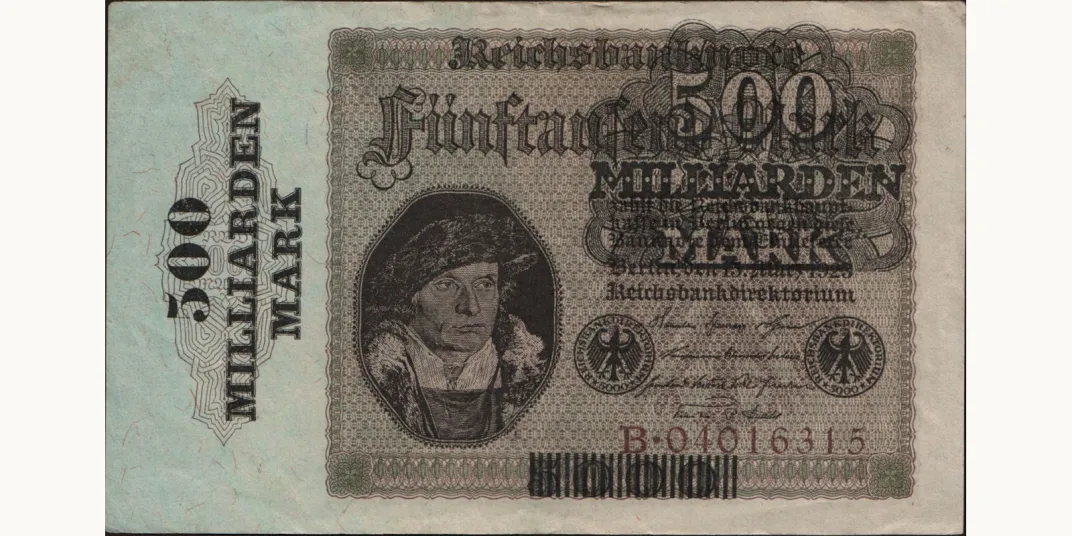
To keep up with rising prices, Germany issued banknotes in increasingly large denominations.
These included millions, billions, and eventually trillions of marks.
Despite their high face value, these notes were nearly worthless.
This phenomenon mirrors what later occurred in Zimbabwe Billion Dollar Notes and other hyperinflation cases.

Daily Life During Hyperinflation
Life during hyperinflation became extremely difficult.
Workers were paid multiple times per day so they could spend their wages before prices increased.
People carried large quantities of cash in baskets or wheelbarrows.
Barter systems emerged, with goods exchanged directly instead of using money.
Foreign currencies became more trusted than the national currency.
Impact on Society
The social impact of hyperinflation was devastating.
The middle class lost its savings, which had been accumulated over years or decades.
Pensioners and fixed-income earners were particularly affected, as their income became worthless.
Inequality increased, and social tensions grew.
Impact on Business and Economy
Businesses struggled to operate in an environment where prices changed constantly.
Long-term planning became impossible. Investment declined, and economic activity slowed.
The financial system weakened, as banks could not function effectively.
Psychological Effects
Hyperinflation also had profound psychological effects.
Trust in institutions collapsed. People became focused on short-term survival rather than long-term planning.
This erosion of trust had lasting consequences for German society.
Currency Reform: Introduction of the Rentenmark
The hyperinflation crisis ended with a major currency reform in late 1923.
Germany introduced the Rentenmark, a new currency backed by assets rather than gold.
The money supply was strictly controlled, restoring confidence in the currency.
This reform successfully stabilized prices and marked the end of hyperinflation.
The mechanism behind such reforms is explained in How Currency Reform Works.
Lessons from Germany 1923
Germany’s hyperinflation provides several important lessons.
Excessive money printing leads to currency collapse
Economic stability requires trust and discipline
Political decisions can have long-term economic consequences
These lessons remain relevant today.
Connection to Other Hyperinflation Cases
Germany is one of the earliest and most famous cases of hyperinflation.
Similar patterns can be seen in Zimbabwe and post-Soviet countries.
In all cases, the combination of money printing, economic decline, and loss of confidence led to collapse.
Collectible Value of German Hyperinflation Banknotes
Today, German hyperinflation banknotes are highly collectible.
Their extreme denominations and historical significance make them attractive to collectors.
They serve as physical reminders of one of the most dramatic economic events in history.
Conclusion
The hyperinflation in Germany in 1923 remains a powerful example of how economic systems can fail.
It highlights the importance of responsible monetary policy and the dangers of uncontrolled inflation.
For historians and collectors alike, it provides valuable insights into the relationship between money, society, and stability.
| Peak inflation | Prices doubling every hours |
|---|---|
| Highest denomination | Trillions of marks |
| Main cause | Money printing |
| Key event | Ruhr occupation |
| Solution | Rentenmark reform |
Question
Why did Germany experience hyperinflation
Answer
Due to war debt, reparations, and money printing
Question
What were trillion banknotes
Answer
Extremely high denomination notes issued during inflation
Question
How did people survive
Answer
By spending money quickly and using barter
Question
How did it end
Answer
Through currency reform and Rentenmark
Question
Are these banknotes collectible
Answer
Yes, they are valuable historical items
Related Articles