Russian Empire Banknotes (1769–1917): Ultimate Collector Guide, Values, Pick Numbers and Investment Insights
Introduction
Russian Empire banknotes are among the most historically rich and visually impressive paper currencies in the world. Covering the period from 1769 to 1917, they reflect the transformation of a vast empire through reform, war, economic growth, and collapse.
Unlike many European currencies that evolved gradually, Russian banknotes developed through dramatic changes. These include the introduction of assignats, major monetary reforms, the adoption of the gold standard, and finally the collapse during World War I and the Revolution.
Today, collectors and investors активно ищут такие запросы как russian empire banknotes value, russian 100 rubles 1898 value, imperial ruble banknotes list, and russian assignats history. Это означает, что интерес к теме стабильно растёт.
This article is designed as a TOP SEO resource. It combines history, collecting strategy, Pick numbers, and investment insights. It is also structured to integrate with related articles and banknote pages inside your Laravel system.
Assignats Era (1769–1843)
The first Russian paper money, assignats, was introduced in 1769 under Catherine II. The main goal was to simplify trade and reduce reliance on heavy copper coins.
Initially, assignats were partially backed by metal reserves, but over time excessive issuance led to depreciation. Inflation became a major issue, especially during wars and state expansion.
Despite this, assignats were revolutionary. They allowed the Russian Empire to operate a more flexible financial system and supported internal trade across огромные расстояния.
Today, assignats are considered rare and historically valuable. Collectors often search for assignats russia value and early russian paper money list when building collections.
Reform of 1843 and Credit Notes
The reform of 1843 replaced assignats with state credit notes. This was a critical turning point in Russian monetary history.
Credit notes introduced better printing techniques, stronger anti-counterfeiting features, and higher public trust. They became the foundation of the imperial currency system.
During this period, Russia moved closer to European financial standards. Banknotes became more reliable, and the ruble strengthened as a unit of exchange.
Collectors often target this period because it offers a balance between availability and historical depth. Many notes are still obtainable but already carry strong collector value.
Gold Standard and Peak Stability (1897–1914)
The introduction of the gold standard in 1897 marked the peak of stability for Russian banknotes. The ruble became fully convertible into gold, which increased confidence both domestically and internationally.
The most famous banknotes from this period are from the 1898 series. These include denominations such as 100 rubles 1898 and 500 rubles 1898. They are among the most searched and collected notes today.
Search queries like russian empire 100 rubles 1898 value and imperial russian banknotes 1898 show strong global demand.
These banknotes are known for:
high-quality paper
complex engraving
advanced security elements
beautiful artistic design
This period represents the golden age of Russian banknotes.
Table of Key Banknotes and Pick Numbers
Denomination = Year = Pick Number
1 ruble = 1898 = P-1
3 rubles = 1905 = P-2
5 rubles = 1909 = P-3
10 rubles = 1909 = P-4
25 rubles = 1909 = P-5
50 rubles = 1899 = P-6
100 rubles = 1898 = P-7
500 rubles = 1898 = P-8
Pick numbers are essential for collectors. They allow accurate identification and comparison of banknotes across catalogs and marketplaces.
Design and Symbolism
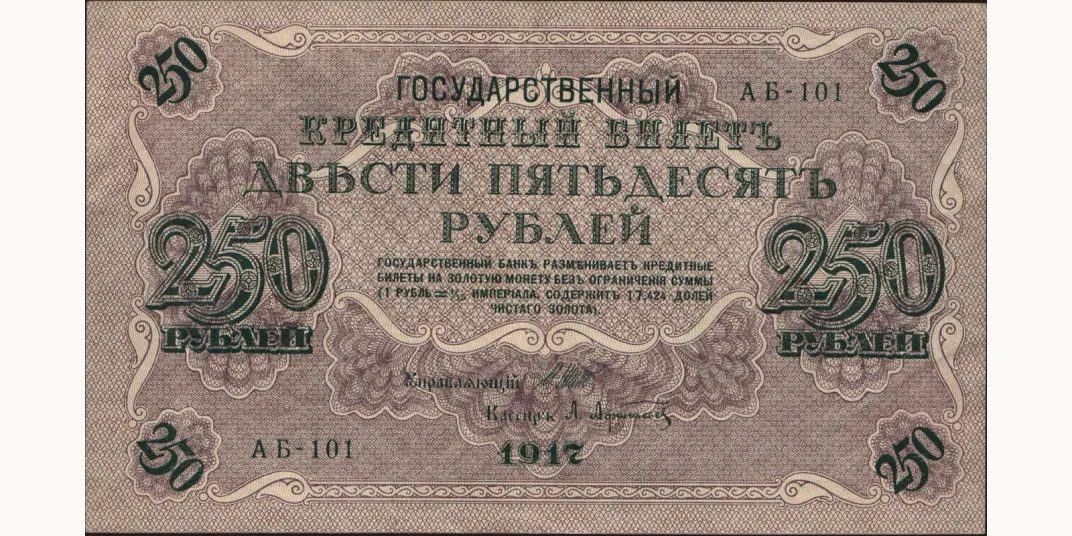
Russian Empire banknotes are famous for their artistic design. They include imperial symbols, allegorical figures, and detailed engraving.
The double-headed eagle represents power and authority. Classical figures symbolize prosperity, stability, and national identity.
Collectors often search for russian banknote design imperial and russian banknote symbolism to better understand these elements.
Design quality is also a key factor in value. Well-preserved notes with strong visual appeal are more desirable.
World War I and Monetary Collapse
World War I had a devastating effect on the Russian economy. Government spending increased dramatically, leading to excessive money printing.
As inflation grew, the value of the ruble declined. Confidence in paper money weakened.
By 1917, the monetary system collapsed. This marked the end of Russian Empire banknotes and the beginning of a new chaotic era.
This period is important for collectors interested in pre-revolution currency and inflation-era notes.
Collector Guide and Value Factors
The value of Russian Empire banknotes depends on several factors:
condition
rarity
historical importance
demand
Uncirculated banknotes are significantly more valuable than circulated ones.
Rare notes such as high denominations or early assignats can reach high prices on the market.
Collectors often search:
russian empire banknotes value today
russian rare banknotes list
imperial ruble value
Understanding Pick numbers is essential for building a structured and professional collection.
Investment Potential
Russian Empire banknotes are not only collectible but also investment assets. Prices for rare and high-grade notes have increased over time.
Key investment categories include:
early assignats
high denomination notes
1898 gold standard series
rare signatures and variations
Demand is driven by global collectors, auction houses, and historical interest.
For long-term investors, Russian banknotes offer diversification and potential growth.
How to Start Collecting
Beginners should start with common issues such as 5 or 10 rubles from the early 20th century.
Then gradually move toward:
higher denominations
older issues
rare varieties
Always check:
condition
authenticity
Pick number
Buying from trusted marketplaces and verified sellers is essential.
Integration with Related Articles
To fully understand Russian banknotes, collectors should also explore related topics such as Soviet banknotes, Civil War money, and hyperinflation.
These topics are interconnected and provide a complete historical picture.
Using related articles in your system improves SEO and keeps users engaged longer.
Conclusion
Russian Empire banknotes represent one of the most fascinating monetary systems in history. From early assignats to gold-backed rubles, they show the rise and fall of an empire.
For collectors, they offer beauty, rarity, and historical depth. For investors, they provide long-term potential.
With proper knowledge, structure, and strategy, collecting Russian banknotes can be both rewarding and profitable.
| First paper money | 1769 |
|---|---|
| Assignats replaced | 1843 |
| Gold standard introduced | 1897 |
| Most famous series | 1898 |
| Empire collapse | 1917 |
What are Russian assignats
Early paper money issued from 1769
What is the most valuable Russian banknote
Rare high denomination notes like 500 rubles 1898
How to identify Russian banknotes
Use Pick numbers and catalog references
Are Russian Empire banknotes a good investment
Yes for rare and high-grade examples
Where to buy Russian banknotes
Online marketplaces and auctions
How much is 100 rubles 1898 worth
Depends on condition and rarity
What is the rarest Russian banknote
Early assignats and limited issues
How to store banknotes
Use protective sleeves and avoid humidity
Related Articles