Delmonte Brothers Barbershop Tokens: The Story of Russia's Rarest Private Emergency Currency (Yeisk, 1918)
Introduction: When a Barbershop Became a Bank
In the turbulent summer of 1918, the North Caucasus was gripped by a monetary crisis unlike anything its residents had ever experienced. The flow of currency from central Russia had dried up entirely. Small denomination banknotes — the everyday coins and bills that kept markets, bakeries, and small shops running — had simply vanished from circulation. People needed change to buy bread, pay for a haircut, or settle debts at the market, but there was nothing small enough to use.
In this vacuum, private citizens, shopkeepers, and business owners across dozens of Russian towns took matters into their own hands. They printed their own money. Not out of greed or rebellion, but out of necessity. These improvised issues are known in numismatics as notgeld — "emergency money" — and in the Russian collector tradition they are often called "bony" (tokens) or "marki" (stamps/marks), reflecting their hybrid nature as objects caught between currency and printed ephemera.
Among the many private issuers in the port city of Yeisk on the Azov Sea, one stands out as particularly charming and historically significant: the Delmonte Brothers Barbershop. This well-known local enterprise issued small cardboard tokens in denominations of 50 kopecks, 1 ruble, and 2 rubles — totaling just 300 rubles — that circulated as genuine currency among Yeisk residents and even found acceptance among the peasant farmers at the surrounding rural markets.
Today, surviving examples of these tokens are extraordinarily rare. They represent a micro-history of economic collapse, local ingenuity, and the resilience of everyday commerce during one of Russia's most chaotic periods. For collectors, they are among the most coveted items in the entire field of Russian notgeld.
The Monetary Crisis of 1918: Why Yeisk Printed Its Own Money
To understand why a barbershop came to issue currency, it is necessary to understand the extraordinary economic conditions of 1918 in the North Caucasus region.
Russia in 1918 was in simultaneous freefall: political revolution, the collapse of the Romanov financial system, the beginning of a brutal civil war, and the breakdown of transportation and supply networks. The Bolshevik government in Petrograd and Moscow was struggling to maintain control over vast territories and had not yet established a functioning replacement monetary system. Imperial banknotes coexisted with new Soviet issues, local government printings, military scrip, and outright forgeries — all simultaneously in circulation, all of varying reliability.
For provincial cities like Yeisk, the situation was made worse by geography. Located on the northeastern shore of the Azov Sea, Yeisk was not a major administrative center. Currency shipments from the capital were unreliable at the best of times and had now stopped almost completely. The so-called "Don money" — banknotes issued by the Don Cossack government to the north — had not yet spread widely enough through the Pre-Caucasus region to fill the gap. The result was a severe shortage of small change.
Without coins and small bills, daily commerce ground to a halt. A merchant could not make change for a customer paying with a large note. Workers could not receive wages in usable denominations. Market traders at the bazaar could not complete ordinary transactions. The economic paralysis was real and immediate.
This is the context in which Yeisk's merchants and business owners stepped in. Multiple private enterprises began issuing their own scrip: the Vazeo and Tsyupko shop, the Express cinema, the Grand Hotel, the Kaplun bakery. None of these were acting with official permission. All of them were responding to the same urgent demand from the public for usable small currency.
The Delmonte Brothers Barbershop was among the first to issue, and their tokens were to become the most celebrated of all Yeisk's private emissions.
The Delmonte Brothers: A Reputable Yeisk Institution
The Delmonte Brothers Barbershop was not some fly-by-night operation. It was, by all accounts, one of the most established and respected commercial enterprises in Yeisk. The barbershop had built a solid reputation over the years for quality service, and the Delmonte name was well-known throughout the city.
This reputation was, in fact, the key reason their tokens worked. Private scrip depends entirely on trust. A token issued by a disreputable shop would be worthless — no one would accept it. But a token backed by the name of an institution that the community trusted was another matter entirely. Residents of Yeisk accepted the Delmonte tokens as readily as official currency because they believed the brothers would honor them. That faith was well-placed.
The brothers themselves were clearly men of some education and organizational ability. The text on the tokens was composed personally by one of the brothers, Saveliy Delmonte (who used the surname variant Delmonte-Savelyev). The design, while simple, was carefully executed. The production was arranged through Kornilov's local print shop, one of Yeisk's established printing establishments, giving the tokens an air of legitimacy that cruder handwritten notes could not achieve.
The tokens were accepted not only by city dwellers but also at the rural market by peasant farmers from the surrounding villages — a remarkable testament to how far the Delmonte name's reputation extended. When a peasant coming in from the countryside was willing to accept a barbershop token in exchange for their produce, that was genuine currency confidence at work.
Physical Description: What the Tokens Looked Like
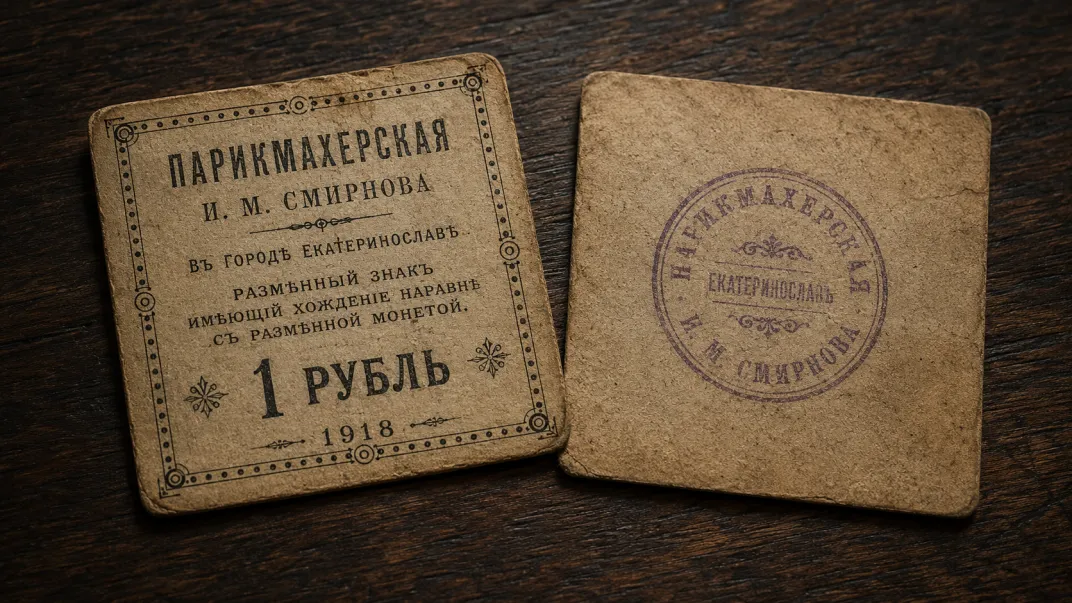
The Delmonte Brothers tokens are small, square pieces of printed cardboard, measuring 36 by 36 millimeters — about the size of a modern postage stamp or a small game token. They were printed on good quality thin white cardboard, which was a deliberate choice. Thin, high-quality card stock gave the tokens a more substantial, official feel compared to the rough paper used by some other private issuers.
The front face of each token features a square border composed of circles and lines — a simple but clean decorative frame typical of the printing conventions of the era. Within this border, four lines of black text are printed:
"Parikmakherskaya — br. Delmonte — Svrka [serial number blank] — 1 rubl" (or the applicable denomination).
The abbreviation "Svrka" likely refers to "sverka" (verification/series check), suggesting the brothers were making a rudimentary attempt to create an accountable issuance system. The serial number space was initially filled in by hand, and later a numbering machine (numerator) was used as production became more systematic.
The reverse side of each token was left blank in terms of printing, but received a violet ink stamp reading "L.S. Delmonte" — the initials and surname of one of the brothers. Additionally, the signature of the printing house owner (Kornilov) was applied. This combination of a printed front and a hand-stamped, hand-signed reverse was a common practice in Russian private token issues of this period, creating a two-stage authentication process.
Three denominations were issued:
50 kopecks
1 ruble
2 rubles
The total issue was strictly limited: 300 rubles total, with 100 rubles worth of each denomination. This modest scale reflects the practical intent of the issue — to provide immediate local change, not to create a significant monetary instrument.
Circulation and Acceptance: From Barbershop to Bazaar
The Delmonte tokens entered circulation without any official authorization — a fact that was entirely standard for private token issues of this period and place. No government authority was functioning at a level that would have made seeking permission either practical or necessary. The tokens simply appeared in the hands of customers of the barbershop and spread from there through ordinary transactions.
Their circulation period lasted approximately from mid-1918 through June 1919 — roughly a year. During this time they functioned as genuine small change throughout Yeisk. This was not a marginal phenomenon: the tokens were accepted at shops, at the market, and by peasant traders coming in from surrounding villages. In the absence of any official small denomination currency, they filled a real and important economic function.
The geography of their acceptance is particularly noteworthy. The fact that rural peasants from the outskirts of Yeisk accepted the tokens means that the Delmonte name and reputation extended beyond the city limits. It also suggests that the tokens were visually distinctive and recognizable enough that people understood what they were receiving and trusted the instrument.
By June 1919, the currency situation in the region had shifted. Don Cossack currency ("don money") had spread more widely, and a sufficient supply of official small denomination notes had returned. The Delmonte brothers then made the decision to redeem their outstanding tokens. The owner purchased back all the tokens he could find and exchanged them for official Don currency. The overwhelming majority of the redeemed tokens were then destroyed.
This redemption and destruction is the primary reason authentic Delmonte tokens are so extraordinarily rare today. Unlike tokens from many other private issuers which were simply abandoned and forgotten, the Delmonte tokens were actively collected and cancelled. Those that carry the handwritten inscription "NEDEYSTVITELNO" (invalid/void) on the reverse are among the redeemed examples — cancelled but preserved rather than destroyed.
Rarity and Collector Value: Among the Rarest Russian Notgeld
The Delmonte Brothers tokens occupy a special place in the world of Russian notgeld collecting. Their rarity is exceptional even by the already high standards of Russian private emergency currency.
Several factors compound to make them particularly scarce. First, the total issue was only 300 rubles — an extremely small emission even for a private token. Second, the active redemption campaign of June 1919 removed the vast majority of circulating tokens from existence. Third, whatever was not redeemed was subject to the general losses of time, the chaos of the Civil War period, and the upheavals of Soviet collectivization and the Second World War.
The tokens known to survive fall into a small number of distinct categories. Examples with the violet stamp and owner's signature on the reverse — representing fully completed circulating tokens — are the most prized. Examples bearing the "NEDEYSTVITELNO" cancellation represent redeemed pieces: authentic but officially voided. Incomplete examples lacking the hand stamp and signature came from the print shop itself, suggesting that not all printed cardboard was actually finished and issued.
The source of much of the documentary information about these tokens is itself a historically significant detail. In March 1928, a collector or researcher was able to interview Saveliy Delmonte himself. Delmonte provided detailed firsthand information about the tokens: the total issue amount, the denominations, the period of circulation, the redemption in June 1919, and the destruction of most redeemed pieces. Some of the tokens described were obtained directly from Delmonte — part of the small number he kept from the redeemed batch.
This direct provenance chain — tokens documented by the issuer in person, less than a decade after their issue — gives the Delmonte tokens an exceptional status in the historical record. They are not just collector curiosities; they are primary documents of local economic history with verified, firsthand documentation.
The Broader Context: Private Token Issues of the Russian Civil War
The Delmonte tokens are one small piece of a much larger phenomenon: the explosion of private and local emergency currency that swept Russia between 1917 and the early 1920s.
The scale of this phenomenon was enormous. Thousands of private issuers — shops, restaurants, cinemas, hotels, estates, cooperative societies, municipalities, and even individuals — printed their own scrip to address the chronic shortage of small change. These issues varied enormously in their physical form: printed cards, rubber-stamped paper slips, handwritten notes on whatever material was available, postage stamps with overprints, and professionally printed tokens indistinguishable from official currency to an untrained eye.
In Yeisk alone, multiple private issuers operated in 1918: the Vazeo and Tsyupko store, the Express cinema, the Grand Hotel, the Kaplun bakery, and the Delmonte barbershop, among others. Each served the same local need for small change. Each reflected the personality and resources of its issuer. And each has its own collector story today.
The North Caucasus was particularly rich in private token issues because of its geographical distance from the centers of revolutionary government, its complex ethnic and political composition, and the intense military activity of the Civil War. The region saw the presence of multiple competing military and political forces, each with their own currency, which created conditions of extreme monetary confusion in which local private solutions could thrive.
Collectors today distinguish between different categories of Russian emergency currency, and the private commercial tokens of 1918-1919 represent one of the most historically interesting classes. They are tangible evidence of the adaptive ingenuity of ordinary people maintaining economic life under extraordinary pressures.
How to Authenticate Delmonte Tokens: A Collector's Guide
Given the rarity and value of authentic Delmonte tokens, any collector who encounters a purported example should approach authentication with care and rigor.
Physical dimensions should be the first check. Authentic tokens measure 36 by 36 millimeters to the outer edge of the decorative border. The cardboard substrate should be thin but good quality white card stock, consistent with high-grade printing materials of the early twentieth century.
The printing on the front should show four lines of black text in a square border of circles and lines. The text structure follows the pattern: name of the institution, serial number field, and denomination. The typography should be consistent with Russian provincial printing of circa 1918 and show the slightly uneven ink distribution characteristic of letterpress printing on a small press.
The reverse authentication marks are critical and must be examined carefully. Authentic circulating examples should show a violet rubber stamp reading "L.S. Delmonte" and the signature of the printing house proprietor Kornilov. Redeemed examples will additionally carry the handwritten inscription "NEDEYSTVITELNO." Incomplete examples from the print shop will lack both stamp and signature.
Collectors should be aware that the serial numbers on the earliest tokens were written by hand before a numbering machine was later adopted. Both hand-numbered and machine-numbered examples are authentic; the hand-numbered pieces represent the earliest issues.
The combination of extreme rarity, well-documented history, and the existence of multiple distinct varieties (complete circulating, redeemed/cancelled, and incomplete) makes the Delmonte tokens a fascinating and technically demanding area of specialization. Serious collectors are advised to consult specialist references in Russian notgeld, particularly works focused on the North Caucasus region and the Yeisk private issues.
The 1928 Interview: Primary Sources and Historical Memory
One of the most remarkable aspects of the Delmonte tokens is the existence of a detailed firsthand account obtained directly from one of the issuers. In March 1928, a collector or numismatic researcher conducted an interview with citizen Saveliy Delmonte and recorded his account of the tokens' creation and history.
This account, preserved in the numismatic literature, provides information of exceptional quality for an issue of this kind. Delmonte confirmed the total issue amount of 300 rubles, the division into three denominations of 100 rubles each, the fact that no authorization was obtained, the identity of the compositors (himself), the printer (Kornilov's shop), the materials used, and the period of circulation. He described the redemption in June 1919 and the destruction of most redeemed pieces.
The existence of this 1928 interview — conducted less than a decade after the tokens were issued, with the issuer still living in the same city — gives these tokens an unusual place in the documentation of Russian emergency currency. Many private issues from this period are known only from surviving specimens with no contemporary documentation whatsoever. The Delmonte tokens have the opposite problem: rich documentation but almost no surviving examples.
The tokens obtained directly from Delmonte during or after the interview represent a documented provenance chain of extraordinary historical significance. These pieces came from the small batch of redeemed tokens that Delmonte had personally kept. They are both cancelled (bearing the "NEDEYSTVITELNO" inscription) and directly attributable to the issuer's own collection.
For historians and collectors alike, this convergence of physical rarity and documentary richness makes the Delmonte tokens an ideal case study in how private emergency currency functioned, circulated, and was ultimately retired during the chaotic years of the Russian Civil War.
| Issuer | Delmonte Brothers Barbershop, Yeisk, North Caucasus |
|---|---|
| Year of Issue | 1918 |
| Denominations | 50 kopecks, 1 ruble, 2 rubles |
| Total Issue | 300 rubles (100 rubles of each denomination) |
| Material | Thin white cardboard (good quality) |
| Dimensions | 36 x 36 mm (to outer border) |
| Front Design | Four lines of black text in square border of circles and lines |
| Reverse Mark | Violet ink stamp "L.S. Delmonte" + owner's signature |
| Printer | Kornilov's print shop, Yeisk |
| Circulation Period | 1918 through June 1919 |
| Redemption | June 1919; redeemed for Don Cossack currency |
| Text Composer | Saveliy Delmonte (Delmonte-Savelyev) |
| Authorization | None (issued without official permission) |
| Primary Documentation | March 1928 interview with Saveliy Delmonte |
| Rarity | Extremely rare; most examples destroyed upon redemption |
| Cancellation Mark | Handwritten "NEDEYSTVITELNO" on redeemed examples |
What are the Delmonte Brothers tokens?
The Delmonte Brothers tokens are private emergency currency (notgeld) issued in 1918 by a well-known barbershop in Yeisk, a port city on the Azov Sea in southern Russia. Issued in denominations of 50 kopecks, 1 ruble, and 2 rubles, they circulated as genuine small change during a severe shortage of official currency in the North Caucasus.
Why did a barbershop issue its own currency?
In 1918, the supply of official small denomination currency to the North Caucasus completely broke down due to the Russian Revolution and Civil War. With no official change available, multiple Yeisk businesses issued private tokens to enable ordinary commerce. The Delmonte Brothers Barbershop was one of the first to do so, acting on the same urgent local need as other issuers including a cinema, a hotel, and a bakery.
How many Delmonte tokens were issued?
The total issue was exactly 300 rubles: 100 rubles worth of 50-kopeck tokens, 100 rubles worth of 1-ruble tokens, and 100 rubles worth of 2-ruble tokens.
Why are Delmonte tokens so rare today?
Most surviving tokens were redeemed by the brothers in June 1919 and destroyed. The active redemption campaign eliminated the vast majority of examples. Only a very small number survived — either as unredeemed circulating pieces, as kept specimens from the redeemed batch (marked "NEDEYSTVITELNO"), or as unfinished examples from the printer.
What does "NEDEYSTVITELNO" mean on some tokens?
It means "invalid" or "void" in Russian. The brothers wrote this on the reverse of tokens they redeemed in June 1919, before destroying most of them. Examples bearing this inscription survived because they were kept rather than destroyed, often by the issuer himself or obtained by early collectors.
How were the tokens authenticated when in circulation?
Authentic circulating tokens had a violet rubber stamp reading "L.S. Delmonte" on the blank reverse, plus the signature of the Kornilov print shop owner. The combination of these two marks served as the authentication system. Serial numbers were initially hand-written, later applied by a numbering machine.
What is the historical significance of the March 1928 interview?
In March 1928, a researcher interviewed Saveliy Delmonte directly and recorded his firsthand account of the tokens. This provides unusually complete primary documentation for a private emergency currency issue, including total quantities, production details, circulation period, and the redemption process — all confirmed by the issuer himself less than a decade after the events.
Where can I find more information about Yeisk private token issues?
Specialist literature on Russian Civil War notgeld, particularly works covering the North Caucasus and Kuban region, is the best source. Russian numismatic journals and auction catalogs occasionally feature Yeisk private issues. The Delmonte tokens appear in historical accounts of North Caucasus emergency currency, sometimes documented alongside other Yeisk issuers such as the Kaplun bakery tokens and the Grand Hotel tokens.
Related Articles