Maltsov Factory Tokens and Private Money in Imperial Russia: The Maltsov Bon Catalog Explained
Introduction: Private Money in Imperial Russia
The history of money is not limited to official state-issued currency. Throughout different periods, private enterprises have created their own monetary systems to solve practical economic problems. One of the most intriguing examples from Imperial Russia is the system of Maltsov factory tokens, commonly referred to as “Maltsov bons”.
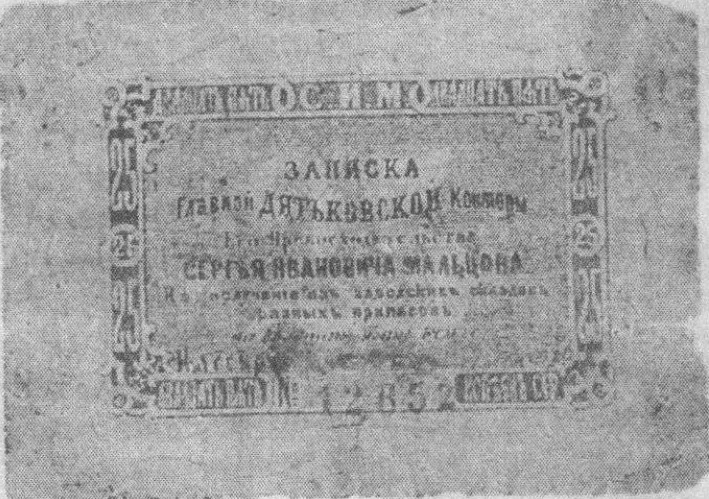
These private monetary instruments were issued by industrial enterprises belonging to the Maltsov family, one of the most influential industrial dynasties in 19th-century Russia. Their existence reflects a broader phenomenon of factory-based economies, where companies operated semi-independent financial systems.
Maltsov bons are not only rare collector items but also key historical artifacts that illustrate how industrial communities functioned economically.
The Maltsov Industrial Empire
The Maltsov family built a large industrial network in central Russia, particularly in regions such as Kaluga, Oryol and Smolensk. Their enterprises included glass factories, ironworks and various manufacturing facilities.
These industrial complexes often operated in relatively isolated areas, where access to official currency was limited. Workers lived in factory settlements, and the enterprise controlled not only production but also trade and daily life.
This environment created the conditions for the emergence of internal monetary systems.
Why Factory Money Was Needed
In the 19th century, Russia’s monetary system was not always efficient in remote industrial regions. Cash shortages, logistical difficulties and administrative barriers made it hard to ensure a steady supply of official currency.
To address these issues, factory owners began issuing their own payment instruments. These tokens allowed workers to receive wages and purchase goods within the factory network.
Maltsov bons functioned as a practical solution to these challenges, enabling economic activity in areas where official money was scarce.
The Introduction of Maltsov Bons
According to historical sources, Maltsov bons began to be issued around 1860. They were used as internal payment instruments within the enterprise system.
These notes were accepted in factory shops and for various services provided by the enterprise. Workers could use them to buy food, clothing and other necessities.
In many cases, the bons could also be exchanged for official currency, although this process was often controlled by the enterprise.
Circulation Across Regions
Maltsov bons circulated across several губернии, including Kaluga, Oryol and Smolensk. Their acceptance extended beyond a single factory, covering a network of industrial settlements.
This regional circulation made them more than just simple tokens. They functioned as a localized monetary system within a broader industrial economy.
Their use in paying taxes and settling obligations further increased their importance.
Design and Variations
One of the most fascinating aspects of Maltsov bons is their diversity. Different issues featured variations in design, typography and inscriptions.
Some notes included references to specific factory offices, while others used more general designations. Differences could also be found in the placement of text and decorative elements.
This variability suggests that multiple series and printings existed, making classification and cataloging a complex task.
Multiple Issues and Catalog Challenges
Researchers believe that there were at least two or three major issues of Maltsov bons. The first issue included notes with specific office names, while later issues introduced corrected inscriptions and standardized formats.
Some notes contained errors on the front side but correct text on the reverse, indicating transitional stages in production.
The large number of variations makes it difficult to create a complete catalog. Many specimens remain undocumented, and new discoveries continue to expand our understanding.
Printing and Production Characteristics
Maltsov bons were printed using relatively simple techniques compared to official banknotes. However, they were functional and recognizable within their intended environment.
Paper quality, typography and layout varied depending on the issue. Some notes featured decorative borders, while others were more utilitarian in appearance.
These differences provide valuable clues for dating and classification.
Economic Function and Worker Life
For workers in Maltsov enterprises, bons were an integral part of daily life. Wages were often paid in these tokens, which could be used within the factory economy.
This system ensured that money remained within the enterprise, reinforcing economic control. However, it also limited workers’ financial independence.
The use of private money reflects the broader social and economic structure of industrial Russia.
Withdrawal and Historical Decline
By the late 19th century, the use of private factory money declined. Improvements in the national monetary system and regulatory changes reduced the need for such instruments.
Maltsov bons were gradually withdrawn from circulation, and many were lost or destroyed.
As a result, surviving examples are rare and highly valuable today.
Collector Value and Rarity
Maltsov bons are among the most sought-after items in Russian notaphily. Their rarity, historical significance and diversity make them particularly attractive to collectors.
Complete sets are extremely rare, and individual notes can vary greatly in value depending on condition and type.
The complexity of classification adds an additional layer of interest for advanced collectors.
Why Maltsov Bons Matter
Maltsov bons provide unique insight into the functioning of private economic systems in Imperial Russia. They illustrate how enterprises adapted to monetary challenges and created self-contained financial environments.
These notes are not just collectibles. They are historical documents that reveal the relationship between industry, labor and money.
For historians and collectors alike, they represent a fascinating chapter in the history of currency.
| Period | circa 1860–1880s |
|---|---|
| Country | Russian Empire |
| Issuer | Maltsov industrial enterprises |
| Type | Private factory currency |
| Regions | Kaluga, Oryol, Smolensk |
| Usage | Wages, factory shops, internal trade |
What are Maltsov bons
Private factory-issued money in Imperial Russia
When were they used
Around 1860–1880s
Why were they issued
To solve cash shortages in industrial regions
Are they rare
Yes, very rare today
Are they valuable
Yes, especially unique variants
Related Articles