Hryvnia vs Karbovanets: The Two Currencies of Revolutionary Ukraine Explained
Two Names, One Nation: The Parallel Currencies of Revolutionary Ukraine
Among the most common questions asked by newcomers to Ukrainian revolutionary-era paper money is a deceptively simple one: what is the difference between the hryvnia and the karbovanets? The two terms appear on different notes from the same short period, often in the context of the same political crisis. They coexisted, overlapped, and were sometimes interchangeable in practice. Understanding their relationship requires a brief excursion into the monetary and political history of Ukraine between 1917 and 1920 — because the distinction between these two currencies is not merely technical. It is a window into the political conflicts, artistic programs, and administrative struggles of a nation attempting to define itself in the midst of revolution.
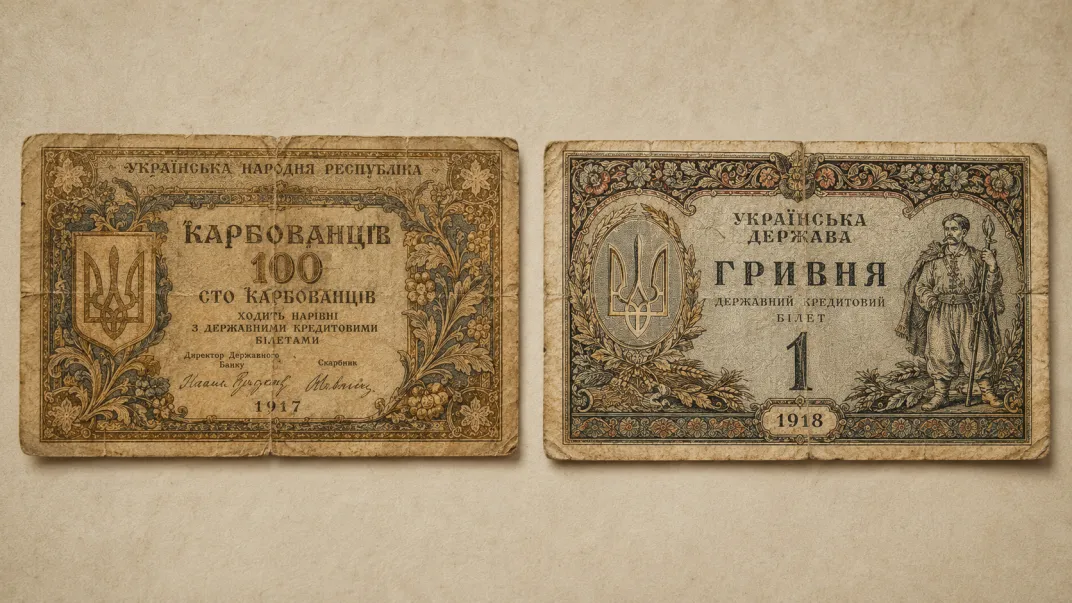
The short answer is that karbovanets and hryvnia were two different monetary units used by successive Ukrainian governments. The karbovanets came first, introduced by the Central Rada in December 1917 as the initial unit of the newly independent state. The hryvnia was introduced by the Hetmanate government of Pavlo Skoropadsky in May 1918 as a replacement, with a specific exchange relationship to the karbovanets. But the full picture is considerably more complex, because neither currency ever fully replaced the other in practice, and both names continued to circulate on government-issued notes right through to the collapse of Ukrainian independence in 1920.
The Karbovanets: Origins and First Use
The word karbovanets has deep roots in Ukrainian and broader East Slavic monetary culture. It derives from an old term meaning a notch or groove cut into a stick — a primitive counting and recording device. In this sense, the karbovanets was a folk monetary concept long before it became a formal denomination, representing a sum counted off on a tally stick. Over time it became associated with specific monetary values in different regional contexts.
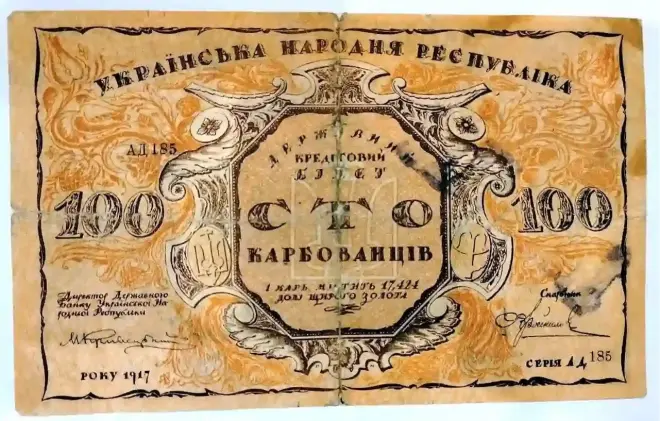
When the Central Rada passed its temporary law on the issue of state credit notes in December 1917, it chose the karbovanets as the denomination of the first Ukrainian paper money. The initial note was the 100 karbovanets, and the authorized emission was set at 500 million karbovanets. The choice was deliberate: the karbovanets was a recognizably Ukrainian term with no Russian imperial associations, and its informal, popular character suited the Rada's self-presentation as a people's government. By contrast with the Russian ruble — the currency of the imperial state against which Ukraine was asserting its independence — the karbovanets was distinctively Ukrainian in name as well as in design.
At its introduction, the karbovanets circulated at parity with the Russian ruble, and some contemporary economists believed it would have traded at a premium had it not been artificially tied to the ruble's value. The early circulation was described as successful, and the notes were accepted alongside Russian currency in ordinary transactions.
The Hryvnia: An Ancient Name for a New Currency
The hryvnia has a far older historical pedigree than the karbovanets. The term derives from the medieval Ukrainian monetary unit of the same name — the hryvnia kuna of the Kyivan Rus period, a weight of silver used as a medium of exchange in the ninth through thirteenth centuries. By invoking this term, the Hetmanate government was making a deliberate historical claim: the hryvnia connected the new Ukrainian currency to the most ancient stratum of Ukrainian statehood, the Kyivan Rus polity.
Hetman Skoropadsky's decree of May 31, 1918, introduced the hryvnia as the new official monetary unit of the Ukrainian State. The exchange rate established was 1 hryvnia = 2 karbovanets, meaning that the hryvnia was the larger unit. This was not merely an administrative decision but a statement: the new government was not simply continuing the monetary system of the Rada but recasting it in a more historically resonant framework.
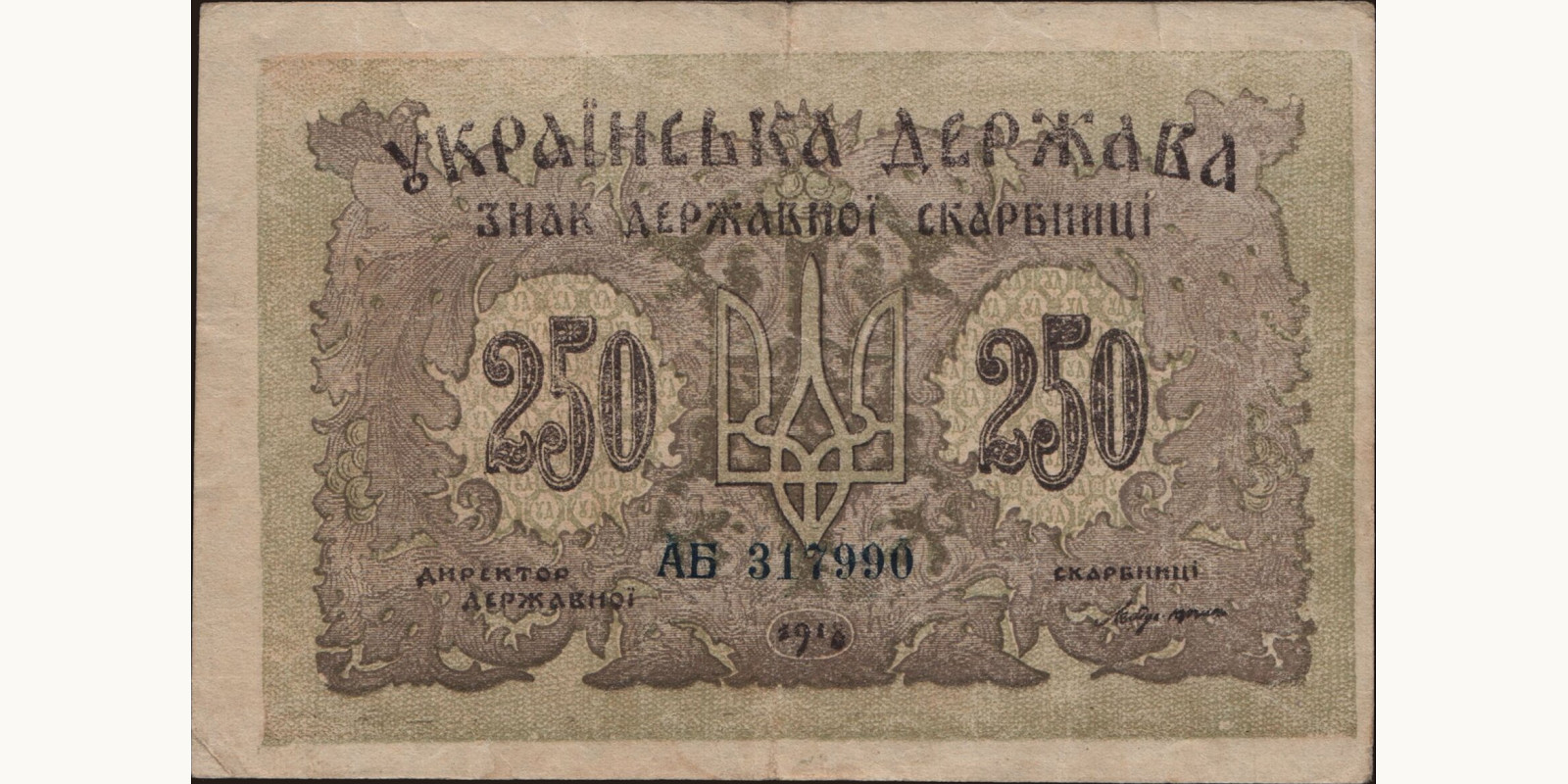
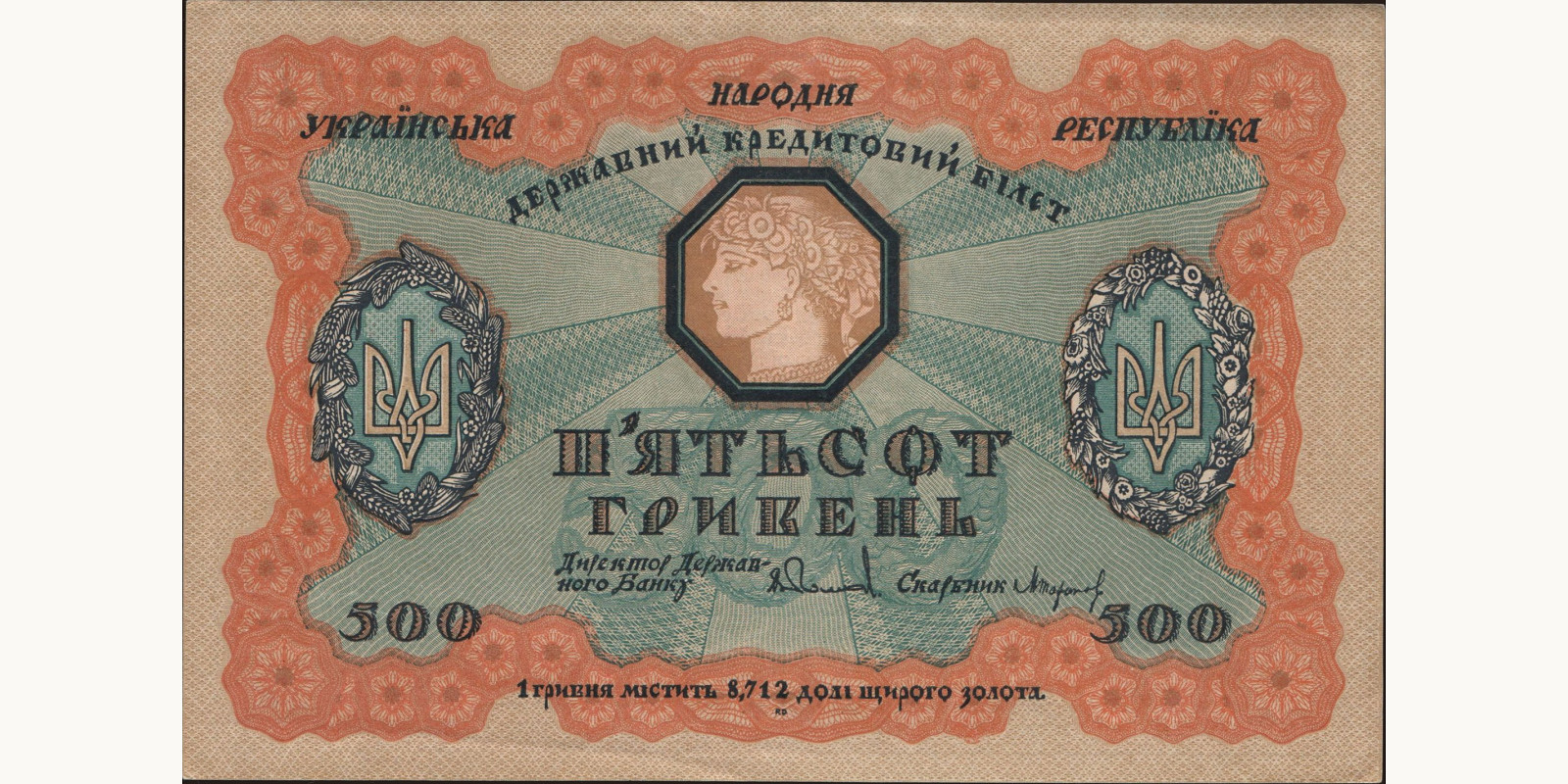
The hryvnia notes were designed and ordered from Germany. The first to arrive, in August 1918, were technically state treasury bonds — 3.6 percent interest-bearing notes — pressed into service as currency. The full hryvnia note series was released from October 1918, in denominations of 2, 10, 100, 500, 1000, and 2000 hryvnias, with designs by Heorhii Narbut (the lower denominations) and Ivan Mozalevsky (the higher denominations). The production quality of these German-printed notes was considerably higher than anything produced locally.
Exchange Rates, Coexistence, and Confusion
In theory, the relationship between karbovanets and hryvnia was clear: 1 hryvnia = 2 karbovanets. In practice, the monetary landscape of 1917–1920 Ukraine was anything but clear. Russian imperial rubles continued to circulate. German marks and Austrian crowns were in use in some areas. Local emergency scrip issued by individual towns, municipalities, and cooperatives circulated alongside the national currencies. Soviet Russian money entered some areas. And throughout this period, both karbovanets and hryvnia notes from different governments continued to be used side by side.
The Hetmanate government never successfully declared the Russian ruble a foreign currency and expelled it from domestic circulation. The result was a chaotic multi-currency environment in which speculative exchange trading was rampant and official exchange rates bore little relation to what actually happened in the marketplace. Skoropadsky's government noted that despite the large quantities of money printed, actual physical cash was scarce in circulation, because disrupted supply chains and communications meant that money accumulated in rural areas and failed to circulate effectively through the economy.
The Directorate, which overthrew Skoropadsky's government in November 1918, inherited this monetary chaos. It continued to issue notes in both karbovanets and hryvnia denominations simultaneously — the karbovanets for some domestic needs, the hryvnia notes continuing in circulation from the previous government's stockpiles. The Directorate's declaration in August 1919 that Soviet money was invalid within its territory was an attempt to impose some order, but by that point the military situation was too precarious for effective monetary policy.
Design Philosophy: What the Two Currencies Said About Ukraine
Beyond their monetary functions, the karbovanets and hryvnia notes made different kinds of symbolic statements about Ukrainian identity, and the differences between them reflect the different political visions of the governments that issued them.
The karbovanets notes of the Central Rada, designed principally by Heorhii Narbut, drew on folk art traditions and a popular aesthetic. The ornamental motifs — embroidery patterns, floral wreaths, agricultural symbols — spoke to a vision of Ukraine as a people's republic rooted in the rural, folk traditions of the Ukrainian peasantry. The choice of the karbovanets as a denomination reinforced this popular character.
The hryvnia notes, by contrast, made a more elevated historical claim. The name itself reached back to medieval Kyivan Rus. The larger denominations incorporated imagery drawn from Ukrainian Baroque culture — the sophisticated artistic tradition of the seventeenth-century Cossack elite. The German printing of these notes, with their higher technical quality, also signaled an aspiration toward the standards of established European states. The Hetmanate was presenting itself as a legitimate European government, heir to the traditions of the old Ukrainian aristocracy, and the currency reflected that self-presentation.
The 500 hryvnia note's allegorical "Young Ukraine" figure, Narbut's design for a woman's head representing the nation, synthesized these two tendencies: it was simultaneously populist (a human face for the currency) and classicizing (drawing on the tradition of national allegory in European art). This synthesis is part of what makes the hryvnia series the most artistically accomplished body of Ukrainian paper money from the period.
Legacy: Which Name Won?
The answer to which name won the historical competition between hryvnia and karbovanets is complicated by the fact that both names returned after a long absence. When the Soviet government dissolved Ukrainian independence and declared Ukrainian money illegal, both terms disappeared. Ukraine's monetary future for most of the twentieth century was the Soviet ruble.
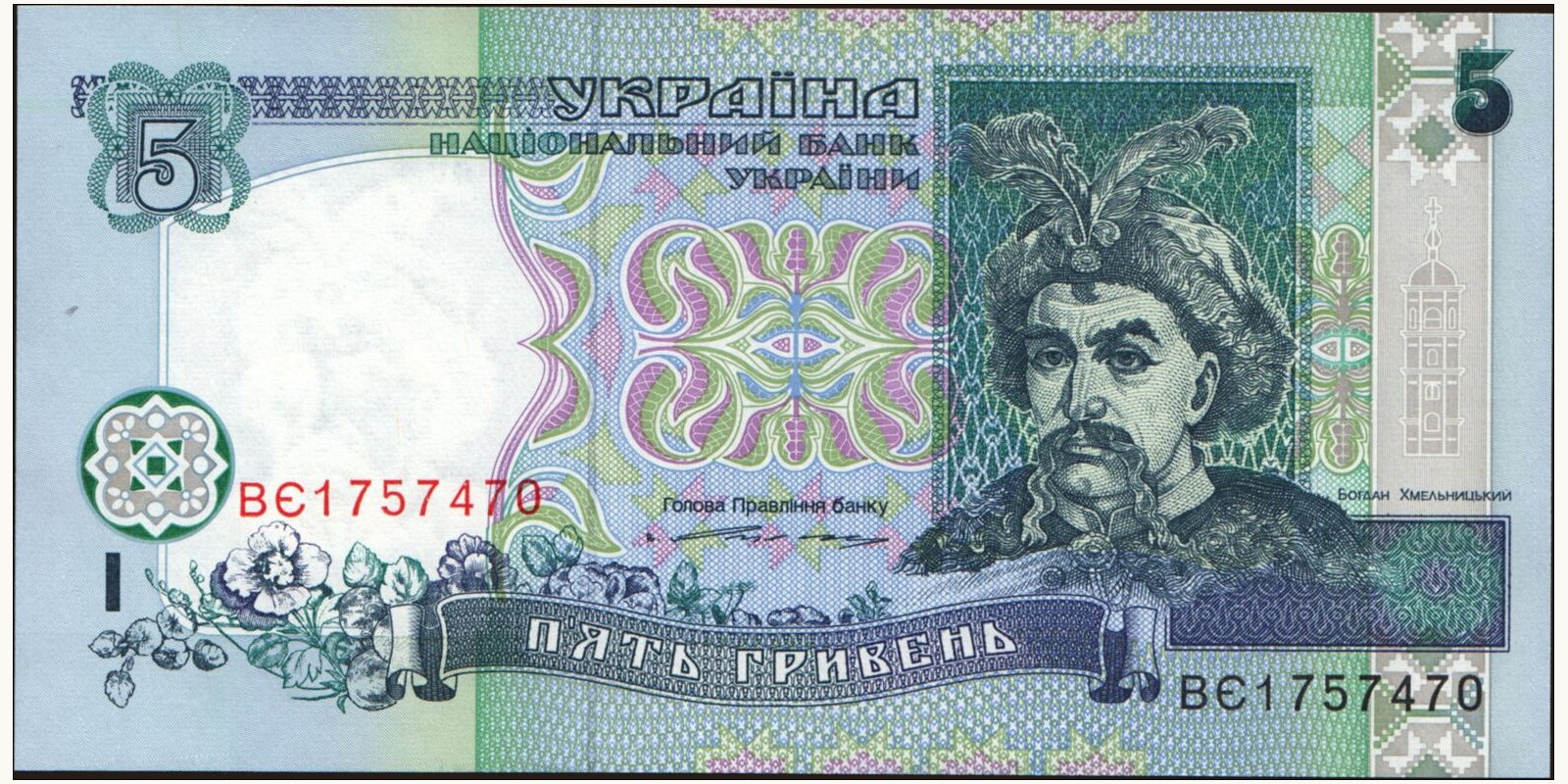
When Ukrainian independence returned in 1991, the question of monetary nomenclature had to be answered again. Ukraine initially introduced a transitional currency called the karbovanets in 1992 — not the same denomination as the 1917 original but a deliberate echo of it, signaling continuity with the short-lived independence of the revolutionary period. Then, in 1996, Ukraine replaced the karbovanets with the hryvnia as the permanent currency, a name it carries to the present day.
So in the long view, the hryvnia won — but only after the karbovanets served its transitional role. The arc from 1917 to 1996 follows a curve from karbovanets to hryvnia that mirrors almost exactly the arc of 1917–1918: the karbovanets as the first assertion of monetary independence, the hryvnia as the more historically grounded permanent settlement.
For collectors, the contrast between the two currencies within the 1917–1920 series is part of what makes the period so rewarding to study. The notes are not just financial instruments: they are arguments, made in paper and ink, about what Ukraine is, where it comes from, and what it aspires to be.
| Karbovanets introduced | December 1917 by the Central Rada |
|---|---|
| Hryvnia introduced | May 31, 1918 by Hetman Skoropadsky |
| Exchange rate | 1 hryvnia = 2 karbovanets |
| Karbovanets etymology | Old East Slavic: a notch cut in a tally stick |
| Hryvnia etymology | Medieval Ukrainian silver weight unit (Kyivan Rus era) |
| Central Rada design style | Folk art, embroidery patterns, agricultural symbols |
| Hetmanate design style | Baroque, historical allegory, European classical motifs |
| German printing of hryvnia | Ordered under the Central Rada, delivered under the Hetmanate |
| Modern revival of karbovanets | 1992 (transitional Ukrainian currency after independence) |
| Modern revival of hryvnia | 1996 (permanent Ukrainian currency, still in use) |
What is the difference between the Ukrainian hryvnia and karbovanets?
They were two different monetary units used by successive governments. The karbovanets was introduced by the Central Rada in December 1917. The hryvnia replaced it under Hetman Skoropadsky in May 1918, at a rate of 1 hryvnia = 2 karbovanets. Both continued to circulate simultaneously through the collapse of Ukrainian independence in 1920.
Which currency was more valuable, the hryvnia or the karbovanets?
The hryvnia was defined as equal to 2 karbovanets, making it nominally more valuable. However, rampant inflation during the period meant that both currencies lost value rapidly, and official exchange rates often bore little relation to actual marketplace conditions.
Why did Ukraine use two different currency names simultaneously?
Because three successive governments each issued their own notes, and old notes remained in circulation even after new governments came to power. The Directorate used both karbovanets and hryvnia notes from previous governments alongside its own new issues.
Which artists designed the karbovanets versus the hryvnia notes?
Both series were primarily designed by Heorhii Narbut. For karbovanets notes, he designed the first 100 karbovanets and subsequent Central Rada denominations. For the hryvnia, he designed the 10, 100, and 500 hryvnia notes. Viktor Krychevsky designed the 2 hryvnia, and Ivan Mozalevsky designed the 1000 and 2000 hryvnia.
Is the current Ukrainian hryvnia connected to the 1918 hryvnia?
Yes, by deliberate historical choice. When Ukraine re-established its currency in 1996, it revived the hryvnia name specifically to connect the modern state to the brief period of Ukrainian independence in 1917–1920, including the hryvnia introduced under the Hetmanate.
Related Articles