Pareidolia in Money: Why We See Faces in Banknotes
Introduction to Pareidolia in Banknotes
Banknotes are filled with intricate designs, fine engraving, and layered visual structures. While these elements are primarily created for artistic and security purposes, they often produce unexpected visual effects. One of the most fascinating among them is the appearance of faces where none were intentionally designed.
This phenomenon is known as pareidolia. It explains why people consistently report seeing faces in smoke, shadows, patterns, and textures found on banknotes. What makes this especially interesting is that different people often see different faces in the same area of a note.
Pareidolia transforms the act of observing a banknote into an interactive experience. Instead of simply viewing the design, the observer becomes an active participant in interpreting it.
What Is Pareidolia
Pareidolia is a psychological phenomenon in which the brain interprets random or ambiguous visual information as familiar patterns, especially faces. It is part of a broader process known as pattern recognition.
Humans are naturally wired to recognize faces quickly. This ability is deeply embedded in the brain and operates even with minimal visual input. Two dots and a line can already be interpreted as a face.
This mechanism evolved as a survival advantage. Recognizing faces allowed early humans to quickly identify allies, threats, and emotional expressions.
In modern life, this same mechanism causes us to see faces in clouds, rocks, shadows, and even in everyday objects like sockets or car fronts.
Why Banknotes Trigger Pareidolia
Banknotes are particularly effective at triggering pareidolia because of their visual complexity. Engraving techniques create dense networks of lines, shadows, and textures.
These patterns provide just enough structure for the brain to form recognizable shapes. Areas such as smoke, hair, clothing folds, and background ornaments are especially prone to this effect.
Unlike simple images, banknotes are designed with layered depth and shading. This increases the number of potential patterns that can be interpreted as faces.
As a result, banknotes become ideal surfaces for pareidolia to occur.
Common Locations of Face Illusions
Certain areas of banknotes are more likely to produce face-like illusions. One of the most common is smoke, such as from trains or industrial scenes. The flowing and irregular nature of smoke creates dynamic patterns.
Clouds and sky backgrounds also frequently produce illusions. Their soft shapes and gradients allow the brain to form facial structures.
Decorative borders and guilloche patterns can create symmetrical shapes that resemble eyes and mouths.
Even shadows around portraits can generate secondary faces that appear separate from the main image.
Real Examples in Banknotes
Collectors have identified many cases of pareidolia in currency. The Harbin Ruble is one of the most famous examples, where a face appears in the smoke of a locomotive.
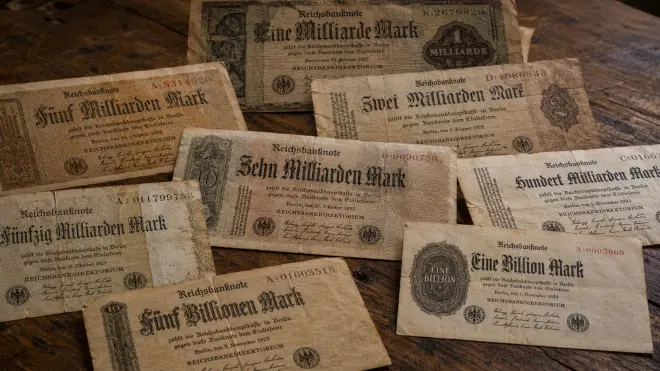
German hyperinflation banknotes from 1923 also contain complex patterns where faces seem to emerge.
Some collectors claim to see faces in US dollar bills, particularly within the background engravings.
These examples demonstrate that pareidolia is not limited to a specific country or design style.
How the Brain Constructs Faces
The brain does not require a complete image to recognize a face. It uses key features such as eyes, nose, and mouth positioning.
When a pattern contains elements that roughly match these features, the brain fills in the gaps and constructs a face.
This process happens almost instantly and often without conscious effort.
Because of this, once a face is seen, it becomes difficult to “unsee” it.
Differences in Perception
Not everyone sees the same images. Perception varies depending on experience, expectations, and focus.
Some people may immediately notice a face, while others may not see anything unusual at all.
Once a person is told where to look, they are more likely to see the same pattern.
This shows how perception is influenced by suggestion and context.
Lighting, Angle, and Magnification
Environmental factors play a major role in pareidolia. Lighting can highlight or hide certain details.
Changing the angle of the banknote can alter the visibility of patterns.
Magnification reveals finer details, increasing the likelihood of detecting face-like structures.
These variables explain why the same banknote can produce different interpretations under different conditions.
Intentional vs Accidental Illusions
There is ongoing debate about whether some illusions are intentional. While artists sometimes include hidden elements in their work, there is little evidence that banknote designers deliberately add hidden faces.
Most illusions are considered accidental, resulting from the complexity of engraving.
However, the possibility of intentional design continues to attract attention and speculation.
The Role of Collectors
Collectors play a key role in identifying and documenting pareidolia in banknotes.
Through careful observation and sharing of findings, they contribute to a growing body of knowledge.
Online communities and forums allow collectors to compare discoveries and interpretations.
This collaborative effort enhances the overall understanding of the phenomenon.
Impact on Collecting
Pareidolia adds a unique dimension to collecting. It encourages closer inspection and deeper engagement with banknotes.
While it does not directly determine value, it increases interest and discussion.
Banknotes associated with well-known illusions often gain additional attention.
Why Pareidolia Matters
Pareidolia demonstrates the connection between human perception and artistic design.
It shows that meaning is not only created by the artist but also by the observer.
For collectors, this adds an interpretative layer that goes beyond catalog descriptions.
Conclusion
Pareidolia in banknotes is a powerful example of how the human brain interacts with complex visual information.
By understanding this phenomenon, collectors can better appreciate the depth of banknote design and the role of perception.
It transforms ordinary currency into a source of discovery and curiosity.
Key Facts
| Phenomenon | Pareidolia |
|---|---|
| Cause | Pattern recognition |
| Common areas | Smoke, clouds, ornaments |
| Intentional | Not proven |
| Collector interest | Very high |
FAQ
Why do we see faces in banknotes?
Because the brain recognizes patterns.
Is pareidolia rare?
No, it is very common.
Do designers include hidden faces?
Usually not intentionally.
Can everyone see the same face?
No, perception varies.
Related Articles