Collector's Guide to Ukrainian Banknotes 1917–1920: What to Know Before You Buy
Why Ukrainian Banknotes of 1917–1920 Are Among the Most Collectible in Eastern Europe
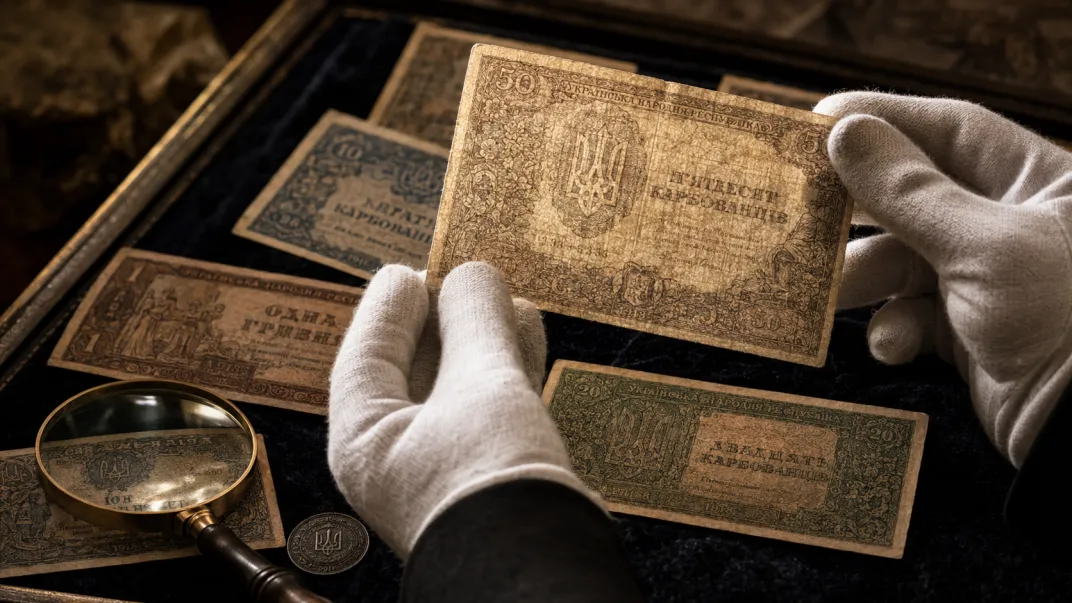
The paper money of revolutionary Ukraine occupies a unique position in the world of bonistics — the specialized collecting of paper currency and related fiscal documents. In a span of just three years, three successive governments produced over twenty distinct denominations, each with its own artistic program, printing history, and pattern of survival. The notes range from masterworks of applied graphic art to rough emergency issues printed on whatever paper was available, and the stories behind them are inseparable from one of the most turbulent political dramas of the twentieth century.
For collectors, this period offers several compelling attractions. First, the artistic quality: the principal designer Heorhii Narbut was a trained graphic artist working consciously in a tradition of European applied art, and his banknotes reflect that training. Several denominations in the series are genuine achievements of early twentieth-century print culture, comparable in artistic ambition if not in technical resources to the great banknote series produced by established European states. Second, the historical density: every denomination carries a story — about the government that issued it, the financial conditions that drove its production, the artists who designed it, and often the popular nickname that ordinary Ukrainians gave it. Third, the variety: within individual denominations, paper variations, watermark differences, printing variants, and overprints create a rich field of subspecialization for the advanced collector.
This guide covers the key issues, varieties, and considerations for anyone beginning or deepening a collection of Ukrainian paper money from the 1917–1920 period.
The Central Rada Issues: First Emissions and Key Varieties
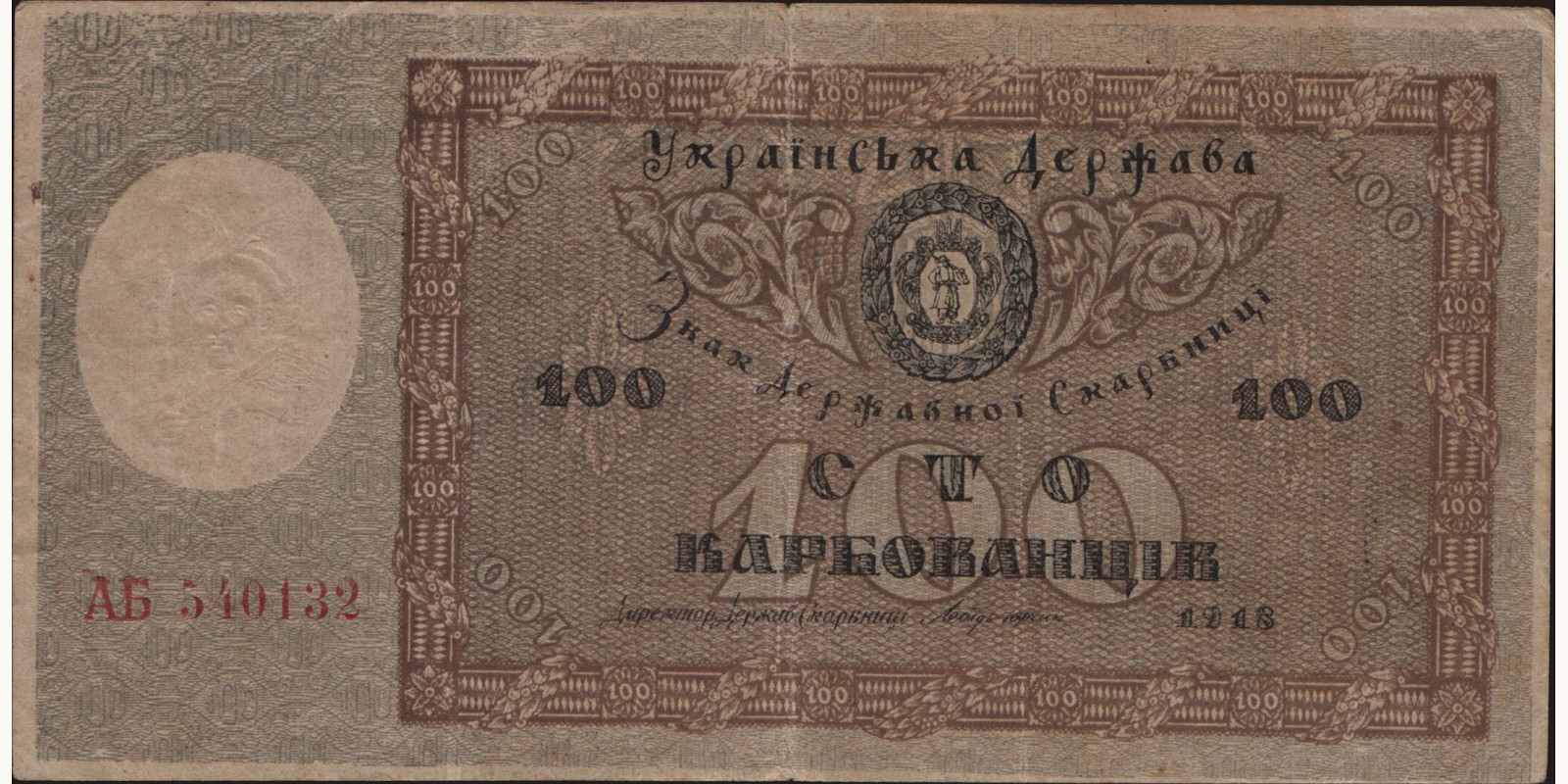
The first Ukrainian banknote — the 100 karbovanets of late December 1917 — is the foundational piece of any serious collection of Ukrainian paper money. Popularly nicknamed "horpynky" by Kyiv residents, this note was the product of the design competition organized by Hrushevsky in the summer of 1917, with the winning design incorporating Narbut's chosen trident-with-cross motif. The note entered circulation at parity with Russian rubles and was initially well-received, which means that well-circulated examples are common, while genuine uncirculated specimens are considerably scarcer.
For the first emission, collectors should pay attention to printing quality: the first notes were produced under difficult conditions on local presses, and there are variations in ink density, registration, and paper quality that form a collecting subspeciality in their own right. The authorized emission total was 500 million karbovanets, but survival rates across circulation grades vary considerably.
The second Central Rada emission, beginning April 6, 1918, produced notes of 25 and 50 karbovanets (the 5 and 10 karbovanets of this authorization were never issued), as well as higher denominations of 100, 200, 400, 500, and 1000 karbovanets on watermarked paper. The 50 karbovanets of this series were nicknamed "lopatky" (little shovels) by the public — a reference to their shape or the feel of them in the hand. Notes in genuinely uncirculated condition from this emission are rare, as the chaotic conditions of early 1918 meant that most notes were heavily used.
Alongside the main currency issues, the Central Rada also authorized the use of postage stamp money — small-denomination stamps (in shahiv, the subunit of the hryvnia) used as substitute small change. These were printed on deliberately coarse paper to withstand prolonged handling, and were still in circulation as late as the end of 1919. Stamp money of this period is a specialized collecting area that intersects with both philately and bonistics.
Hetmanate Issues: German Quality on Ukrainian Themes
The hryvnia notes produced for the Hetmanate government of Pavlo Skoropadsky, printed in Germany to high technical standards, represent the peak of production quality in the 1917–1920 series. They were printed on better paper, with more sophisticated security features, and with a higher level of artistic finish than the locally produced notes.
The first German-printed hryvnias to arrive in Ukraine in August 1918 were technically issued as bonds — 3.6 percent State Treasury Bills — before being pressed into service as currency. These bond-banknotes, in denominations of 50, 100, 200, and 1000 hryvnias, each with eight coupons (four per side), are a distinctive collecting category. The coupons are often detached — notes with all coupons intact are significantly more desirable than those with coupons removed.
The main hryvnia emission released from October 17, 1918, comprised six denominations: 2, 10, 100, 500, 1000, and 2000 hryvnias. Collectors should note the important distinction in the inscriptions: the lower four denominations (2, 10, 100, 500 hryvnias) bear the name "Ukrainska Narodna Respublika" (Ukrainian People's Republic, the Rada-period state name), while the 1000 and 2000 hryvnia notes bear "Ukrainska Derzhava" (Ukrainian State, the Hetmanate name). This reflects the history of their production: the lower denominations were designed under the Rada, with designs by Narbut and Krychevsky, while only the two largest denominations were specifically commissioned under Skoropadsky.
Within this series, the 500 hryvnia note with Narbut's "Young Ukraine" head is particularly prized for its artistic quality. The 2000 hryvnia note, produced in smaller quantities because of the circumstances of its commission, is scarcer than the lower values.
Directorate Issues: Emergency Money Under Fire
The banknotes of the Ukrainian Directorate (late 1918 through 1920) are perhaps the most varied and in some respects the most difficult area of the field. The government was in constant motion — from Kyiv to Vinnytsia to Ternopil to Stanyslaviv to Kamianets-Podilsky — and printing conditions varied accordingly.
The Stanyslaviv-printed 5 hryvnia notes are particularly interesting to collectors because of a well-documented production error: in the haste of printing, some individual notes omit the letter "r" from the word "hryvnia" (Грнень instead of Гривень). Notes with this error are more sought-after than standard examples, and the error is documented rather than rumored, making it a legitimate variety rather than a forgery question. These notes were printed on gray paper with a mushroom watermark.
The Kamianets-Podilsky emissions include several denominations in karbovanets (10, 25, 100, 250, 1000) that were struck from plates prepared under the previous Skoropadsky government, creating a complex series of variants that can be distinguished by paper type, watermark, and overprint characteristics. Among these, the 100 karbovanets "bohdanivky" — named for the embossed stamp of Bohdan Khmelnytsky on the obverse margin — comes in two paper varieties (star watermark and mushroom watermark), both collectible.
The 1000 karbovanets in Ukrainian Baroque style, designed by Hryhorii Zolotov and nicknamed "hetmanky," is one of the most aesthetically appealing notes of the entire period and among the most sought-after by collectors. Issued first in Kamianets-Podilsky on November 13, 1918, and later in Warsaw in 1920, there are documented distinctions between printings that reward careful examination.
Watermarks, Paper, and Authentication
Watermarks are among the most important authentication criteria for Ukrainian banknotes of this period, and understanding the watermark types associated with specific issues is essential for any serious collector. The main watermarks encountered are stars, mushrooms (mushroom shapes), and grids or geometric patterns on the German-printed issues.
The German-printed hryvnia series was produced on paper imported to Germany and manufactured to higher specifications than the locally produced notes. The security printing features — microtext, fine-line backgrounds, and anti-counterfeiting guilloché patterns — are substantially more sophisticated on the German issues than on notes produced in Kyiv, Stanyslaviv, or Kamianets-Podilsky under wartime conditions.
For Directorate-period notes, the combination of paper type and watermark is often the primary determinant of which variety a note belongs to, since the visual design may be identical between variants. The mushroom and star watermarks are clearly distinguishable when the note is held to a light source, and any serious collector should develop the habit of checking watermarks as a routine part of examining any potential acquisition.
Forgeries of Ukrainian banknotes from this period are known, though the market is not as heavily contaminated as some other areas of Eastern European paper money. The most commonly encountered fakes target the high-value and high-rarity issues. Any note offered at a substantial discount below market should be examined with appropriate skepticism and, for significant acquisitions, subjected to expert review.
Building a Collection: Strategy and Key Acquisitions
A systematic collection of Ukrainian paper money from 1917–1920 can be organized in several ways. The most natural approach is chronological by government: Central Rada issues, Hetmanate issues, Directorate issues, with the USSE trial issue as a special category. Within each government, denominations can be arranged by emission date.
An alternative organizing principle is by artist: building a collection centered on Narbut's designs creates a coherent aesthetic narrative, with the 100 karbovanets (first emission), 10, 100, and 500 hryvnias (Hetmanate period), and various Directorate karbovanets forming the core. This approach tends to focus collecting resources on the highest artistic quality items.
For collectors on a budget, the more common denominations of the Hetmanate hryvnia series in circulated condition offer excellent value: they are genuine historical artifacts with outstanding artistic quality, available at accessible price points. The rarer items — the 1000 karbovanets "hetmanky" in high grade, uncirculated first-emission 100 karbovanets, the Stanyslaviv 5 hryvnias with printing error, the USSR trial 50 karbovanets — represent significant investment and should be purchased only from specialist dealers with provenance documentation.
The stamp money (shahiv denominations) of the Central Rada and Hetmanate period offers an interesting entry point for collectors interested in the intersection of philately and bonistics. These small notes, made of deliberately coarse paper and used in bundles of 100 during the height of the small-change shortage, are historically interesting and generally accessible.
| First emission date | Late December 1917 (100 karbovanets, Central Rada) |
|---|---|
| Nickname for 100 karbovanets (first emission) | Horpynky |
| Nickname for 50 karbovanets (second Rada emission) | Lopatky (little shovels) |
| Nickname for 100 karbovanets Directorate issue | Bohdanivky (for Khmelnytsky embossed stamp) |
| Nickname for 1000 karbovanets Baroque-style note | Hetmanky |
| German printing start | August 1918 (State Treasury Bills), October 1918 (main hryvnia series) |
| Main watermark types | Stars, mushrooms, geometric patterns |
| Known printing error | Stanyslaviv 5 hryvnia: letter "r" missing from "hryvnia" |
| Inscription distinction on hryvnia series | Lower denominations: "Ukrainska Narodna Respublika"; 1000 and 2000 hryvnia: "Ukrainska Derzhava" |
| Rarest documented item | Soviet Ukraine trial 50 karbovanets (1919, never issued, few specimens known) |
What is the most valuable Ukrainian banknote from 1917–1920?
Among the most prized are the uncirculated first-emission 100 karbovanets (first Ukrainian banknote), the 1000 karbovanets "hetmanky" in high grade, and the Soviet Ukraine trial 50 karbovanets, which was never officially issued and survives in very few specimens.
How can I tell apart the watermark varieties of Directorate-period notes?
Hold the note to a strong light source. Star-pattern watermarks appear as repeated star shapes distributed across the paper; mushroom watermarks appear as repeated mushroom-shaped outlines. The pattern is usually clearly visible once you know what to look for.
Are there known forgeries of Ukrainian banknotes from this period?
Yes, though the market is less heavily counterfeited than some other areas of Eastern European paper money. Exercise caution with high-value notes offered at discount, particularly the 1000 karbovanets "hetmanky" and first-emission 100 karbovanets.
What does the inscription on a Ukrainian hryvnia note tell me about when it was printed?
Notes reading "Ukrainska Narodna Respublika" were designed under the Central Rada; notes reading "Ukrainska Derzhava" were specific to the Hetmanate. Both types were printed in Germany in 1918, but only the two largest denominations (1000 and 2000 hryvnias) bear the Hetmanate inscription.
Where is the best place to buy Ukrainian revolutionary-era banknotes?
Specialist Eastern European numismatic dealers, major auction houses with banknote departments, and specialist paper money conventions. For significant acquisitions, always request documentation of provenance and, where possible, third-party expert authentication.
Related Articles