Mininki Banknotes of Tsaritsyn 1917: The Revolutionary Emergency Currency That Defied the Provisional Government
Introduction: The Banknotes That Bore a Revolutionary's Name
In the autumn of 1917, in the industrial city of Tsaritsyn on the Volga River — the city that would later be renamed Stalingrad and then Volgograd — a remarkable act of financial defiance took place. The local city council, operating under the effective control of Bolshevik leader Sergei Konstantinovich Minin, issued its own emergency banknotes to break a financial blockade imposed by the Provisional Government in Petrograd.
The notes were immediately nicknamed "mininki" by the local population — a diminutive form of Minin's name, reflecting both the man's personal authority over the issue and the affection or ironic familiarity with which Tsaritsyn's workers and soldiers regarded their Bolshevik city head. The name stuck, and it is by this name that these notes are known to collectors and historians today.
The mininki occupy a unique and fascinating place in the history of Russian emergency currency. Unlike the many private tokens issued by shops, hotels, and businesses in response to the change shortage of 1917-1918, the mininki were a politically charged act — a deliberate assertion of local Bolshevik authority against the legal government of the day, issued months before the October Revolution formally ended Provisional Government rule. They were, in a very real sense, revolutionary money.
Yet their story is also complicated by a persistent cataloguing error. Standard reference catalogs of Russian and Soviet paper money have long listed the mininki as an issue of 1918. The correct date, based on the historical record, is 1917. They were issued under the Provisional Government — in open defiance of it — not after its fall.
Tsaritsyn in 1917: A City Under Bolshevik Influence
To understand why Tsaritsyn issued its own currency, it is necessary to understand the city's unusual political situation in the autumn of 1917.
Tsaritsyn was a major industrial center, home to large metalworking factories and a significant working-class population. By the autumn of 1917, the local Bolshevik organization — the Tsaritsyn Committee of the RSDLP(b) — had built a strong base of support among the city's factory workers and the soldiers of the local garrison. The Bolshevik committee was chaired by Sergei Minin, a professional revolutionary and party member since 1905.
Crucially, Minin had also been elected as the city's mayor (gorodskoy golova) through the city duma — the municipal council. This gave the Bolsheviks an unusual combination of formal institutional authority and grassroots popular support. They controlled the streets through the backing of workers and soldiers, and they also held the legal chairmanship of the city government.
The Provisional Government in Petrograd, aware of the situation in Tsaritsyn and determined to reassert its authority, undertook several countermeasures. The city was denied central funding — an economic pressure tactic designed to destabilize the Bolshevik-controlled administration. Bolshevik-sympathizing military units stationed in the city were transferred elsewhere, reducing the armed support available to Minin's faction. And a punitive detachment was dispatched to Tsaritsyn under the command of Colonel Korvin-Krukovsky, with orders to suppress the local Bolshevik organization.
The Bolsheviks responded on two fronts: militarily, by forming Red Guard detachments from the city's workers; and financially, by using the authority of the city duma to issue emergency currency that would free the city from its dependence on central government funding.

The Issuance of the Mininki: Emergency Currency as Political Act
The decision to issue the mininki was both a practical financial measure and an act of political assertion. The Provisional Government had cut off the city's funding; the local administration needed money to pay workers, soldiers, and the costs of urban administration. Printing its own notes was the most direct solution available.
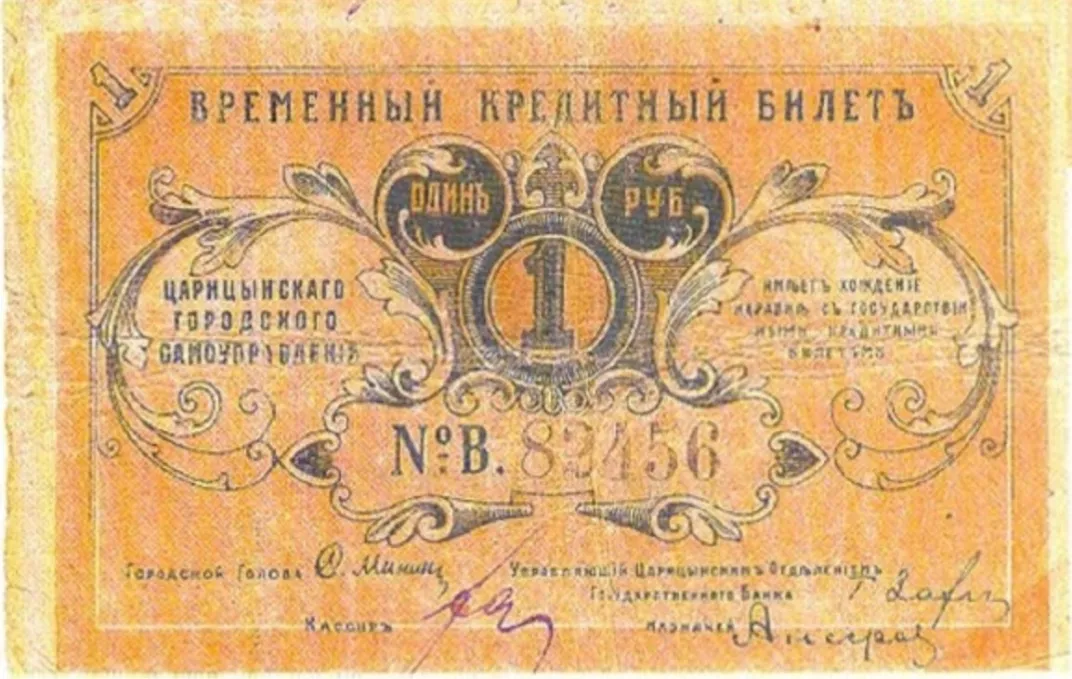
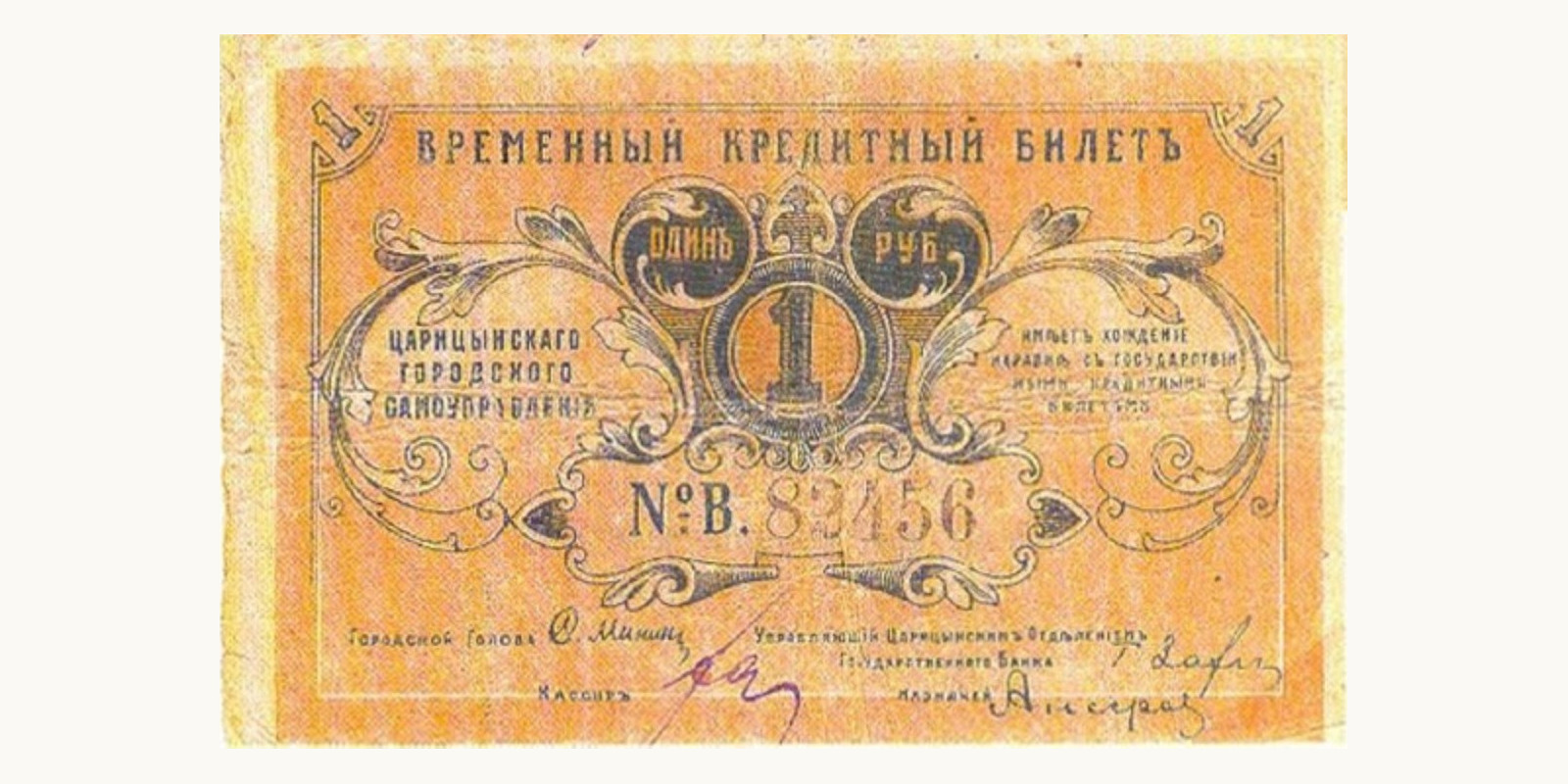
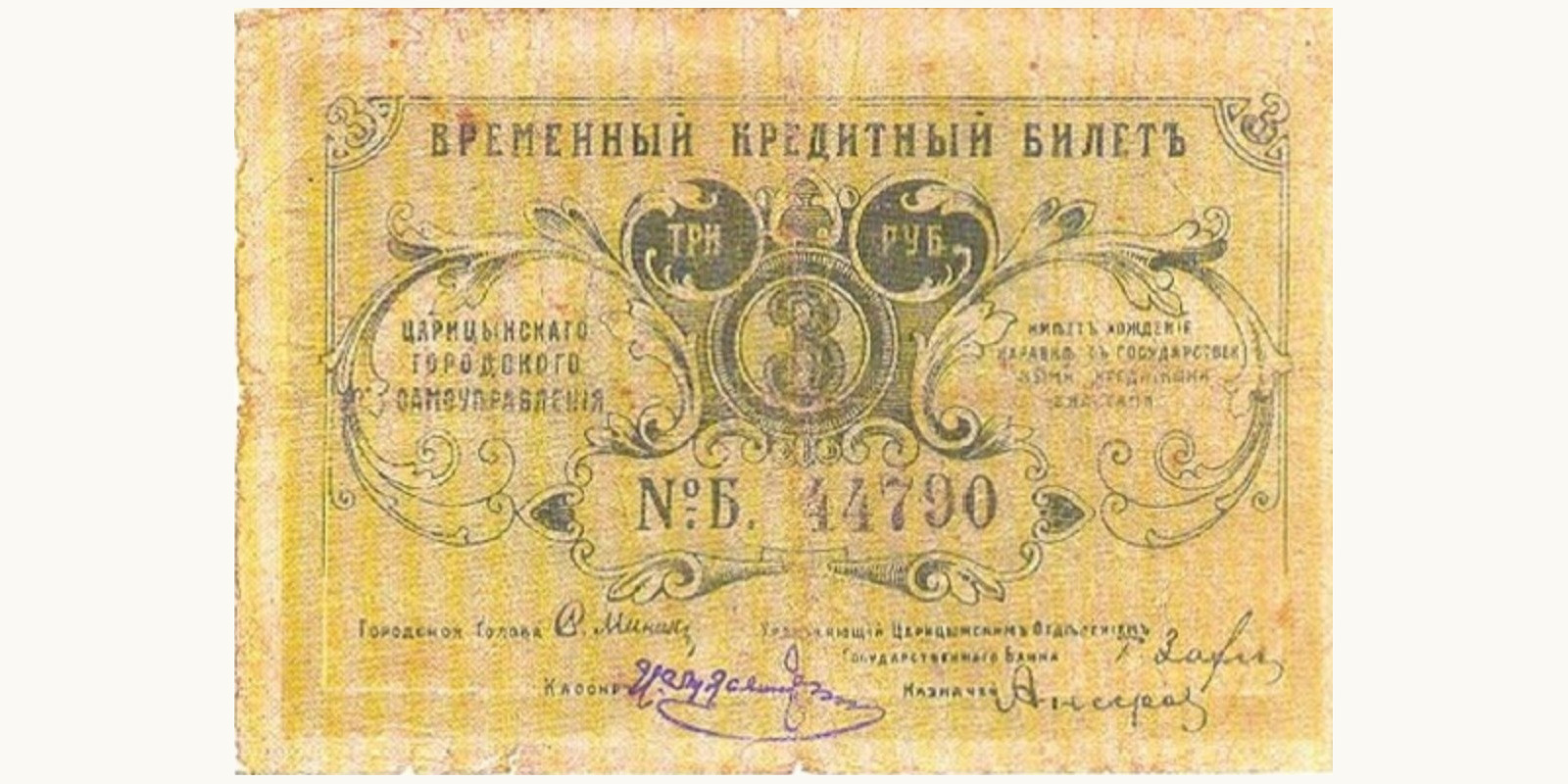
The notes were officially designated as "temporary credit notes" (vremennye kreditnye bilety) — a terminology that echoed official government currency language while making clear their provisional, local character. They were issued in five denominations: 1, 3, 5, 25, and 100 rubles, covering a practical range from small everyday transactions to larger payments.
Production was practical rather than sophisticated. The notes were printed on plain white paper without watermarks. The year of issue was not indicated on the notes — an omission that has contributed to the long-standing cataloguing error placing them in 1918 rather than 1917. The emblems of the Provisional Government (the Imperial eagle stripped of its crown and regalia) were absent, a pointed political statement given that official Russian currency of the period was required to carry this symbol.
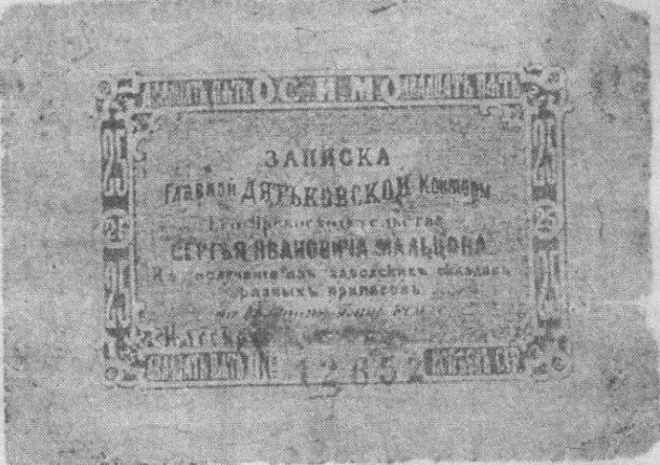
The design of the front face incorporated the denomination, ornamental design elements, text, signatures, series letter, and serial number. The reverse carried the denomination, ornamental elements, and text. While modest by the standards of professionally engraved national currency, the notes were functional and recognizable as official municipal instruments.
Crucially, the notes bore the signature of Minin himself. This personal endorsement — highly unusual for a municipal emergency currency — is what gave rise to the popular name. The mininki were Minin's money, signed by his hand, issued on his authority. For the workers and soldiers of Tsaritsyn who trusted him, that was sufficient guarantee.
The Arrest of Minin and the General Strike
The Provisional Government's punitive detachment under Colonel Korvin-Krukovsky moved to suppress the Bolshevik leadership. Minin and several other leading Bolsheviks were arrested. It appeared, briefly, that the central government had reasserted control.
But the popular response was immediate and decisive. The workers of Tsaritsyn launched a general strike. And the soldiers of the 141st Infantry Regiment, garrisoned in the city, added their voices to the demand for the prisoners' release. Faced with this combination of labor action and military pressure, Korvin-Krukovsky's detachment was forced to release Minin and the other arrested Bolsheviks.
This episode is significant not only as a dramatic moment in the mininki's story but as a microcosm of the broader political dynamics of Russia in October 1917. Across the country, the authority of the Provisional Government was evaporating in the face of Bolshevik organization, working-class solidarity, and the sympathies of rank-and-file soldiers. Tsaritsyn was one city among many where these forces were visibly at work, and the mininki — financial instruments born of this confrontation — bear the marks of the struggle in their very existence.
Within weeks of these events, the October Revolution brought the Provisional Government to an end across Russia. The mininki, issued in defiance of that government, were now simply local emergency notes in a country whose central financial system had been transformed.
Post-Revolution Circulation: The Mininki After October 1917
After the October Revolution, the mininki continued to circulate in Tsaritsyn and, according to some accounts, in the surrounding districts. They were used alongside the many other categories of currency in circulation at the time: old Imperial notes, Provisional Government issues, early Soviet notes, and various other local and regional instruments.
The wear condition of surviving mininki tells this story clearly. Notes of the lower denominations — 1, 3, and 5 rubles — are frequently encountered in heavily worn condition, reflecting substantial circulation through many hands over an extended period. Higher denomination notes of 25 and 100 rubles show somewhat better average preservation, consistent with less frequent hand-to-hand exchange.
This pattern of wear is itself historically informative. The small denomination mininki circulated intensively, used for everyday purchases in the markets, factories, and shops of Tsaritsyn during the chaotic months that followed the revolution. They were practical instruments of daily life, not ceremonial documents.
The period of their circulation likely extended through the early phase of Soviet power in Tsaritsyn, until a sufficient supply of centrally issued Soviet currency made local emergency notes redundant. At that point, the mininki were gradually withdrawn from use, though the precise date of their formal demonetization is not well documented in the surviving records.
The Cataloguing Error: Why 1917, Not 1918
One of the most interesting aspects of the mininki is the persistent cataloguing error that has placed them in 1918 rather than their correct year of issue, 1917. Both of the major reference catalogs of Russian and Soviet paper money — those of F. Chuchin and N. Kardakov — list the Tsaritsyn municipal notes in the section covering Crimea and southeastern Russia, and both assign them a date of 1918.
The error is understandable in origin. The notes themselves bear no year of issue — a consequence of the circumstances of their production, which did not allow for such niceties as accurate dating. Without an explicit date on the note, cataloguers working from the physical evidence alone had to estimate based on context. The general wave of local and municipal currency issues in Russia peaked in 1918, and it was natural for researchers to place undated notes from that period within that framework.
But the historical record, including contemporary accounts of the confrontation between the Tsaritsyn Bolsheviks and the Provisional Government, clearly establishes that the mininki were issued in autumn 1917. The political context — the financial blockade by the Provisional Government, the punitive mission of Korvin-Krukovsky, the arrest and release of Minin — all took place before the October Revolution, not after it.
This distinction matters for collectors and historians alike. A note issued in defiance of the Provisional Government in October 1917 is a different historical artifact from a note issued in the post-revolutionary chaos of 1918. The mininki's correct date places them in the very moment of revolutionary transition — not in its aftermath.
Sergei Minin: The Man Behind the Notes
The man whose name the notes bore — Sergei Konstantinovich Minin — had a career that extended far beyond the Tsaritsyn episode. Understanding his subsequent history adds depth to the mininki as historical artifacts.
Born in 1882, Minin joined the Bolshevik faction of the Russian Social Democratic Labour Party in 1905, during the first revolutionary wave. By 1917 he was an experienced underground organizer and was serving as chairman of the Tsaritsyn Bolshevik committee and as elected city mayor. His personal authority was central to both the issuance of the mininki and the political mobilization that secured his release after arrest.
After the October Revolution, Minin rose to significant positions in the new Soviet state. He served as a member of the Revolutionary Military Council (Revvoensovet) of the North Caucasus Military District, the 10th Army, and the First Cavalry Army — the famous Konarmiya of the Civil War. He also served as a member of the collegium of the People's Commissariat of Internal Affairs (NKVD).
Following the Civil War, Minin moved into political and educational work. He directed political work in the armed forces of Ukraine, served as an assistant to Mikhail Frunze, and simultaneously held membership in the Central Committee of the Communist Party of Ukraine. In 1923 he served in Leningrad as rector of both the Communist University and the State University, and was a member of the Northwestern Bureau of the Central Committee of the All-Union Communist Party.
From 1927 Minin was ill and no longer active. He died in Moscow on January 8, 1962 — living long enough to see Tsaritsyn renamed Stalingrad and then Volgograd, the city where, decades earlier, his signature on small paper notes had been the guarantee of emergency municipal currency.
Physical Description and Collector's Guide
For collectors approaching the mininki, a clear understanding of the physical characteristics of authentic examples is essential.
The notes were issued in five denominations: 1, 3, 5, 25, and 100 rubles. They are printed on plain white paper without watermarks — a deliberate or practical decision that distinguishes them from official government currency of the period. No year of issue appears on any denomination.
The front (obverse) of each note carries the denomination in prominent numerals, ornamental design elements typical of early twentieth century Russian note design, text identifying the notes as temporary credit notes of the Tsaritsyn city administration, the series letter, and the serial number. The signatures present on the notes include that of Minin himself — the key feature giving rise to the popular name.
The reverse carries the denomination, additional ornamental elements, and text. The absence of the Provisional Government eagle emblem — present on official Russian currency of the period — is a significant identifying feature and a deliberate political statement.
Condition varies considerably. Small denomination notes (1, 3, and 5 rubles) are commonly found in heavily circulated condition, reflecting their intensive use in everyday commerce. The 25- and 100-ruble notes are generally found in somewhat better average condition, though well-worn examples exist across all denominations.
The notes are not considered rare within Russian Civil War era notgeld collecting — they are well represented in collections and appear regularly at specialist auctions and in dealer stocks. However, examples in very fine or better condition, particularly for the lower denominations, are meaningfully scarcer than average circulated examples.
Historical Significance: Revolutionary Money
The mininki stand apart from most Russian emergency currency issues of the 1917-1921 period by virtue of their political character. Most private and municipal emergency notes of this era were purely practical responses to the shortage of official small change — apolitical instruments of commerce issued by shopkeepers, hoteliers, and local governments simply trying to keep trade flowing.
The mininki were something different. They were issued as a direct counter-move in a political and economic confrontation between the Bolshevik-controlled city government and the Provisional Government of Russia. Their issuance was an assertion of local sovereignty. Their bearing of Minin's personal signature was a declaration of who held real power in Tsaritsyn. Their design — specifically the deliberate omission of the Provisional Government's eagle — was a statement of political allegiance.
In this sense, the mininki are not merely numismatic curiosities. They are primary historical documents of the revolutionary transition of 1917. They were printed and issued at a moment when the old order was visibly failing and a new one was asserting itself through exactly the kind of local, practical actions that the mininki represent.
For collectors of Russian history as much as for collectors of Russian banknotes, the mininki offer a tangible connection to one of the most dramatic episodes in modern history. Holding a worn 1-ruble mininki is holding an object that passed through the hands of Tsaritsyn factory workers in the autumn of 1917, in the weeks around the October Revolution — money that bore the name of the man who would shortly join the Revolutionary Military Council of the Civil War armies.
| Issuer | Tsaritsyn City Duma, under Bolshevik administration |
|---|---|
| Year of Issue | 1917 (catalogues incorrectly list 1918) |
| Denominations | 1, 3, 5, 25, and 100 rubles |
| Official Name | Temporary Credit Notes (Vremennye Kreditnye Bilety) |
| Popular Name | Mininki (after Sergei Minin) |
| Material | Plain white paper, no watermarks |
| Year Printed on Note | None |
| Government Emblem | Absent (deliberate omission of Provisional Government eagle) |
| Key Feature | Personal signature of S.K. Minin |
| Political Context | Issued in defiance of the Russian Provisional Government |
| Post-Revolution Circulation | Continued in Tsaritsyn and surrounding districts |
| Condition of Low Denominations | Commonly heavily worn due to intensive circulation |
| Rarity | Not rare; well represented in collections |
| Named After | Sergei Konstantinovich Minin (1882–1962), Bolshevik revolutionary |
| Cataloguing Error | F. Chuchin and N. Kardakov catalogs incorrectly date the issue to 1918 |
What are the mininki?
The mininki are emergency banknotes issued by the Tsaritsyn city council in autumn 1917, under the effective control of Bolshevik leader Sergei Minin. Issued in denominations of 1, 3, 5, 25, and 100 rubles, they were nicknamed after Minin because they were issued on his authority and bore his personal signature.
Why were the mininki issued?
The Provisional Government in Petrograd cut off financial support to Tsaritsyn in an attempt to undermine the Bolshevik-controlled city administration. To overcome this economic blockade, the city duma issued its own emergency currency, allowing the local government to continue paying workers and soldiers and maintaining urban administration.
Are the mininki rare?
No — they are considered relatively common within Russian Civil War era emergency currency and appear regularly in specialist collections and auctions. However, examples in very fine or better condition, especially in lower denominations, are significantly scarcer than average circulated examples.
Why do some catalogs say 1918?
Major reference catalogs by Chuchin and Kardakov incorrectly assign the mininki to 1918. The notes themselves bear no date, which led early cataloguers to place them within the general 1918 wave of local currency issues. Historical records clearly establish that they were issued in autumn 1917, before the October Revolution.
What makes the mininki politically significant?
Unlike most emergency currency of the period, the mininki were a deliberate political act — issued in direct defiance of the Provisional Government, bearing the signature of the local Bolshevik leader, and specifically designed without the Provisional Government's official eagle emblem. They are among the very few pieces of emergency currency that can be described as genuinely revolutionary.
Who was Sergei Minin?
Sergei Konstantinovich Minin (1882–1962) was a professional Bolshevik revolutionary, party member since 1905, and chairman of the Tsaritsyn Bolshevik committee in 1917. After the revolution he served in the Revolutionary Military Councils of several Civil War armies, held senior Soviet administrative posts, and later worked in higher education in Leningrad. He died in Moscow in 1962.
What happened to Minin after he was arrested?
Colonel Korvin-Krukovsky's punitive detachment arrested Minin and other Bolshevik leaders, but a general strike by Tsaritsyn workers and pressure from the soldiers of the 141st Infantry Regiment forced the detachment to release all the arrested men.
How can I identify authentic mininki?
Key features include plain white paper without watermarks, no year of issue printed on the note, absence of the Provisional Government eagle emblem, and the presence of Minin's signature. The five denominations are 1, 3, 5, 25, and 100 rubles. Small denomination notes are typically found in heavily worn condition due to intensive circulation.
Related Articles