History of Ukrainian Paper Money 1917–1920: Banknotes of a Nation in Revolution
The Birth of Ukrainian Paper Currency: Why 1917 Changed Everything
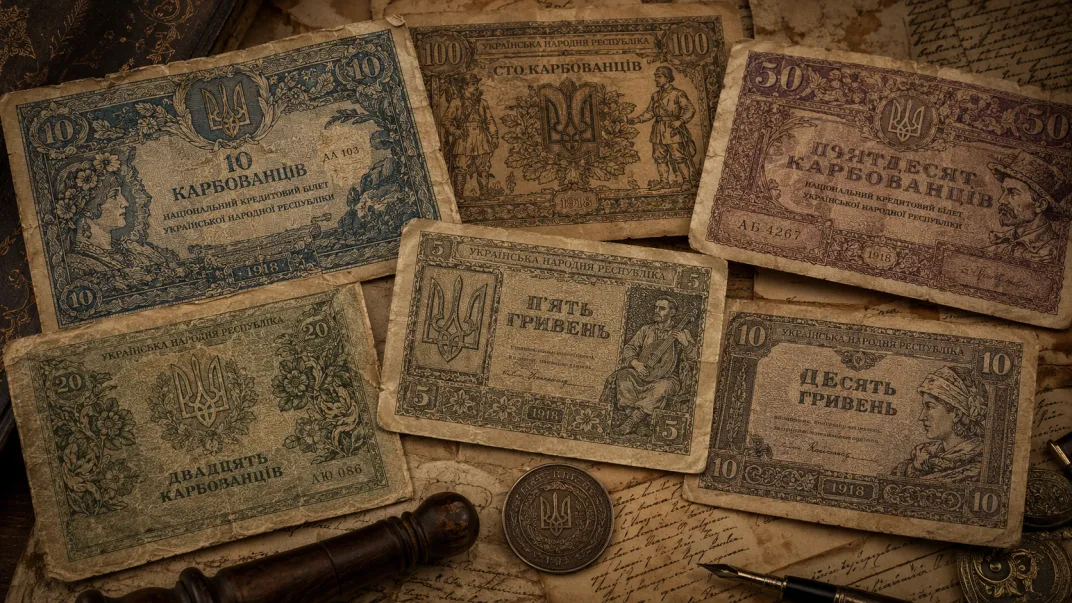
Few episodes in monetary history are as dramatic as the emergence of Ukrainian paper money between 1917 and 1920. In the space of just three years, a newly asserting nation produced over twenty distinct paper denominations, cycling through three successive governments, all while enduring revolution, foreign occupation, and civil war. These banknotes were not simply tools of commerce. They were declarations of sovereignty, works of art, and ultimately fragile witnesses to a state struggling to survive.
Before 1917, Ukraine had no currency it could genuinely call its own. The monetary history of the territory was dominated by Russian imperial rubles and the administrative structures of the tsarist empire. Ukrainian coins of any kind were rare historical curiosities: the medieval coins of Kyivan prince Volodymyr Olgerdovych in the fourteenth century, and the so-called Sevsk cheky minted for Ukraine in 1686–1687, represented the entirety of what collectors could point to as distinctly Ukrainian. The twentieth century had produced nothing. So when the political earthquake of 1917 arrived, the question of national currency was not merely a financial matter but a profoundly symbolic one.
The February Revolution of 1917 and the subsequent formation of the Central Rada in March opened a window of possibility. Initially, the Rada's ambitions were limited: the goal was autonomy within a federal democratic Russian republic, not full independence. In that context, a separate currency made no sense. But as the political situation deteriorated through the summer and autumn, the young Ukrainian government was forced to confront the question of full sovereignty head-on. By December 1917, weeks before the Fourth Universal would formally proclaim independence in January 1918, the Central Rada had already passed a temporary law authorizing the issue of state credit notes. Ukraine was about to print its own money.
The First Emission: Karbovanets and the Central Rada
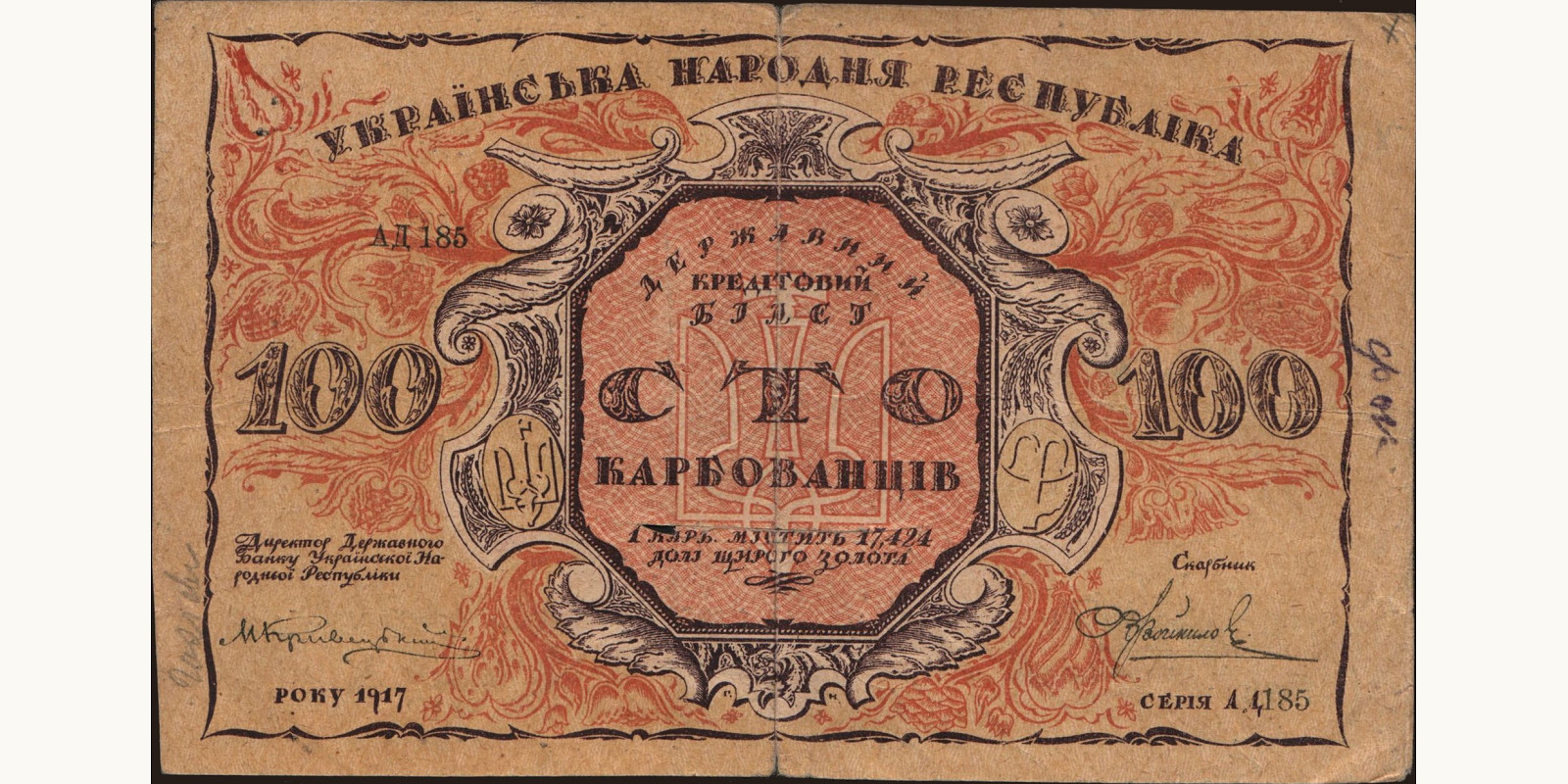
The first Ukrainian paper money entered circulation on December 24 or 26, 1917 (January 5 or 7, 1918, by the new calendar). The denomination chosen was 100 karbovanets — a word derived from an old term for a notch cut into a stick used as a primitive counting tool, giving it an almost folkloric resonance. The total authorized emission was set at 500 million karbovanets.
These first notes, popularly nicknamed "horpynky" by Kyiv residents — after the embroidered aprons known locally by that name, whose decorative patterns resembled the ornamentation on the banknote — were an immediate success. They circulated at parity with Russian rubles, and some economists of the time believed that without the artificial peg to the ruble, the Ukrainian karbovanets might even have traded at a premium. For collectors of paper money today, the 100 karbovanets note of this first emission holds an honored place as the foundational artifact of Ukrainian currency history.
The artistic dimension of these first notes deserves particular attention. As early as the summer of 1917, Mykhailo Hrushevsky had announced a competition for the best designs for Ukrainian paper money. The participants included some of the most significant Ukrainian artists of the era: Heorhii Narbut, Anton Seredа, H. Zolotov, O. Krasovsky, and M. Romanovsky. Among the proposed symbols for the national emblem were a trident with a cross, an image of a Cossack with a musket, and even a swastika — the latter a traditional folk motif at the time, well before it was irrevocably associated with Nazism. Narbut, who had devoted extensive study to ancient coins and heraldic traditions, chose the trident with a cross. That symbol appeared on the face of the first Ukrainian banknotes.
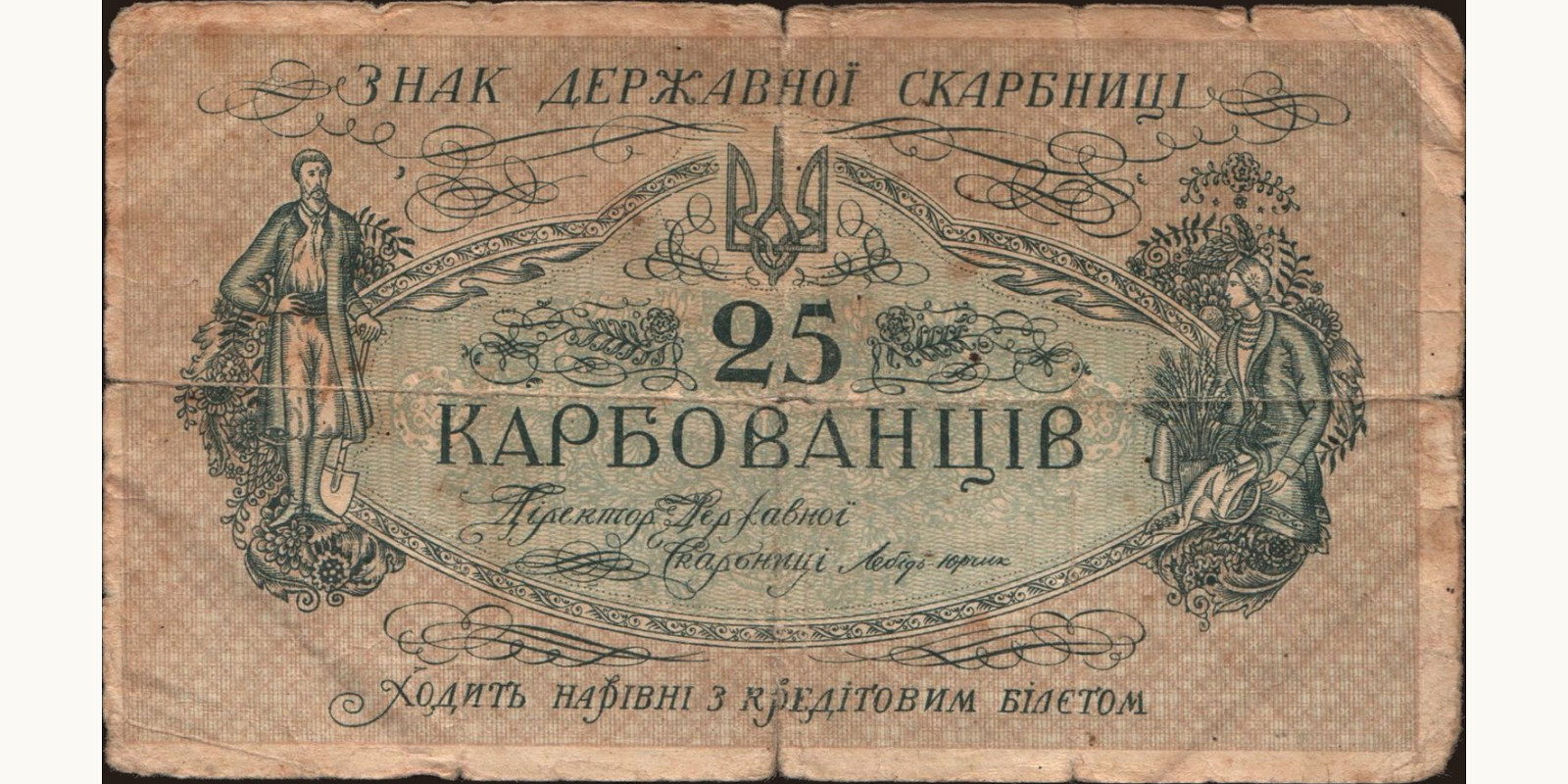
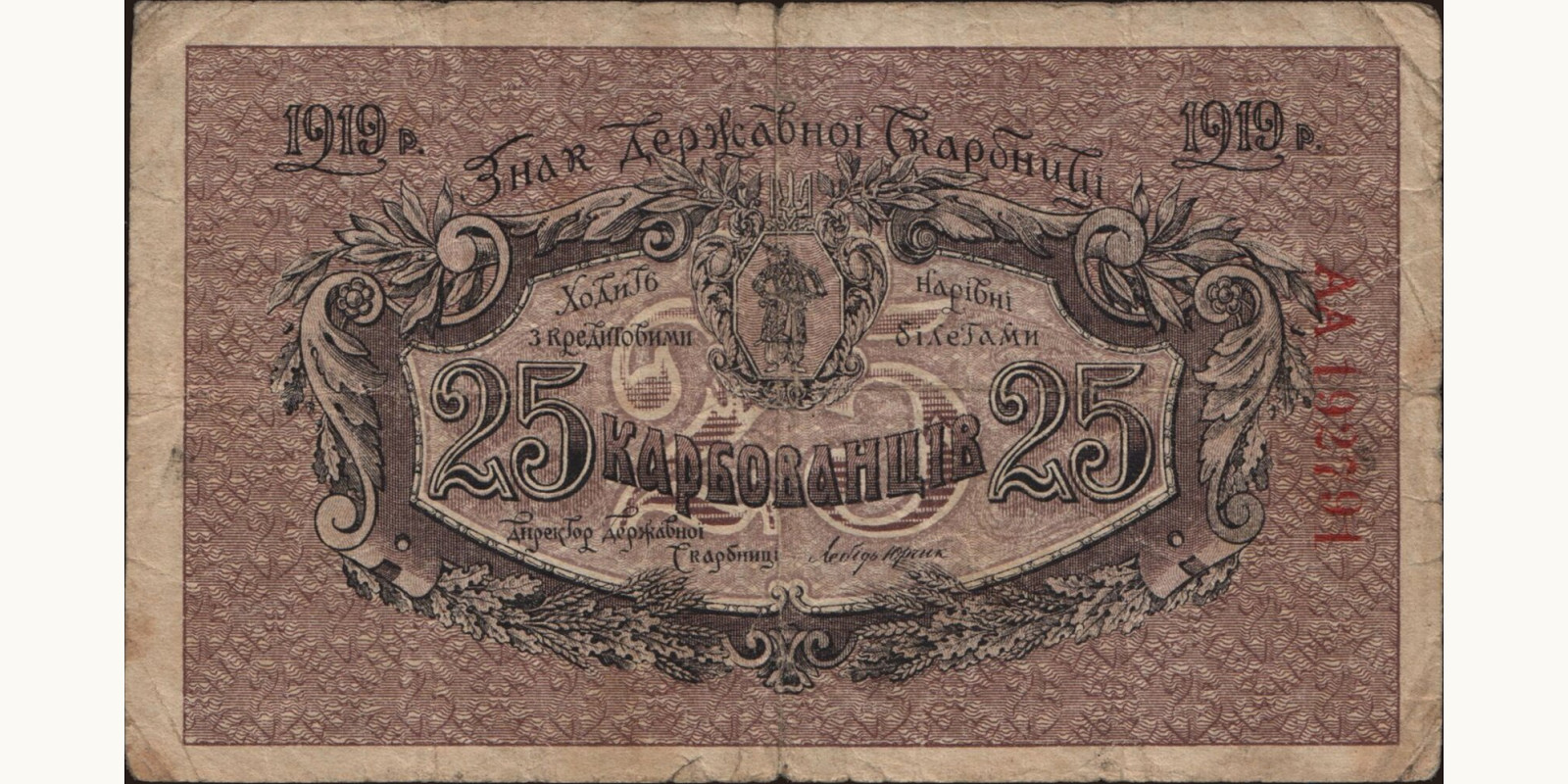
A second emission by the Central Rada followed from April 6, 1918 onward, after the signing of the Treaty of Brest-Litovsk and the Rada's return to Kyiv on March 1. The Ukrainian State Bank began printing temporary settlement notes to address an acute shortage of currency, with denominations of 100, 200, 400, 500, and 1000 karbovanets, printed on high-quality paper with watermarks. A law of March 30, 1918 also authorized notes of 5, 10, 25, and 50 karbovanets, though the 5 and 10 karbovanets notes were never actually issued. The 25 karbovanets note entered circulation on April 6, while the 50 karbovanets — nicknamed "lopatky," meaning small shovels — appeared later.
The Hetmanate Period: German Presses and the Hryvnia
The Central Rada's days were numbered. On April 29, 1918, a congress of landowning farmers, organized with German and Austrian backing, elected Pavlo Skoropadsky as Hetman of Ukraine. He promptly dissolved the Rada and proclaimed the Ukrainian State. On May 31, 1918, Skoropadsky issued a decree introducing a new monetary unit: the hryvnia.
The hryvnia notes were not printed in Ukraine. They had been ordered from Germany while the Central Rada was still in power, and printing continued in Berlin under the new government. The first hryvnia banknotes appeared on August 5, 1918, in a form that was somewhat unusual: they were issued as 3.6 percent bonds of an internal state loan, designated "Bills of the State Treasury," in denominations of 50, 100, 200, and 1000 hryvnias. Each bill was printed with eight coupons — four on each side. The artistic designs were again the work of Heorhii Narbut, who had produced sketches during the Rada period.
The Hetmanate government found itself inheriting not just the Rada's artistic legacy but its financial chaos. Ukraine had no functioning budget. All state institutions operated on debt. Administrative costs rose without restraint. The printing press became the government's primary financial instrument, and the resulting expansion of the money supply drove severe inflation and price increases. Despite the large quantities of notes in print, physical cash was scarce in circulation, because disrupted communications and goods shortages caused money to accumulate in rural areas rather than flowing through the economy.
By October 1918, the first consignments of German-printed hryvnias began arriving in Ukraine. The Kyiv branch of the State Bank began distributing them on October 17, 1918. Six denominations were released simultaneously: 2, 10, 100, 500, 1000, and 2000 hryvnias. Notably, the 1000 and 2000 hryvnia notes bore the official name of the Hetmanate state — "Ukrainska Derzhava" (Ukrainian State) — while the lower denominations still carried the name of the preceding government, "Ukrainska Narodna Respublika" (Ukrainian People's Republic), because their designs had been prepared under the Rada. The designers were Viktor Krychevsky (2 hryvnias) and Heorhii Narbut (10, 100, and 500 hryvnias), with Ivan Mozalevsky responsible for the 1000 and 2000 hryvnia notes.
Under an agreement between Ukraine and Germany, Germany was obligated to produce Ukrainian state credit notes totaling 11,500 million hryvnias by January 1, 1919. The decorative programs of these notes drew extensively on Ukrainian folk art traditions. The 100 hryvnia note featured an oval wreath of Ukrainian vegetables, fruits, and flowers, a trident at the center, a peasant woman in national dress holding a sickle and sheaf on the left, and a worker in an apron holding a hammer wreathed in laurel on the right. The reverse displayed two columns, flowers, and a laurel wreath enclosing a trident. The 500 hryvnia note carried the image of a woman's head symbolizing "Young Ukraine," an allegorical figure that Narbut had previously used on a 30-shahi stamp.
The Directorate: War, Inflation, and the Scattered Presses
The revolutions that swept Germany and Austria-Hungary in November 1918 ended the occupation of Ukraine. The Hetmanate fell in their wake. On the night of November 14, 1918, the Ukrainian Directorate was formed in Bila Tserkva, and within a month it had entered Kyiv. The new ministers of finance — first Vasyl Mazurenko and Borys Martos, later Mykhailo Kryvetsky, then Martos again — faced an impossible financial situation.
The Directorate was fighting simultaneously against Soviet Russia and Ukrainian Soviet forces, and the cost was enormous. The government continued issuing money without any meaningful stabilization of the monetary system. In Kyiv, it relied on reserves of notes printed under both the Central Rada and the Hetmanate, supplemented by Russian rubles, German marks, Austrian crowns, and the local emergency scrip issued by individual towns and villages across Ukraine.
As the military situation deteriorated, the government was forced to move. From Vinnytsia to Ternopil to Stanyslaviv (now Ivano-Frankivsk), the printing operations followed. In Stanyslaviv, 5 hryvnia banknotes were printed in great haste — so hastily that some individual notes omitted the letter "r" from the word "hryvnia." These notes were printed on gray paper with a mushroom watermark.
On August 22, 1919, the Directorate declared Soviet money invalid within the territory of the Ukrainian People's Republic. The next day, Finance Minister Martos and Credit Chancellery director V. Sapytsky issued a decree establishing the official currency order: pre-revolutionary tsarist notes of 100 rubles and below would remain in limited circulation at a reduced exchange rate, alongside postage stamp money and local scrip denominated in kopeks.
In Kamianets-Podilsky, where the Directorate had relocated, notes of 10, 25, 100, 250, and 1000 karbovanets were put into circulation, along with the Stanyslaviv 5 hryvnias. Some of these — the 100, 250, and 1000 karbovanets — were struck from plates prepared under the Skoropadsky government. To maintain the flow of money, the Directorate arranged with the German firm Junkers for aircraft to ferry printed notes regularly from Breslau to Kamianets-Podilsky between June and November 1919.
The 100 karbovanets note of the Directorate period (designed by Narbut) came in two varieties: one on paper with a star watermark, one with a mushroom watermark. On the obverse, an embossed stamp on the blank margin depicted Bohdan Khmelnytsky, earning these notes the popular nickname "bohdanivky." On the reverse: a Cossack with a musket at center, with books in a cartouche to the left and a compass and cogwheel to the right.
One of the most admired notes of the entire period was the 1000 karbovanets designed by Hryhorii Zolotov in the Ukrainian Baroque style, printed in Kyiv and put into circulation on November 13, 1918 in Kamianets-Podilsky, and later in Warsaw in 1920. These notes, popularly called "hetmanky," depicted on the reverse two female figures flanking a trident and the number 1000, with a man holding a hetman's mace on the left and a woman with a cornucopia on the right.
The Soviet Ukraine Trial Issue: The 50 Karbovanets That Never Was
Among the most obscure and debated items in Ukrainian paper money history is the trial issue of 50 karbovanets bearing the name of the Ukrainian Soviet Socialist Republic, dated 1919. This note is documented by so few sources that inexperienced collectors have sometimes questioned whether it really exists.
Its existence is, however, confirmed by the signature on the obverse: that of Narkom (People's Commissar) of Finance M. Lytvynenko. Historical records show that Lytvynenko was appointed to that position by decree of the All-Ukrainian Central Executive Committee on May 12, 1919. This allows the trial production of the note to be dated to the window between May 12 and May 22, 1919 — the latter date being when Lenin's directive telegram arrived at the Ukrainian Sovnarkom.
The face of the note showed a hammer and sickle amid the rays of a rising sun, with the slogan "Workers of all countries, unite!" in both Russian and Ukrainian. Flanking the coat of arms of the Ukrainian SSR — adopted by the Constitution of November 14, 1919 — were a laurel branch and an oak branch. Below the emblem, the large numeral "50" and the denomination in both languages. On the reverse, a worker leaning on a cogwheel, a hammer over his shoulder, stood before a factory backdrop, with an anchor and chain in the foreground — symbolizing the republic's connection to maritime industry.
This trial note never entered circulation. Only a few specimen copies are known to exist, held by private collectors in Ukraine. None are held in state archives.
The End of Ukrainian Currency: Suppression and Legacy
By the close of 1920, the Soviet government had consolidated control over Ukraine. A special decree declared Ukrainian currency illegal tender throughout the territory of the Ukrainian SSR. The enforcement of this decree was far from simple: in some regions, particularly in western Ukraine, hryvnias and karbovanets continued to circulate into 1921. Authorities pursued and penalized those who continued to use them, but the old money persisted wherever the reach of the new state was weakest.
The final accounting of this extraordinary monetary episode is impressive by any measure. From late 1917 to late 1920, Ukrainian authorities issued paper money totaling approximately 19.5 billion hryvnias (equivalent to 9.75 billion karbovanets). Across this period, 24 distinct paper denominations were produced. Despite the financial chaos and hyperinflation that plagued the era, the majority of these notes were designed with remarkable artistry, drawing on Ukrainian folk art, Baroque traditions, and national symbolism. On both international exchanges and domestic markets, the Ukrainian currency maintained a surprisingly respectable position for as long as the state itself held together.
The lesson of 1917–1920 is, in the words of the historian Vitalii Chernoivanenko, that it was not the currency's Ukrainian identity that caused its collapse — it was the collapse of the state itself. The notes lived as long as the republic did, and fell with it. For collectors and historians alike, these banknotes remain among the most evocative physical documents of an era when a nation attempted, against extraordinary odds, to build an independent financial identity.
| First Ukrainian banknote issued | December 1917 (100 karbovanets, Central Rada) |
|---|---|
| Total paper money issued 1917–1920 | approximately 19.5 billion hryvnias |
| Distinct denominations issued | 24 |
| Primary designer of early banknotes | Heorhii Narbut (1886–1920) |
| National symbol chosen for first notes | Trident with cross |
| Nickname for first 100 karbovanets | "Horpynky" (Kyiv slang for embroidered aprons) |
| Printing location for hryvnia notes | Berlin, Germany (ordered via Germany) |
| Hryvnia introduced under | Hetman Pavlo Skoropadsky, May 31, 1918 |
| Notes nicknamed "bohdanivky" | 100 karbovanets of the Directorate (embossed stamp of Bohdan Khmelnytsky) |
| Notes nicknamed "hetmanky" | 1000 karbovanets, Baroque style, designer H. Zolotov |
| Ukrainian currency declared illegal by | Soviet government decree after 1920 |
What was the first Ukrainian paper money denomination?
The first Ukrainian banknote was a 100 karbovanets note issued by the Central Rada in late December 1917 (early January 1918 by the new calendar), nicknamed "horpynky" by Kyiv residents.
Who designed Ukraine's first banknotes?
The principal designer was artist Heorhii Narbut (1886–1920), who chose the trident with cross as the national symbol and designed the 10, 100, 500, and other denominations of the hryvnia series.
What is the difference between karbovanets and hryvnia in this period?
Karbovanets was the unit used during the Central Rada's first emissions (1917–1918) and by the Directorate. Hryvnia was introduced by the Hetmanate of Skoropadsky in 1918 and became the official currency; 1 hryvnia equaled 2 karbovanets.
Why were Ukrainian banknotes printed in Germany?
The Central Rada ordered high-quality banknote production from German printing firms as local facilities lacked the technical capacity for security printing. These orders continued to be fulfilled even after the political change to the Hetmanate.
Are early Ukrainian banknotes valuable to collectors today?
Yes. The 100 karbovanets of the first Central Rada emission, the hryvnia series designed by Narbut, and rare Directorate-period variants are all highly sought by specialist collectors of Eastern European paper money (bonistics).
What caused the collapse of Ukrainian currency?
The primary cause was the loss of statehood. The Soviet government declared Ukrainian money illegal after consolidating control. High inflation driven by wartime money-printing also severely eroded purchasing power during the 1917–1920 period.
Related Articles