Maslyanino “Dorozhki” 1999: Enterprise Currency, Barter Economy and Surrogate Money in Post-Soviet Russia
Introduction: When Companies Printed Their Own Money
The late 1990s in Russia represent one of the most unusual periods in modern monetary history. During this time, not only governments but also private enterprises and local organizations began issuing their own forms of money. Among the most fascinating examples are the “dorozhki” banknotes issued in 1999 by the Maslyanino Road Construction Enterprise in the Novosibirsk region.
These notes were not official currency, yet they functioned as money within a defined economic ecosystem. They were used to pay wages, buy goods and settle obligations. Their existence reflects a deeper structural crisis in the Russian economy, where traditional monetary mechanisms temporarily failed.
The story of Maslyanino “dorozhki” is not just about unusual banknotes. It is about survival, adaptation and the emergence of parallel financial systems in times of economic instability.
The Economic Collapse of the 1990s
After the dissolution of the Soviet Union in 1991, Russia faced a dramatic economic transition. Central planning collapsed, state subsidies disappeared and industries struggled to adapt to market conditions.
Hyperinflation in the early 1990s destroyed savings and undermined trust in the national currency. Prices increased rapidly, and the ruble lost much of its purchasing power. Although inflation was partially stabilized by the mid-1990s, structural problems remained.
One of the most critical issues was the lack of liquidity. Enterprises had assets, products and services, but they did not have enough cash. This created a paradox: economic activity existed, but money circulation was insufficient.
The Rise of the Barter Economy
To cope with the shortage of cash, Russian enterprises increasingly relied on barter and mutual settlements. Instead of paying in money, companies exchanged goods and services directly.
For example, a construction company might provide services to a factory, which in turn supplied materials or products. These transactions were recorded as accounting offsets rather than monetary payments.
While this system allowed businesses to continue operating, it created serious problems. Employees could not be paid properly, and local economies lacked circulating currency for everyday transactions.
This environment created the perfect conditions for the emergence of surrogate money systems.
What Is Surrogate Money
Surrogate money refers to any form of payment that is not official legal tender but functions as money within a specific context. In post-Soviet Russia, such systems became widespread.
These included vouchers, coupons, enterprise-issued notes and regional currencies. They were typically backed by goods, services or internal accounting systems rather than central bank authority.
The Maslyanino “dorozhki” fall into this category. They were created to solve a specific economic problem: the lack of usable cash within a functioning local economy.
The Creation of Maslyanino “Dorozhki”
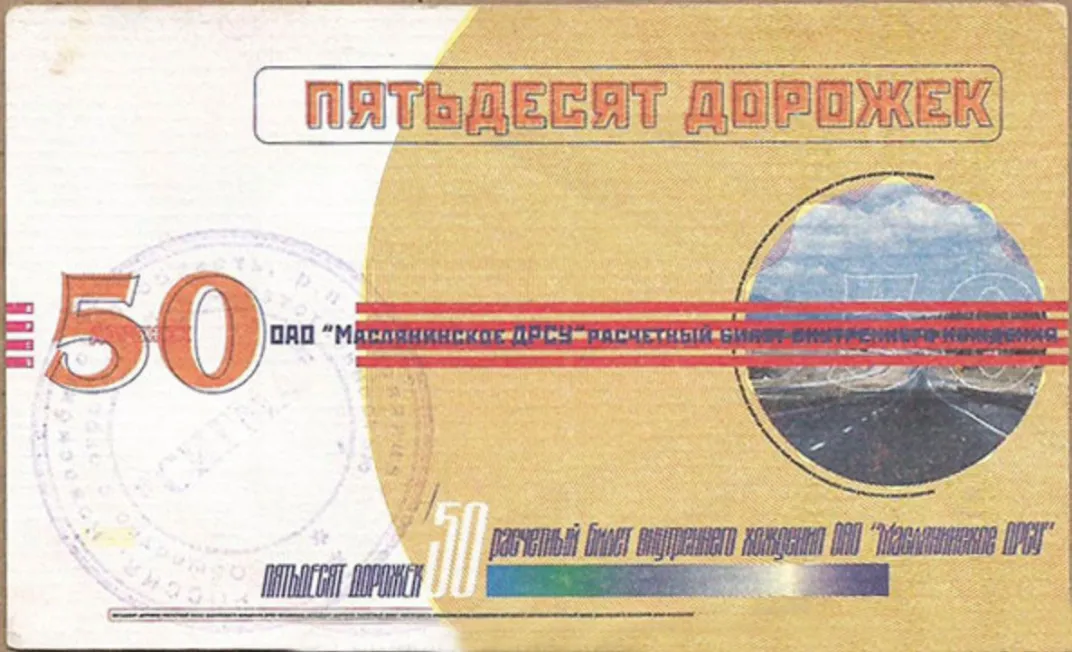
In 1999, the Maslyanino Road Construction Enterprise introduced its own payment instruments known as “dorozhki”. The name itself reflects their origin within the road construction sector.
The notes were issued in denominations of 1, 3, 5, 10, 50 and 100 units. Their total emission reportedly reached significant volumes relative to the size of the local economy.
The decision to issue these notes was driven by practical necessity. Due to widespread accounting offsets, employees were not receiving sufficient cash wages. The enterprise needed a way to restore purchasing power and maintain workforce stability.
By issuing “dorozhki”, the company effectively created its own monetary system.
Circulation and Economic Ecosystem
The success of any currency depends on its acceptance. The “dorozhki” were accepted within a network of facilities controlled or affiliated with the enterprise.
These included shops, fuel stations and food outlets. This created a closed-loop economic system in which the notes could circulate continuously.
In addition, local authorities accepted the notes for certain payments, including taxes. This significantly increased their legitimacy and usability.
The exchange rate was fixed at 1:1 with the Russian ruble, simplifying calculations and encouraging adoption.
Design, Printing and Security
Unlike many other forms of surrogate money, the Maslyanino “dorozhki” were produced with relatively high quality. They were printed in Novosibirsk by a professional printing company.
The notes featured watermarks, microtext and structured layouts. These elements were intended to prevent counterfeiting and enhance credibility.
All denominations shared a consistent design style, with variations in color and numerical value. This standardization made the notes easier to recognize and use.
Interestingly, some circulating notes lacked official signatures, which adds a layer of variation that is now of interest to collectors.
Comparison with Other Local Currencies
Maslyanino was not alone in issuing surrogate currency. Across Russia in the 1990s, hundreds of enterprises and municipalities created similar systems.
However, many of these were poorly designed, limited in circulation or short-lived. The “dorozhki” stand out due to their structured implementation and relatively high production quality.
They can be compared to other well-known cases of local currency, such as municipal coupons or enterprise vouchers. Each example reflects a different approach to solving the same underlying problem: lack of cash.
The 1998 Financial Crisis and Its Impact
The Russian financial crisis of 1998 played a crucial role in the emergence of systems like “dorozhki”. The devaluation of the ruble and the default on government debt destabilized the economy.
Banks collapsed, savings were lost and trust in financial institutions declined sharply. In this environment, local solutions became necessary.
The issuance of enterprise currency was not an anomaly but a rational response to systemic failure.
Daily Life with “Dorozhki”
For workers in Maslyanino, “dorozhki” became part of everyday life. Salaries could be partially paid in these notes, which were then used for purchases within the local network.
This system helped stabilize consumption and maintain economic activity. However, it also limited freedom, as the currency was not widely accepted outside the local area.
Despite these limitations, the system functioned effectively within its intended scope.
Collector Value and Market Interest
Today, Maslyanino “dorozhki” are considered an important part of notaphily. They represent a unique intersection of economic history and monetary experimentation.
Collectors value these notes for their rarity, historical significance and design. Complete sets of denominations are particularly desirable.
Variants, including unsigned notes or specific print runs, can command higher prices in the collector market.
Interest in such items has grown as more collectors focus on emergency and local currencies.
Why These Banknotes Matter Today
The story of Maslyanino “dorozhki” provides valuable insights into how economies adapt under pressure. It demonstrates that money is not just a government-issued instrument but a social agreement.
When official systems fail, alternative forms of money can emerge to fill the gap. These systems may be temporary, but they play a critical role in maintaining economic stability.
For historians, economists and collectors, these banknotes offer a tangible connection to a transformative period in Russian history.
| Year | 1999 |
|---|---|
| Country | Russia |
| Region | Maslyanino, Novosibirsk |
| Type | Enterprise surrogate currency |
| Denominations | 1, 3, 5, 10, 50, 100 |
| Printing | Novosibirsk |
| Exchange Rate | 1:1 RUB |
| Context | Barter economy and liquidity crisis |
What are Maslyanino dorozhki
Enterprise-issued local currency used in 1999
Why were they created
To solve cash shortages in a barter-based economy
Were they legal money
No, but they functioned locally as currency
Where were they accepted
Shops, fuel stations and local services
Are they rare today
Yes, especially full sets and variants
Do collectors value them
Yes, they are important in notaphily
Related Articles