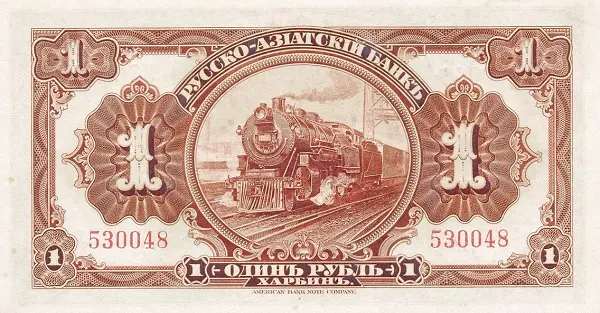
Gunter Reindorff: The Father of Estonian Banknote Art
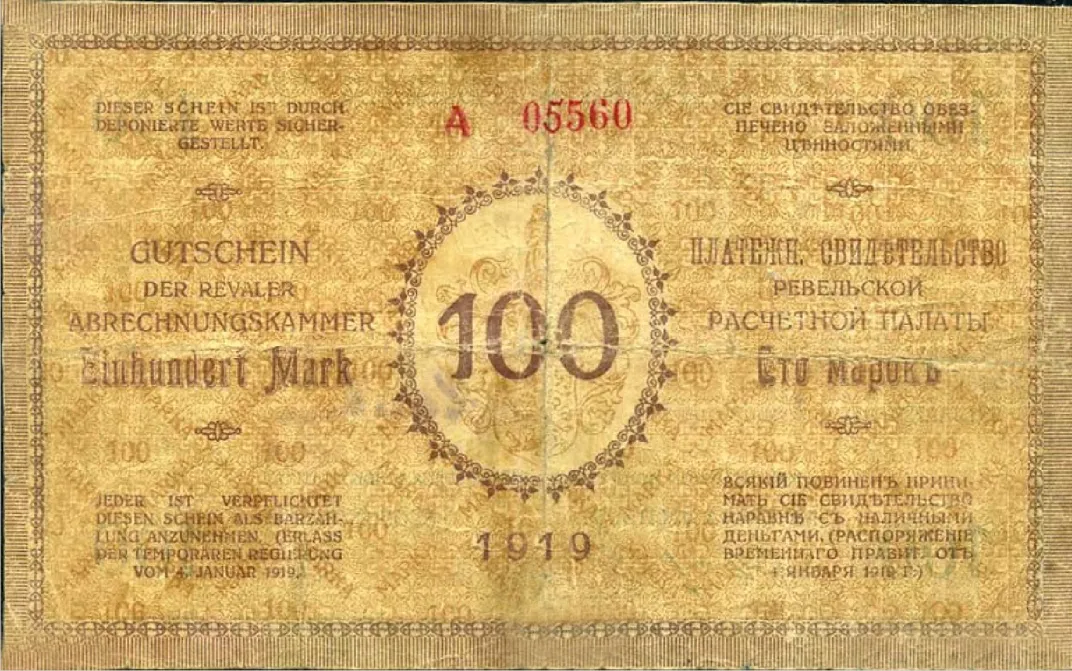
Who Was Gunter Reindorff?
Gunter Friedrich Reindorff was born on January 26, 1889, in Saint Petersburg, Russia. Though he entered the world in one of Europe's great imperial capitals, his life would become inseparably linked to a small nation on the Baltic coast — Estonia. In 1897, when Gunter was just eight years old, his family relocated permanently to Reval, the city that would later be renamed Tallinn. That move defined everything that followed.
Reindorff's artistic journey began in the classical tradition. After completing his early education at a real school in Tallinn, he returned to Saint Petersburg in 1905 to enroll in the prestigious Central School of Technical Drawing, founded by Baron Stieglitz. This school was one of the premier applied arts institutions in the Russian Empire, producing graduates who combined fine art sensibility with technical precision — exactly the skill set needed for banknote design.
Among Reindorff's teachers at the Stieglitz School was Professor P. B. Lambin (1862–1923), a leading figure in applied decorative arts. The training was rigorous and multidisciplinary, covering engraving, illustration, ornamental design, and printmaking. Reindorff graduated with distinction in 1913, earning the right to travel abroad at state expense — a rare honor granted to the school's finest graduates.
Training Across Europe: The Making of a Master
The years 1914 and 1915 found Reindorff in France and Spain, immersing himself in the visual traditions of Western Europe. These were formative years, coinciding with the final flowering of Art Nouveau and the early emergence of Art Deco — movements that would profoundly shape his aesthetic. The decorative architecture of Paris, the grand altarpieces of Madrid, the rhythmic patterns of Catalan modernisme — all left their marks on his developing visual language.
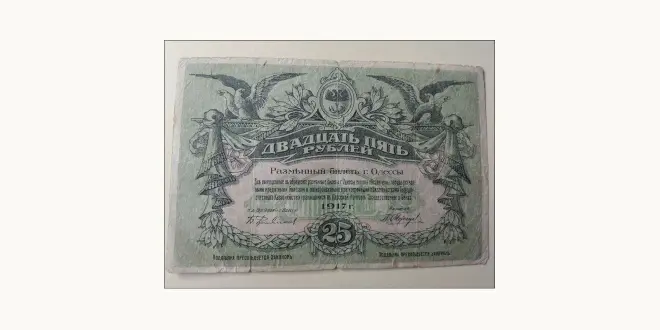
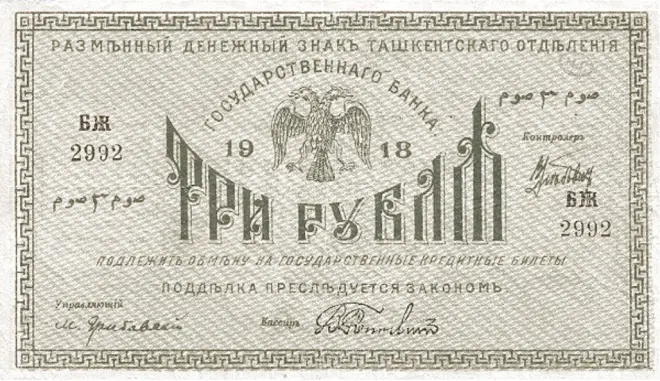
Returning from the continent, Reindorff entered professional practice at the Expedition for the Preparation of State Papers in Petrograd, the central government printing facility responsible for producing Russia's banknotes, stamps, and official documents. He later transferred to the Moscow branch. These were extraordinary years to be working in this field: Russia was collapsing into revolution, and the newly formed Soviet state needed its own visual symbols from scratch.
Reindorff contributed significantly to this effort. He created drafts for the first Soviet banknotes and postage stamps, and participated in designing the first coat of arms of Soviet Russia. This early work in official document design gave him unparalleled technical expertise in the security printing arts — an expertise he would bring back to Estonia when he returned to Tallinn in 1920.
Return to Estonia: Building a National Visual Identity
Reindorff arrived in Tallinn in 1920, the same year Estonia consolidated its independence following the War of Independence against Soviet Russia. The young republic was building its institutions, and visual identity was a crucial part of that project. Currency, in particular, carries enormous symbolic weight: it is the most widely distributed artifact of statehood, passing through every citizen's hands daily.
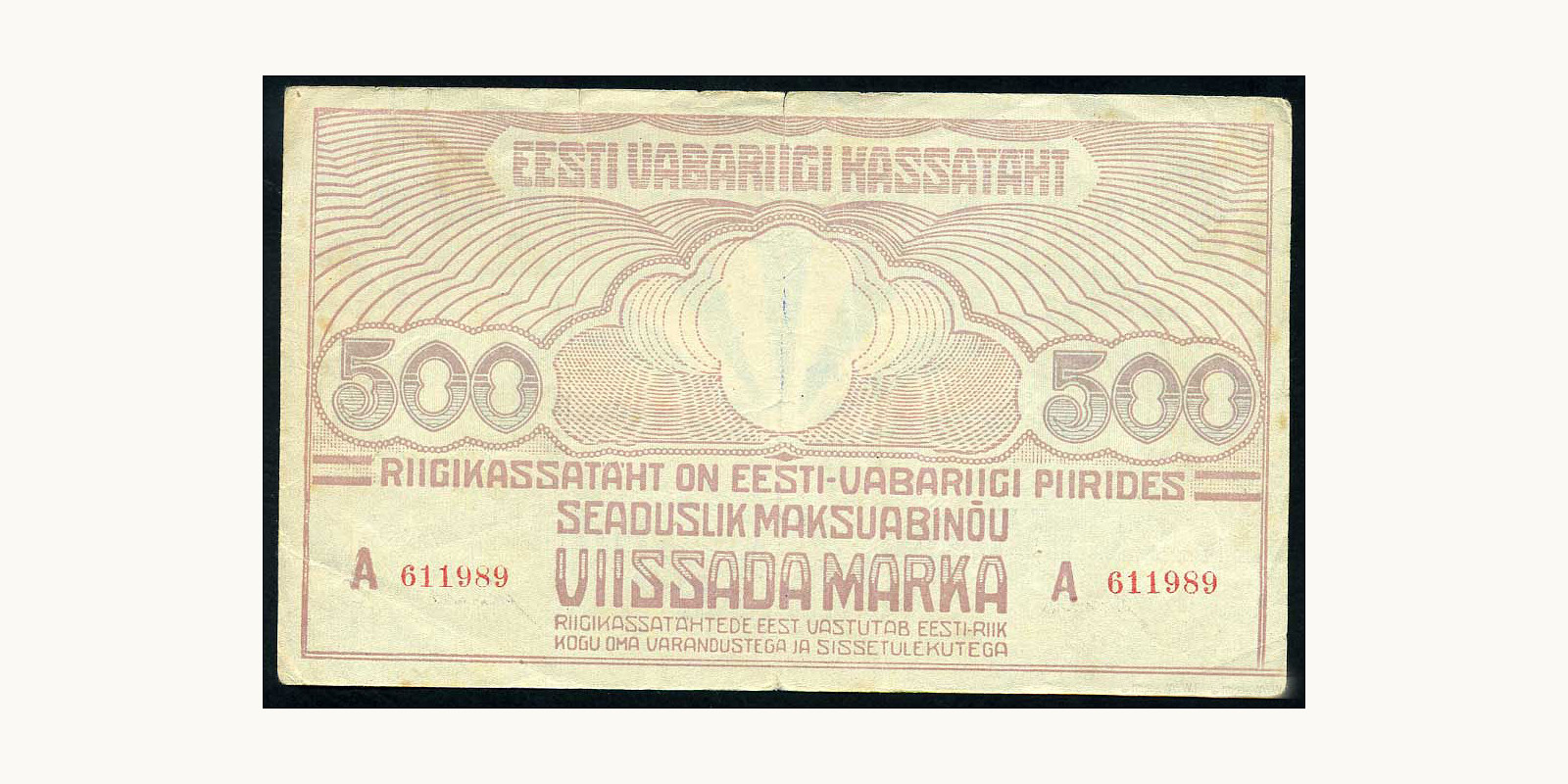
Estonia had issued its first treasury notes in the spring of 1919, designed in part by notable Estonian artists including Kristian Raud (1865–1943) and Nikolai Triik (1884–1940). Reindorff joined this effort and quickly rose to prominence. He took up a teaching position at the Tallinn School of Arts and Crafts, where he trained the next generation of Estonian graphic designers.
From 1922 to 1932, Reindorff served as artistic consultant to the State Printing House, where Estonia's treasury notes were printed. This decade-long appointment placed him at the very center of Estonia's monetary design program. During this period, he also traveled extensively — to Germany, England, Austria, Switzerland, Italy, Sweden, and Finland — studying the banknote traditions and printing innovations of each country and bringing that knowledge back to his work in Tallinn.
The 1926 Competition and the Crown Jewels of Estonian Currency
In 1926, Reindorff entered a national competition for the design of Estonian banknotes and won the First Prize. This victory was not merely symbolic. It led directly to his most celebrated works: the 50-kroon note of 1929, the 20-kroon note of 1932, and the 10-kroon note of 1937. These three banknotes are widely regarded as among the finest examples of graphic art ever produced in Estonia.
The 50-kroon banknote is perhaps the most admired. Its reverse side features a finely rendered panorama of Estonia's northern coastline — the Baltic Sea, dramatic limestone cliffs, pine forests reaching to the shoreline. Reindorff rendered this landscape with the sensitivity of a master printmaker, using subtle tonal gradations and delicate line work to convey the cool, austere beauty of the Estonian north. The scene is not merely decorative; it is a statement about national character — stoic, rooted, quietly magnificent.
The 20-kroon and 10-kroon notes take a different approach, centering on the human figure. They depict idealized Estonian peasants, symbols of the agricultural nation. The 20-kroon note features a female portrait dressed in traditional folk costume, complete with a colorful headdress. She holds a sickle and a sheaf of grain — timeless symbols of harvest and abundance. The 10-kroon note pairs a male shepherd figure with pastoral symbols: a horn, animals, the open land. Both portraits are executed with warmth and dignity, presenting the Estonian people not as subjects but as the true sovereigns of their land.
Art Nouveau, Art Deco, and the Influences That Shaped Reindorff's Style
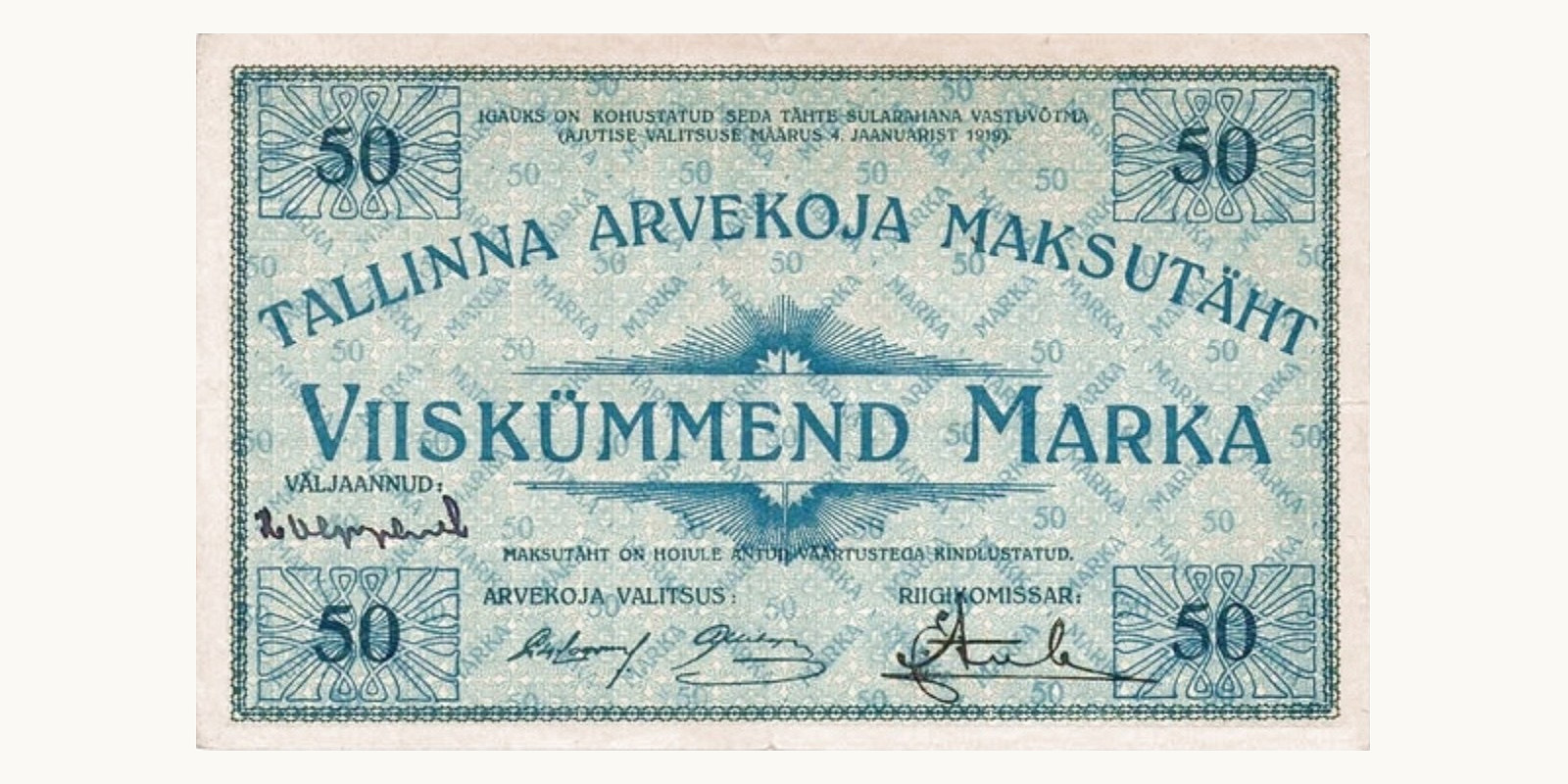
To understand Reindorff's banknotes, one must understand the stylistic currents of his formative years. His visual sensibility was shaped primarily in the 1910s and 1920s, under the twin influences of Art Nouveau and Art Deco — two movements that succeeded each other while sharing a commitment to beauty in applied art.
Art Nouveau, which peaked around 1890–1910, emphasized organic forms, flowing lines, and the integration of fine and decorative arts. It rejected the rigid historicism of Victorian design in favor of natural inspiration: plant forms, waves, the human figure in motion. Reindorff absorbed this tradition at the Stieglitz School, where it was the dominant aesthetic.
Art Deco emerged in the 1920s as a more geometric, streamlined successor to Art Nouveau. It favored bold outlines, symmetry, and a certain monumental quality — all of which translated well into the demanding requirements of banknote design, where images must be legible at small scale, resistant to forgery, and immediately recognizable.
Two specific artists influenced Reindorff deeply: Sergei Chekhonin and Ivan Bilibin. Chekhonin was a leading Soviet graphic designer known for his elegant integration of folk motifs with modernist design — a fusion very much present in Reindorff's peasant portraits. Bilibin was celebrated for his illustrations of Russian folk tales, rendered in a highly stylized, decorative manner that drew on medieval Russian manuscript traditions. Bilibin's use of strong outlines, flat color areas, and ornamental borders is clearly echoed in Reindorff's banknote compositions.
Beyond Banknotes: The Full Scope of Reindorff's Artistic Legacy
Reindorff's contribution to Estonian visual culture extended far beyond banknote design. He was a prolific artist across multiple genres of graphic art, and his output over a career spanning five decades was remarkable in both its volume and its quality.
He designed several series of Estonian postage stamps, bringing the same rigorous aesthetic to the small format of philately. Stamp design presents unique challenges: the image must be instantly readable, symbolically rich, and technically precise enough to survive mass reproduction. Reindorff's stamps are as admired by philatelists as his banknotes are by numismatists.
He created a large number of military insignia and decorations, designing the visual vocabulary of Estonia's armed forces. He also produced many bookplates (ex-libris), a form of graphic art that enjoyed great popularity in early twentieth-century Europe and that allowed artists considerable creative freedom within a small format. His diplomas and advertising sheets demonstrate the same mastery of ornamental composition.
Among his most significant works in book illustration are his drawings for the fairy tales of Alexander Pushkin. These illustrations show Reindorff at his most expressive, deploying the full range of his decorative vocabulary — stylized natural forms, rich ornamentation, evocative figure drawing — in the service of narrative.
Reindorff and the Estonian Landscape: A Deep Visual Bond
Running through all of Reindorff's work — banknotes, stamps, illustrations, landscapes — is a deep and abiding love of the Estonian natural environment. This is not merely topographical description but a kind of visual poetry: the artist's effort to capture the particular emotional quality of a northern Baltic landscape.
The Estonian coastline, as depicted on the 50-kroon banknote, exemplifies this quality. The limestone coastal cliffs known as pank, the dark Baltic sea, the sky heavy with northern light — these elements appear in Reindorff's work with a romantic intensity that elevates documentary accuracy into artistic expression. He was not simply recording a view; he was declaring that this land, with its specific and irreplaceable character, was worthy of the highest artistic attention.
This bond between landscape and national identity was not incidental in the context of the 1920s and 1930s. Estonia was a new nation asserting its existence against the pressures of larger neighbors. The imagery on its banknotes was a form of cultural self-definition: here is our land, our people, our beauty, our distinctiveness. Reindorff gave that assertion its most compelling visual form.
Life Under Soviet Occupation: Adaptation and Honor
Estonia was occupied by the Soviet Union in 1940, and with occupation came a profound transformation of public life. The Estonian kroon was abolished. The banknotes Reindorff had designed with such care became historical artifacts. Yet Reindorff himself managed to continue working and to build a respected career under the new political order.
He continued teaching and creating, adapting his skills to the demands of the Soviet cultural system without abandoning his artistic identity. His career in Soviet Estonia was, in his biographer's words, "quite successful" — a careful formulation that acknowledges both his professional achievements and the compromises that survival in a totalitarian state required.
The honors he accumulated were substantial. He was awarded the title of People's Artist of the Soviet Union, the highest recognition available to a Soviet artist. He held the rank of Professor. He received the Order of the Badge of Honor. He was elected a Corresponding Member of the Academy of Arts of the USSR. These distinctions testify to genuine artistic achievement recognized across political boundaries.
Gunter Friedrich Reindorff died on March 14, 1974, in Tallinn — the city that had been his home for three-quarters of a century, through independence, occupation, war, and occupation again.
The Restoration of Estonian Currency and Reindorff's Enduring Relevance
In the early 1990s, as the Soviet Union collapsed and Estonia moved toward restored independence, the question of currency arose once again. The new Estonian kroon was introduced in 1992, designed by artists Urmas Ploomipuu and Vladimir Taiger. The new notes depicted cultural figures and architectural monuments — a continuation of the tradition that Reindorff had helped establish.
The new generation of designers worked in a different era and with different tools, but they inherited a tradition that Reindorff had shaped. The expectation that Estonian banknotes should be works of art — that they should reflect the nation's landscape, its people, its culture — was established in the designs of the 1920s and 1930s, above all in Reindorff's masterful kroon notes.
Collectors and art historians today regard Reindorff's banknotes as significant documents of Estonian national culture. They appear in major collections of paper money and graphic art alike, valued both as numismatic objects and as examples of the applied arts at their finest. The 50-kroon note of 1929, in particular, is recognized internationally as one of the outstanding banknote designs of the interwar period.
Why Reindorff Matters to Collectors and Art Lovers Today
For collectors of world paper money, Reindorff's Estonian kroon notes represent a compelling combination of rarity, historical significance, and genuine artistic quality. The interwar period (1919–1940) produced some of the most beautiful banknotes ever made, as newly independent nations invested heavily in the visual symbolism of their currencies. Estonia's notes from this era stand among the best of that tradition.
The 50-kroon of 1929 is the most sought-after piece. High-grade examples are increasingly difficult to find, and their value has risen steadily as the sophistication of world paper money collecting has grown. The 20-kroon of 1932 and 10-kroon of 1937 are similarly prized, particularly in the folk-costume portrait designs that so vividly express Estonian national identity.
For art historians, Reindorff represents an important node in the network of early twentieth-century European graphic art. His training at the Stieglitz School in St. Petersburg connected him to Russian decorative traditions; his time in France and Spain connected him to Western European modernism; his work in Soviet Russia placed him at a unique historical moment; and his long career in Estonia made him the central figure in that country's applied arts tradition.
For anyone interested in the intersection of art, history, and national identity, Gunter Reindorff's life and work offer an unusually rich subject. His banknotes are not just monetary instruments — they are portraits of a nation, rendered by an artist of the highest order.
| Full Name | Gunter Friedrich Reindorff |
|---|---|
| Born | January 26, 1889, Saint Petersburg, Russia |
| Died | March 14, 1974, Tallinn, Estonia |
| Education | Central School of Technical Drawing, Baron Stieglitz (graduated 1913) |
| Key Teacher | Professor P. B. Lambin (1862–1923) |
| Artistic Influences | Art Nouveau, Art Deco, Sergei Chekhonin, Ivan Bilibin |
| State Printing Work | Expedition for Preparation of State Papers, Petrograd and Moscow (pre-1920) |
| Return to Estonia | 1920 |
| Consulting Role | Artistic Consultant, Estonian State Printing House (1922–1932) |
| Competition Win | First Prize, Estonian Banknote Design Competition, 1926 |
| Major Banknotes Designed | 50 kroon (1929), 20 kroon (1932), 10 kroon (1937) |
| Other Works | Estonian postage stamps, military insignia, ex-libris, Pushkin fairy tale illustrations |
| Honors | People's Artist of the Soviet Union, Professor, Order of the Badge of Honor, Corresponding Member of the USSR Academy of Arts |
| Category | Banknote Design and Symbolism |
Who designed Estonia's pre-war banknotes?
Gunter Friedrich Reindorff designed the most celebrated Estonian banknotes of the interwar period, including the 50-kroon (1929), 20-kroon (1932), and 10-kroon (1937) notes, after winning the national design competition in 1926.
What artistic style did Reindorff use on Estonian banknotes?
Reindorff worked in a style influenced by Art Nouveau and Art Deco, with additional influence from Russian graphic masters Sergei Chekhonin and Ivan Bilibin. His designs combine romantic naturalism in landscape depiction with stylized, ornamental figure drawing.
What is depicted on the 50-kroon note of 1929?
The 50-kroon note features a finely rendered panorama of Estonia's northern Baltic coastline, including limestone cliffs, pine forests, and the sea, rendered with great sensitivity and romantic intensity.
Why are Reindorff's banknotes significant to collectors?
They represent a rare combination of high artistic quality, historical significance, and the symbolism of a newly independent nation. The interwar Estonian kroon notes are considered among the finest banknote designs of that era worldwide.
Did Reindorff only design banknotes?
No. Reindorff had a wide-ranging career that included Estonian postage stamps, military decorations, bookplates (ex-libris), advertising materials, diplomas, and illustrations for Pushkin's fairy tales.
Where did Reindorff study?
He studied at the Central School of Technical Drawing founded by Baron Stieglitz in Saint Petersburg, graduating in 1913. He also traveled to France and Spain on a state-funded study grant, and worked at state printing facilities in Petrograd and Moscow.
What happened to Reindorff after Soviet occupation of Estonia?
He continued working as an artist and teacher under Soviet rule, ultimately receiving the title of People's Artist of the Soviet Union, the rank of Professor, and membership as a Corresponding Member of the USSR Academy of Arts.
Related Articles