The First Banknotes of Odessa 1917–1918: Emergency Currency and Monetary Crisis
Introduction: Monetary Crisis in Odessa
At the end of 1917, Odessa faced a serious financial problem — a severe shortage of cash. This crisis was part of the broader collapse of the Russian Empire’s monetary system, but in major cities like Odessa it was felt especially strongly.
As revolutionary events unfolded and economic connections were disrupted, the banking system stopped functioning normally. By December 1917, local newspapers were already reporting a shortage of currency and difficulties in financial transactions.
Money existed formally, but in practice it disappeared from circulation. This marked the beginning of what became known as a “money famine.”
Bank Panic and Financial Collapse
Rumors of cash shortages quickly led to panic among the population. People rushed to banks to withdraw their deposits.
However, banks were unable to meet this demand. Private banks limited withdrawals, while state institutions struggled to cope with the volume of requests.
Long queues formed outside banks, and trust in the financial system declined rapidly.
This process only worsened the crisis, as attempts to withdraw money accelerated its disappearance from circulation.
Decision to Issue Local Currency
Faced with a growing crisis, authorities were forced to take action.
The Ukrainian General Secretariat authorized the issuance of local currency. In Odessa, this task was carried out by the Committee of Credit Institutions and the local branch of the State Bank.
Thus, the so-called “small change notes of the city of Odessa” were introduced.
These notes were intended as a temporary solution to restore economic activity.
Organization of the Emission
The issuance process was organized quickly and efficiently.
Local printing houses were used to produce the notes, while financial institutions supervised the process.
To ensure credibility, the new currency was backed by government securities and treasury obligations.
This helped establish a level of trust among the population.
Denominations and Volume
The Odessa notes were issued in several denominations.
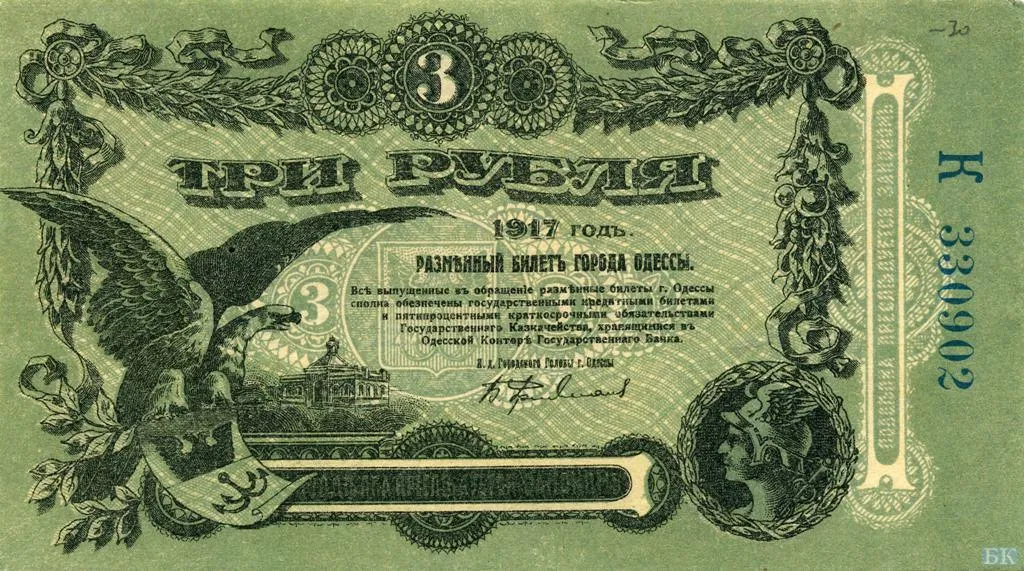
The most common were 3, 5, and 10 rubles.
The total emission reached millions of rubles, helping to ease the shortage of small change.
These denominations were chosen to meet the needs of everyday transactions.
Design of Odessa Banknotes
Odessa banknotes featured detailed and artistic designs.
They included decorative elements, official symbols, and references to the city.
A double-headed eagle was prominently displayed, symbolizing authority.
Architectural motifs, such as city buildings and the stock exchange, were also included.
Different color schemes were used, including green, blue, and red tones.
Security Features
Despite limited resources, certain security elements were incorporated.
These included complex patterns, decorative grids, and official markings.
However, compared to official state banknotes, their security level was lower.
This made them more vulnerable to counterfeiting.
Role in the Local Economy
The introduction of Odessa notes helped stabilize the local economy.
They allowed trade to continue and enabled people to purchase goods and services.
Gradually, these notes were accepted by both citizens and businesses.
Public Trust
Public confidence played a key role in the success of the currency.
Newspapers reported that the population accepted the notes relatively quickly.
However, trust remained fragile and depended on political stability.
Political Instability
The political situation in Odessa was highly unstable.
Frequent changes in authority affected the circulation and acceptance of banknotes.
New governments could introduce their own currency or invalidate existing notes.
Comparison with Other Cities
Odessa was not the only city issuing local currency.
Similar processes occurred in Kiev, Kharkov, and other regions.
However, Odessa notes stand out due to their design and organization.
Collector Value
Today, Odessa banknotes are rare and highly valued by collectors.
Their historical significance and limited survival make them desirable items.
Well-preserved examples are especially valuable.
Conclusion
The first banknotes of Odessa were a response to a deep financial crisis.
They played a crucial role in maintaining economic activity during a period of instability.
Today, they remain important historical artifacts and collectible items.
Key Facts
| City | Odessa |
|---|---|
| Period | 1917–1918 |
| Type | Local currency |
| Denominations | 3, 5, 10 rubles |
| Purpose | Emergency circulation |
FAQ
Why were Odessa banknotes issued?
Due to cash shortage
What denominations existed?
3, 5, 10 rubles
Were they official?
Yes, locally
Are they collectible?
Yes
Related Articles