Odessa 1918 Monetary Crisis: Emission, Inflation and the Collapse of Real Value
Introduction to the Odessa Monetary Crisis
In 1918, Odessa became one of the most striking examples of monetary collapse during the Russian Civil War. The city, once a major commercial and financial hub of the Black Sea region, suddenly found itself without a stable monetary system.
The breakdown of central authority, combined with war, political fragmentation, and supply disruptions, created a situation in which traditional currency could no longer support economic activity.
In response, local authorities initiated large-scale emission of their own banknotes. While this temporarily restored liquidity, it also triggered rapid inflation and fundamentally altered the value of money in everyday life.
This article explores how the emission of Odessa banknotes led to inflation, how prices evolved, and what this meant for the population.
The Collapse of Central Monetary Control
The root of the crisis was the collapse of centralized financial control following the революция.
Before 1917, Odessa relied on the monetary system of the Russian Empire, which provided a relatively stable currency supply. However, as state institutions disintegrated, the flow of official banknotes stopped.
Banks could no longer receive new funds, and existing currency began to disappear from circulation. Citizens, fearing uncertainty, started hoarding money, further reducing liquidity.
This created a paradox: money existed, but it was no longer available for economic use.
Initial Emission of Odessa Banknotes
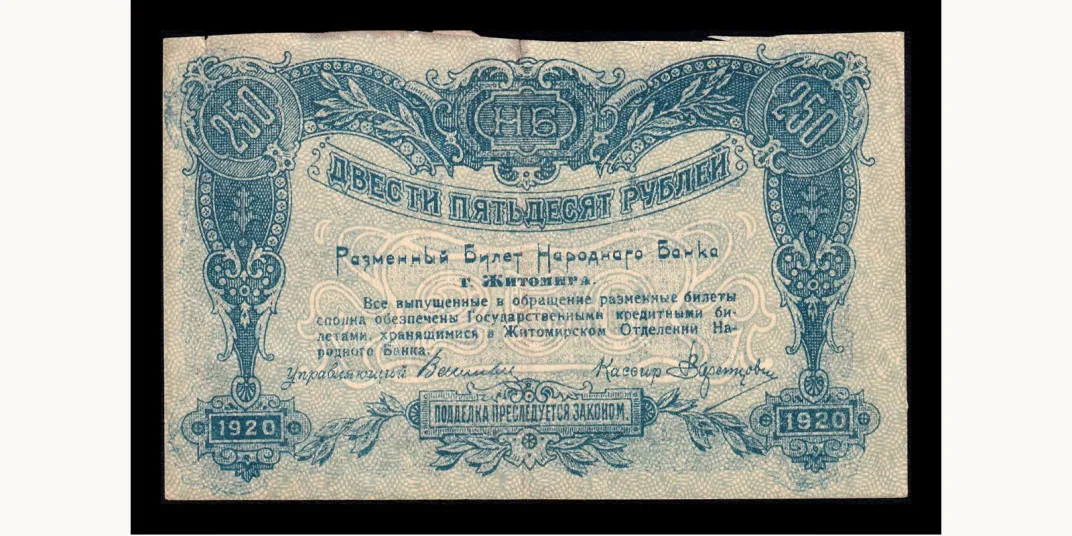
To address the growing cash shortage, Odessa authorities introduced local banknotes known as “Razmennye bilety.”
The first emission, conducted in early 1918, amounted to approximately 5,000,000 rubles. At this stage, the goal was to provide sufficient liquidity for everyday transactions, especially small payments.
However, this initial emission quickly proved insufficient. The scale of economic disruption required far larger volumes of currency.
Rapid Expansion of Money Supply
Within months, the volume of issued currency increased dramatically.
By March 1918, the amount of Odessa banknotes in circulation had already reached millions of rubles.
By April, the total emission rose to approximately 43,500,000 rubles, representing an increase of more than eight times compared to the initial issue.
This rapid expansion of money supply was necessary to maintain economic activity but had serious consequences for price stability.
Denominations and Monetary Structure
The structure of the new currency system included a wide range of denominations.
Small denominations, such as 50 kopecks and later 15 and 20 kopecks, were introduced to address the shortage of small change.
Larger denominations, including 25 and 50 rubles, were issued to support trade and larger transactions.
This multi-level system allowed the currency to function across different layers of the economy, from daily purchases to commercial operations.
Competition Between Currencies
Odessa’s local banknotes did not exist in isolation.
They circulated alongside imperial Russian notes, Ukrainian currency, and other regional issues.
This created a complex monetary environment in which multiple currencies competed for acceptance.
In some cases, authorities even restricted the use of certain denominations to stabilize the market.
This competition further destabilized prices and complicated transactions.
The Mechanics of Inflation
The rapid increase in money supply directly contributed to inflation.
As more banknotes entered circulation, the value of each individual unit decreased.
At the same time, the supply of goods was shrinking due to war, transport disruption, and economic breakdown.
This imbalance between money and goods led to a sharp rise in prices.
Inflation in Odessa was not gradual but explosive, with prices changing within weeks or even days.
Real Prices and Purchasing Power
Historical evidence shows how dramatically purchasing power declined.
Goods that were once affordable became increasingly expensive.
Basic food items, including bread, meat, and milk, saw rapid price increases.
In some cases, prices doubled or tripled within a short period.
The real value of money eroded so quickly that holding cash became a risk.
People preferred to spend money immediately rather than save it.
Daily Life During Inflation
Inflation had a profound impact on everyday life.
Citizens faced constant uncertainty, as prices changed unpredictably.
Queues formed not only at banks but also at markets, as people rushed to purchase goods before prices rose further.
Barter became increasingly common, especially for essential goods.
Money was no longer trusted as a stable store of value.
Counterfeiting and Monetary Chaos
Another consequence of rapid emission was the rise of counterfeiting.
The simplified design and limited security features of Odessa banknotes made them vulnerable to forgery.
Reports from the period indicate that counterfeit notes circulated widely.
This further undermined trust in the currency and contributed to economic instability.
Spread of Odessa Currency
Despite its limitations, Odessa currency spread beyond the city.
It was used in neighboring regions and even circulated in cities such as Nikolaev.
This expansion increased its importance but also amplified inflationary effects.
The more widely the currency was used, the greater the pressure on its value.
Attempts to Control the Crisis
Authorities attempted to regulate the monetary system and control inflation.
Measures included limiting emissions and restricting certain banknotes.
However, these efforts were largely ineffective due to lack of centralized control and ongoing economic disruption.
The crisis continued to deepen.
Collector Perspective
For collectors, Odessa banknotes represent a unique case of emergency currency.
Their value lies not only in rarity but also in historical context.
Understanding the relationship between emission and inflation provides deeper insight into their significance.
Different issues and denominations reflect different stages of the crisis.
Conclusion
The monetary crisis in Odessa in 1918 demonstrates how quickly a financial system can collapse when trust, stability, and supply are disrupted.
The large-scale emission of banknotes temporarily solved the problem of liquidity but created a new problem: inflation.
This experience shows the delicate balance between money supply and economic stability.
Today, Odessa banknotes remain a powerful symbol of crisis, adaptation, and economic reality.
| Year | 1918 |
|---|---|
| City | Odessa |
| Initial emission | 5,000,000 rubles |
| Peak emission | 43,500,000 rubles |
| Main issue | Inflation |
Why did Odessa print money?
Cash shortage
Did emission cause inflation?
Yes
Were multiple currencies used?
Yes
Did people trust the money?
Less over time
Related Articles