
10 Mark 1919 — Estonia ( Pick: 46c )
Region:
Europe
Front side
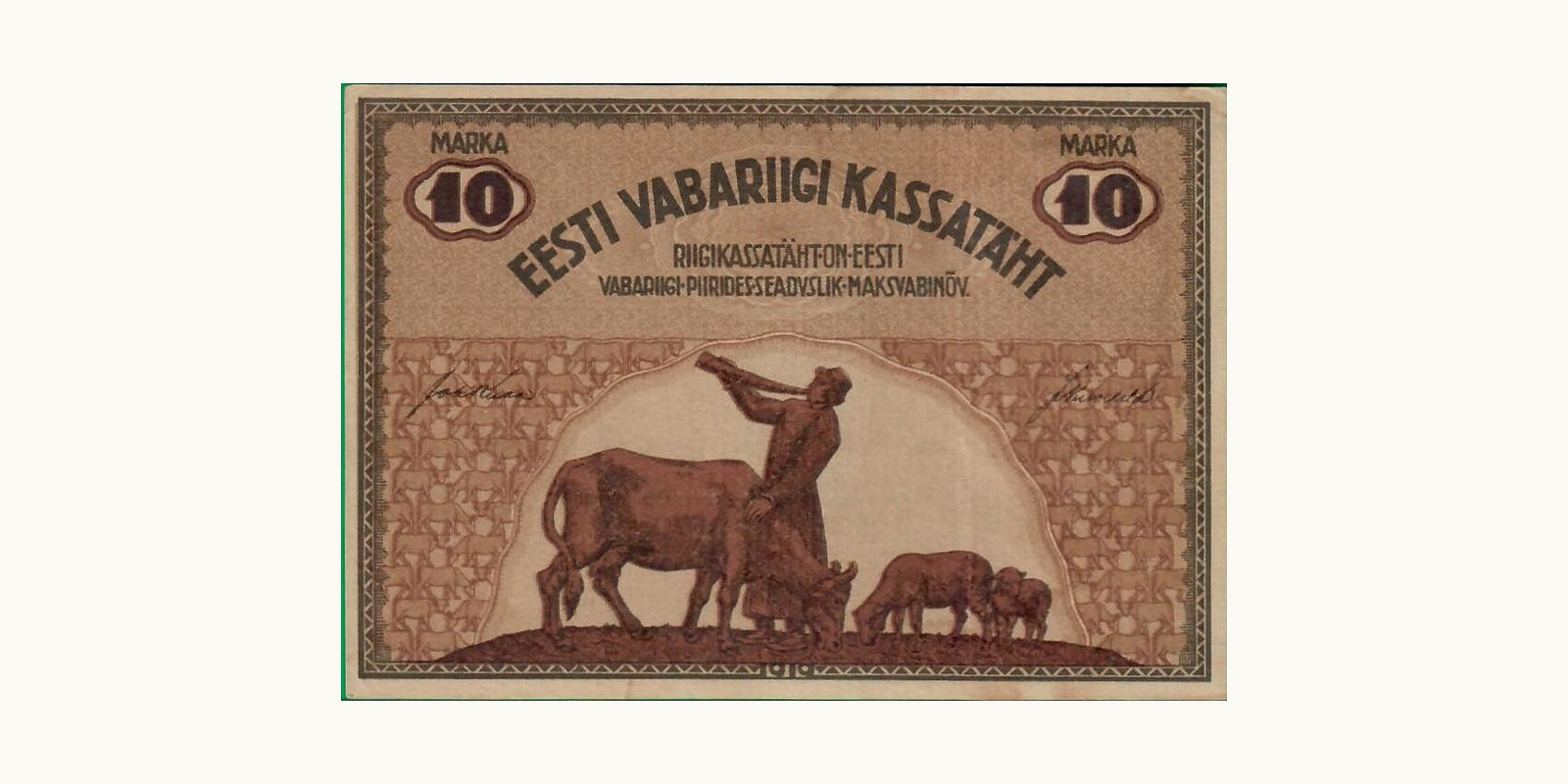
Banknote description
The 10 Mark banknote from Estonia, issued in 1919, marks an important period in the nation's history as it sought to establish its financial independence following the tumultuous aftermath of World War I. In the wake of gaining autonomy from Russia, Estonia faced significant economic challenges. This banknote symbolizes not only a new currency but also a national identity in a time of transformation and recovery. The issuance of paper money in these early years reflected the need for a stable economic framework and democratized access to currency for the populace.
Visually, the 10 Mark showcases intricate design elements representative of the era's artistic trends. The banknote features striking colors that encapsulate the essence of Estonian artistry, potentially blending traditional motifs with modern influences. Inscriptions in Estonian are prominently displayed, affirming national pride and the banknote's official capacity. Though specifics about decorative features aren’t detailed, one can imagine the careful craftsmanship typical of early 20th-century banknotes, which often included ornate borders and unique watermarks designed to prevent counterfeiting.
For collectors, this banknote holds considerable interest due to its historical significance and the rarity of early Estonian currency. The 1919 issue represents a formative moment in Estonia's financial history, making it a compelling piece for those looking to understand the evolution of currency in the context of national identity and autonomy. Its inclusion in collections reflects not only the monetary trends of the time but also a broader narrative of a nation rebuilding itself.
Visually, the 10 Mark showcases intricate design elements representative of the era's artistic trends. The banknote features striking colors that encapsulate the essence of Estonian artistry, potentially blending traditional motifs with modern influences. Inscriptions in Estonian are prominently displayed, affirming national pride and the banknote's official capacity. Though specifics about decorative features aren’t detailed, one can imagine the careful craftsmanship typical of early 20th-century banknotes, which often included ornate borders and unique watermarks designed to prevent counterfeiting.
For collectors, this banknote holds considerable interest due to its historical significance and the rarity of early Estonian currency. The 1919 issue represents a formative moment in Estonia's financial history, making it a compelling piece for those looking to understand the evolution of currency in the context of national identity and autonomy. Its inclusion in collections reflects not only the monetary trends of the time but also a broader narrative of a nation rebuilding itself.
Specifications
- Signed by
- J. Kukk; J. Kiwisild
- Numbering
- 2 x 8
- Date of issue
- 23.06.1919
- Invalid from
- 01.03.1924
- Printing office
- Tilgmann, Helsinki, Finland
- Paper
- Tervakoski, Finland
- Colour
- Brown
- Dimensions
- 124 x 84 mm
- Amount produced
- 2050400
- Pick catalog
- 46c
About this banknote
The Eesti Vabariigi Kassatäht 10 Mark note was issued by the Republic of Estonia in 1919 as part of the Treasury Notes series. This series was introduced during the early years of Estonia's independence to stabilize the national economy and establish a distinct monetary system.
The front of the note features an engraving depicting a farmer with cattle, symbolizing agriculture. The note is printed in brown on Tervakoski paper from Finland and measures 124 x 84 mm. It was printed by Tilgmann in Helsinki and carries signatures from J. Kukk and J. Kiwisild, with a production total of 2,050,400 notes.
Related banknotes
10 Krooni
Estonia
· 1928
Bank Notes of 1928–1940 (First Estonian Kroon)
·
Bank Notes of 1928

5 Penni
Estonia
· 1918
Treasury and Bank Notes of 1918–1923
·
Treasury Notes of 1918
10 Penni
Estonia
· 1918
Treasury and Bank Notes of 1918–1923
·
Treasury Notes of 1918

10 Penni
Estonia
· 1918
Treasury and Bank Notes of 1918–1923
·
Treasury Notes of 1918

20 Penni
Estonia
· 1918
Treasury and Bank Notes of 1918–1923
·
Treasury Notes of 1918
50 Penni
Estonia
· 1919
Treasury and Bank Notes of 1918–1923
·
Treasury Notes of 1919