5000 reis 1826 — Portugal ( Pick: 24 )
Region:
Europe
Front side
Back side
Banknote description
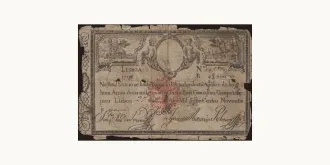
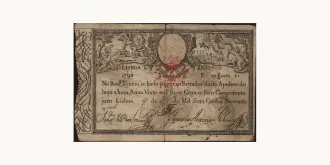
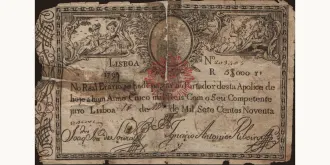
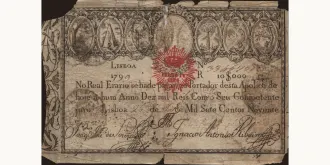
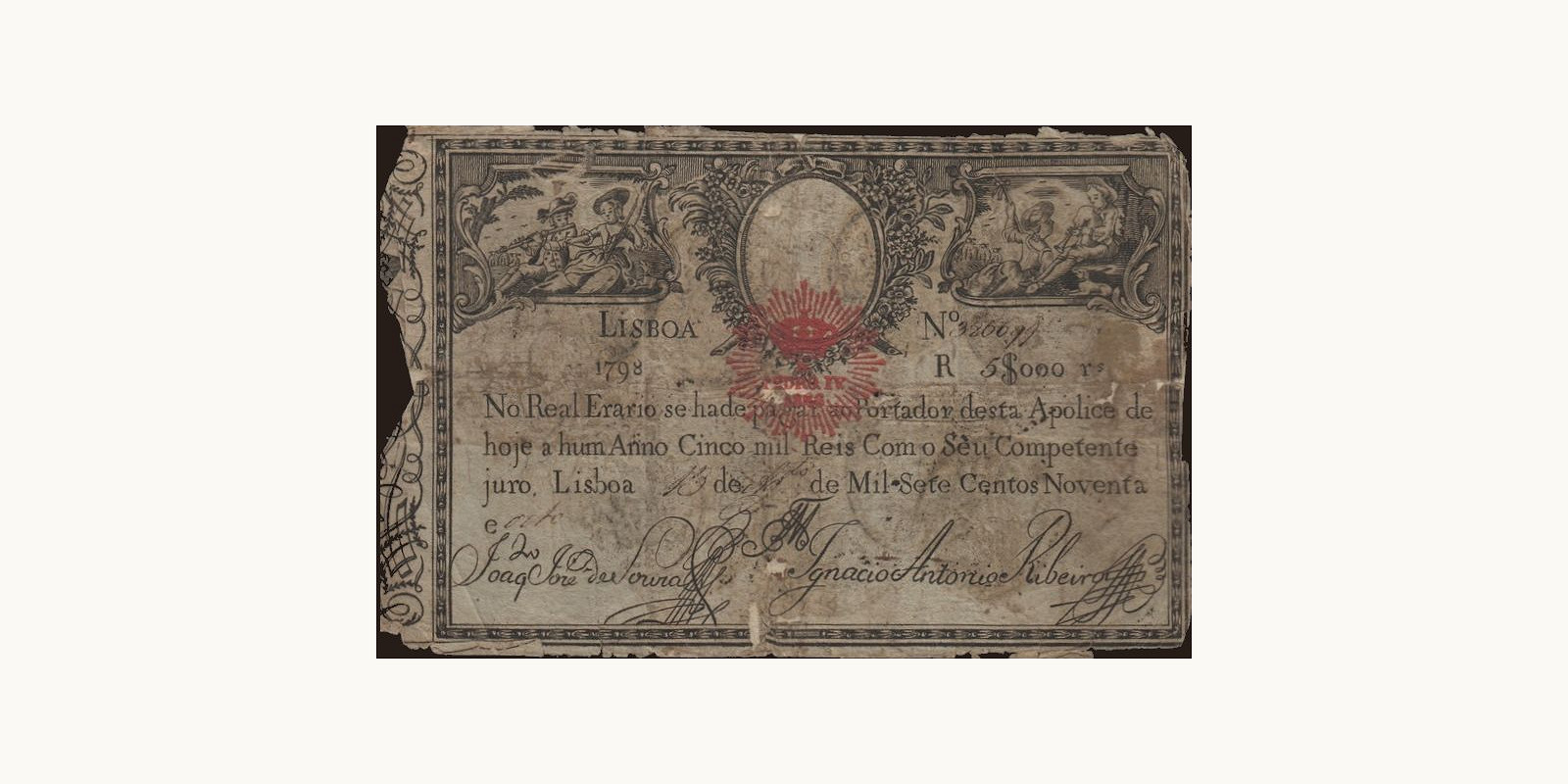
The banknote is a 5000 reis issued in Portugal in 1826. It is cataloged under Pick number 24. This note features designs from the Imperial Treasury's 1826 Revalidation Issues, with references to the old dates of 1798-1799. Depicted on the front are young couples, with males playing musical instruments at the upper left, framed in a starburst design.
This banknote has a brown color and measures 146 x 92 mm. It is signed by Joaquim José de Souza Ignácio Antonio Ribeiro and produced by the Imperial Treasury (Tesouro Imperial).
The specific amount produced remains unknown. The Imperial Treasury was responsible for producing banknotes in the early 19th century, contributing to Portugal's monetary circulation at that time.
This banknote has a brown color and measures 146 x 92 mm. It is signed by Joaquim José de Souza Ignácio Antonio Ribeiro and produced by the Imperial Treasury (Tesouro Imperial).
The specific amount produced remains unknown. The Imperial Treasury was responsible for producing banknotes in the early 19th century, contributing to Portugal's monetary circulation at that time.
Specifications
- Signed by
- Joaquim José de Souza Ignácio Antonio Ribeiro
- Date of issue
- 1826
- Printing office
- Imperial Treasury (Tesouro Imperial)
- Colour
- brown
- Dimensions
- 146 x 92 mm
- Amount produced
- unknown
- Pick catalog
- 24
About this banknote
The Imperial Treasury (Tesouro Imperial) of Portugal issued the 5000 réis banknote in 1826 as part of the "D. PEDRO IV" Revalidation Issue. This series involved overprinting existing notes with a red, crowned "D. Pedro IV - 1826" inscription to affirm their validity under the new monarch, King Pedro IV, who began his reign in 1826.
The obverse of the brown-colored note features illustrations at the top, with a blank medallion in the center. The overprint includes the red, crowned "D. Pedro IV - 1826" inscription in a starburst pattern. The note measures 146 × 92 mm and was signed by Joaquim José de Souza Ignácio Antonio Ribeiro. It was demonetized on August 31, 1834.