50 mark 1918 — Germany ( Pick: 65 )
Region:
Europe
Front side

Back side

Banknote description
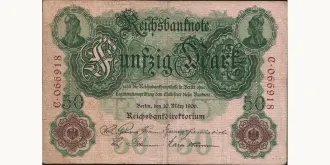
The banknote is a 50 mark issued in Germany in 1918. It is cataloged under Pick number 65, identifying it within documented banknotes of this issue. This note is part of the 1915-1919 Issue and is known as the "Mourning Note" due to its dark brown color on a gray-violet underprint, accompanied by a green guilloche design on the left. The front features a margin with an egg-shaped white area, often referred to as the "Egg Note."
The banknote displays dimensions of 143 x 114 mm and is printed on paper by the Reichsbank. It is signed by Rudolf Havenstein, Otto von Glasenapp, Oskar Schmiedicke, Korn, Erich Maron, Karl von Lumm, Karl von Grimm, Carl Kauffmann, Paul Schneider, and Arnold Budczies.
The amount produced is not specified. The chervonets series was demonetized on December 29, 1947.
The banknote displays dimensions of 143 x 114 mm and is printed on paper by the Reichsbank. It is signed by Rudolf Havenstein, Otto von Glasenapp, Oskar Schmiedicke, Korn, Erich Maron, Karl von Lumm, Karl von Grimm, Carl Kauffmann, Paul Schneider, and Arnold Budczies.
The amount produced is not specified. The chervonets series was demonetized on December 29, 1947.
Specifications
- Signed by
- Rudolf Havenstein, Otto von Glasenapp, Oskar Schmiedicke, Korn, Erich Maron, Karl von Lumm, Karl von Grimm, Carl Kauffmann, Paul Schneider, Arnold Budczies
- Date of issue
- 30 November 1918
- Printing office
- Reichsbank
- Colour
- Dark brown on gray-violet underprint with green guilloche at left, known as the 'Mourning Note'
- Dimensions
- 143 x 114 mm
- Amount produced
- Not specified
- Pick catalog
- 65
About this banknote
The Reichsbank issued the 50 mark banknote in 1918 as part of the 1915-1919 series. This series was introduced during World War I to help finance the war efforts, leading to the issuance of multiple denominations with distinctive designs. The notes were signed by several officials, including Rudolf Havenstein and Otto von Glasenapp.
The front side features what is known as the "Egg Note," characterized by an egg-shaped white area within its margin. The banknote measures 143 x 114 mm and is printed on paper with a dark brown on gray-violet underprint and green guilloche on the left. This note is recognized for its unique design elements and is commonly referred to as the "Mourning Note."